Swiss retail banks focus on sustainable funds
A study by Lucerne University of Applied Sciences and Arts shows: Sustainable investments already make up the majority of the in-house funds offered by Swiss retail banks. And distribution is working well: the majority of new money from Swiss private investors flows into these funds. At the same time, new regulations in Switzerland and the EU are ensuring that sustainable funds are increasingly gaining credibility.





The Swiss market for sustainable funds is currently undergoing radical change. This is the conclusion of the latest Sustainable Investments Study by Lucerne University of Applied Sciences and Arts. This has been triggered by new requirements for when a fund may be described as «sustainable». The European Securities and Markets Authority (ESMA) tightened the requirements in May 2025. The Swiss industry associations of banks and asset managers are also increasingly raising the bar. «In future, funds that advertise with terms such as sustainable or ESG will have to provide much more evidence of their sustainability promise,» explains co-author of the study Dr. Brian Mattmann. «Products that do not provide this evidence can no longer be described as sustainable and will be eliminated from the competition,» says the HSLU lecturer.
Over the past twelve months, the market has been streamlined in this way by around 300 funds to 2,033 sustainable funds. This still corresponds to a considerable 20 percent of all mutual funds available on the Swiss market. The remaining sustainable funds can increasingly lay claim to greater credibility.
Swiss retail banks focus on green funds
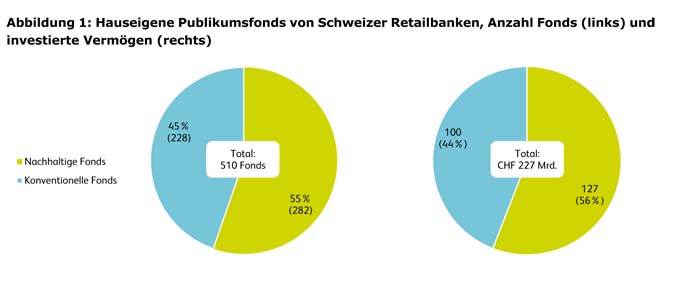
Sustainable investments already make up the majority of the in-house funds offered by Swiss retail banks (Figure 1). The 27 Swiss retail banks included in the study currently offer their customers 510 in-house funds. More than half of these products are clearly positioned as sustainable. These investment vehicles account for 69 percent of newly invested funds. «We have been observing a sustained high level of interest from private investors in sustainable investments for years. This is clearly reflected in the banks» product range,« explains co-author of the study Prof. Dr. Manfred Stüttgen. »Swiss retail banks have invested heavily in products, processes and training in sustainability in recent years and are now reaping the rewards of their commitment," Stüttgen continues.

Investments in the energy transition as an investment opportunity?
Sustainable funds are multi-faceted. One example of this is investments that aim to promote the energy transition. The aim is to replace fossil fuels with clean technologies and electrification, and to protect the climate in the long term. An ambitious goal. Only a small proportion - 45 funds in total - recognize an investment opportunity in the energy transition. These funds make concentrated investments in selected technologies that are driving the energy transition forward. They want to benefit from the fact that twice as much capital is already flowing into clean energies as into fossil fuels. The focus is on renewable energies, distribution grids and energy storage, measures to increase efficiency and electrification. The impact of the investments on environmental sustainability goals and how profitable they are for investors varies from case to case. However, newer analytical approaches are providing ever better indicators on how investors can assess such systems. At the same time, data transparency is increasing: more than half of all sustainability funds in Switzerland already check companies to see whether they have a negative impact on selected aspects of the energy transition. Only around 20 percent of conventional funds currently do this (Figure 2).
Source: Lucerne University