A look at Germany: Industry most affected by supply chain problems
Compared to other European countries, German companies are struggling the most with supply bottlenecks. While 32 percent of German companies report a strong impact on their business, Dutch and Spanish companies are much more optimistic. These are the findings of a recent study by Reichelt Elektronik.





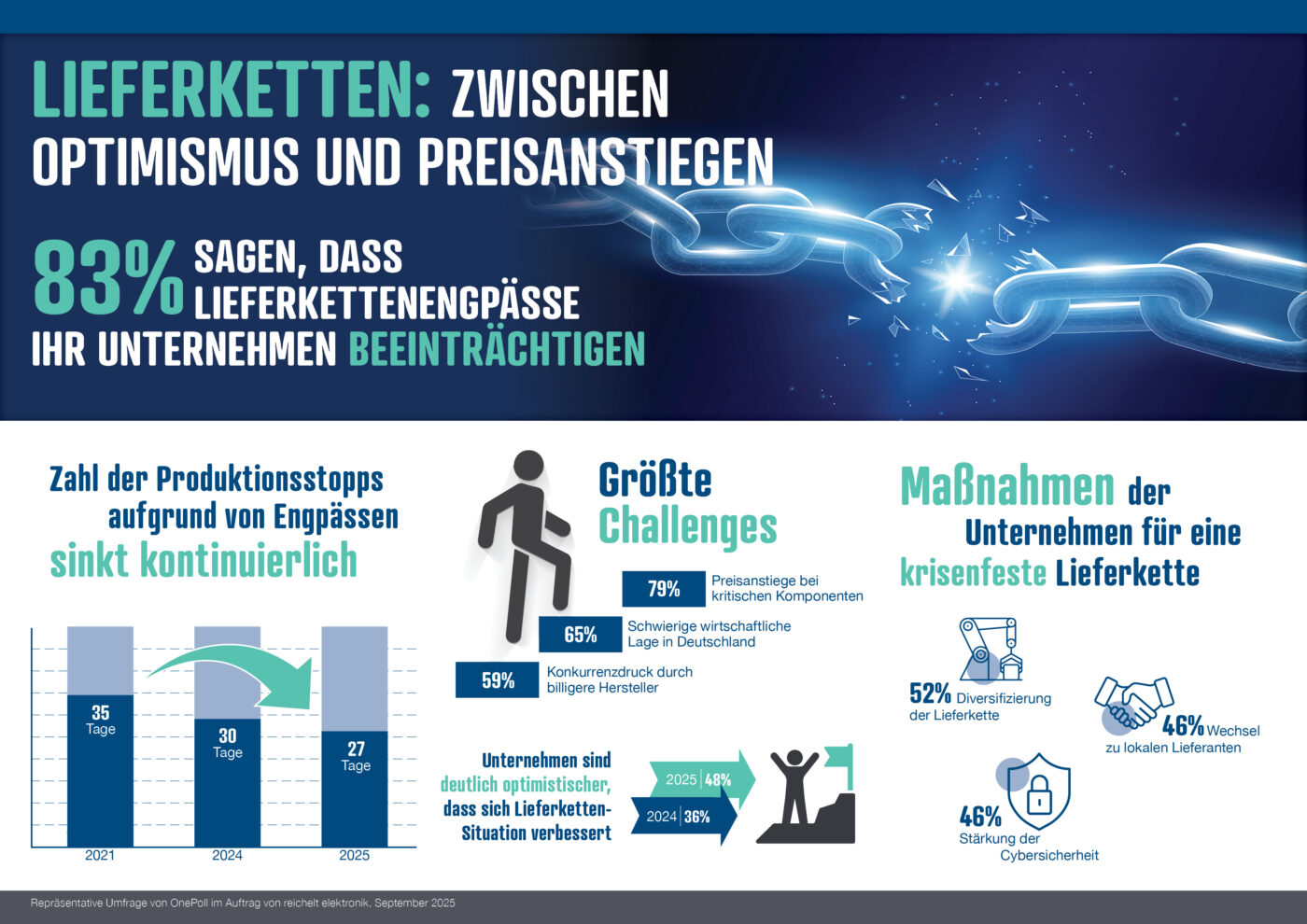
A look at our northern neighbor shows: German companies are significantly more affected by supply chain problems than the rest of Europe. At least that's according to the latest edition of Reichelt Elektronik's annual supply chain report. In the study, which has now been conducted for four years in a row, more than 1,500 industrial companies from Germany, France, Italy, the Netherlands and Spain were surveyed by the independent survey institute Onepoll.
Germany leads the way in supply bottlenecks
At 32%, German companies are the most likely to report a strong impact of supply chain bottlenecks on their business. Particularly serious: companies in Germany and the Netherlands had to stop production for an average of 26.3 and 26.8 days respectively - making these two countries the absolute leaders. In Spain, on the other hand, production was halted for an average of 16.7 days.
The measures taken to combat these persistent problems varied from country to country. For example, around 52% of German companies stated that they had diversified their suppliers. Spain, on the other hand, mostly relies on switching to local suppliers (50 percent), whereas the Netherlands prioritizes automation solutions (46 percent).
Semiconductor crisis hits Germany the hardest
The country comparison also reveals major differences in the procurement of components: while 45% of companies in the Netherlands rate the procurement of critical components as «easy», this figure is only 35% in Germany. The supply bottlenecks for semiconductors, one of the most important components in the age of AI, are particularly serious. For example, 44% of German companies state that they have problems with the procurement of semiconductors - significantly higher than the average (35%) and 21 percentage points above the Netherlands, which has the lowest figure at just 23%. The situation is similarly drastic when it comes to sensors: 37% of German companies report bottlenecks, while only 20% of Spanish companies are affected.
However, Germany stands out positively when it comes to the procurement of other components: Dutch companies struggle disproportionately with battery bottlenecks (37% compared to 24% in Germany), while French and Italian companies have more problems with the procurement of developer boards (31%). Germany has the least problems with supply bottlenecks, with only 19%.
Bureaucracy reduction and digitization difficulties
A particularly clear difference can also be seen in the challenges for the future. 55% of German companies are pushing for a reduction in bureaucracy within the EU - the absolute top figure compared to other European markets. For example, only 39% of Dutch companies stated that they were struggling with the administrative hurdles in the European single market. German companies were also affected by digitalization difficulties to an above-average extent (50 percent). In contrast, only 31% of companies in France consider digitalization to be a challenge.
Future prospects: Southern Europe optimistic, Germany cautious
European companies are looking to the future with different expectations: while 52% of companies across Europe are hoping for an easing of the delivery situation, there are clear regional differences. Spanish (66%) and Italian companies (62%) are much more optimistic than their German (48%), Dutch (48%) and French (40%) equivalents.
Germany is also more pessimistic in its assessment of political risks: 68% see political decisions as a threat, while only 48% of French companies share this concern. Similarly, 66% of German companies rate the global economic situation as difficult. This figure is only topped by Spain, where as many as 76% are concerned about the current political situation. These figures make it clear that German companies are particularly sensitive to political and economic uncertainties due to their strong focus on international trade relations.
Conclusion: Germany threatens to fall behind in Europe
«The study clearly shows that German companies were particularly hard hit by the challenges in global trade,» says Christian Reinwald, Head of Product Management & Marketing at Reichelt Elektronik. «On top of ongoing supply chain problems, there are new export tariffs and political uncertainties. This is not only reflected in the growth figures of recent years, but also in the mood. While other European countries are reacting more flexibly to crises and are sometimes more optimistic about the future, Germany is groaning under the strain. Nevertheless, it would be too early to throw in the towel. German companies still have unique expertise and great innovative potential. These strengths can help to overcome the current difficult situation and remain competitive in the long term.»
Source and further information: www.reichelt.de