Agentic AI in the Financial Sector: High Interest, Little Productive Use
A joint study by Wavestone and the Institute for Information Systems at the University of St. Gallen shows that banks and insurance companies are very interested in agent-based AI—yet not a single company surveyed has implemented a production-ready multi-agent system to date. The biggest hurdles lie not in the technology, but in organizational maturity.


Agentic AI is considered the next stage in the evolution of artificial intelligence: In the future, autonomous AI agents are expected to independently manage complex business processes and make decisions. It seems as though banks and insurance companies are already in the midst of this transformation. However, a joint study by Wavestone and the Institute for Information Systems (IWI-HSG) at the University of St. Gallen paints a much more nuanced picture.
For the current study, more than 30 business and IT leaders from financial institutions were interviewed—including CIOs, CDOs, and AI leaders from major banks and insurance companies. The clearest finding: Not a single one of the companies surveyed is currently operating a production-ready multi-agent system. All initiatives are in the pilot, testing, or proof-of-concept phases.
Organizational maturity is the deciding factor, not technology
The reasons for the lack of productive deployment lie less in the technology itself than in the organizational prerequisites. Many organizations are currently still working to establish generative AI company-wide. The necessary expertise, governance structures, and operating models to successfully scale agentic AI are often lacking. The study therefore reaches a clear conclusion: It is not the performance of the models that currently determines progress, but rather the maturity of the organization.
«Our interviews show that technological development is currently outpacing organizational transformation. Many companies are already discussing agentic AI, but are first laying the groundwork for the productive use of generative AI. The key success factor, therefore, is not the technology alone, but an organization’s ability to develop its governance, processes, and competencies accordingly,» says Eugen Ensinger, Associate Partner for Financial Services at Wavestone.
This becomes particularly clear in a quote from the interviews: «If 95 percent of the workforce has never worked with GenAI, there’s no point in even starting to set up a Center of Excellence or implement agents,» said the CIO of a Swiss insurance company. Digital competence—known as AI literacy—is therefore an absolute prerequisite for productive use.
The pressure to innovate meets cautious implementation
Another key finding is what is known as the “Red Queen dynamic.” Many financial institutions are currently investing in AI because they fear falling behind the competition. At the same time, these same companies are pursuing a deliberately cautious strategy when adopting new technologies, initially observing the experiences of other market participants. For the study’s authors, this apparent contradiction reflects an industry in which the pressure to innovate and regulatory requirements are equally high.
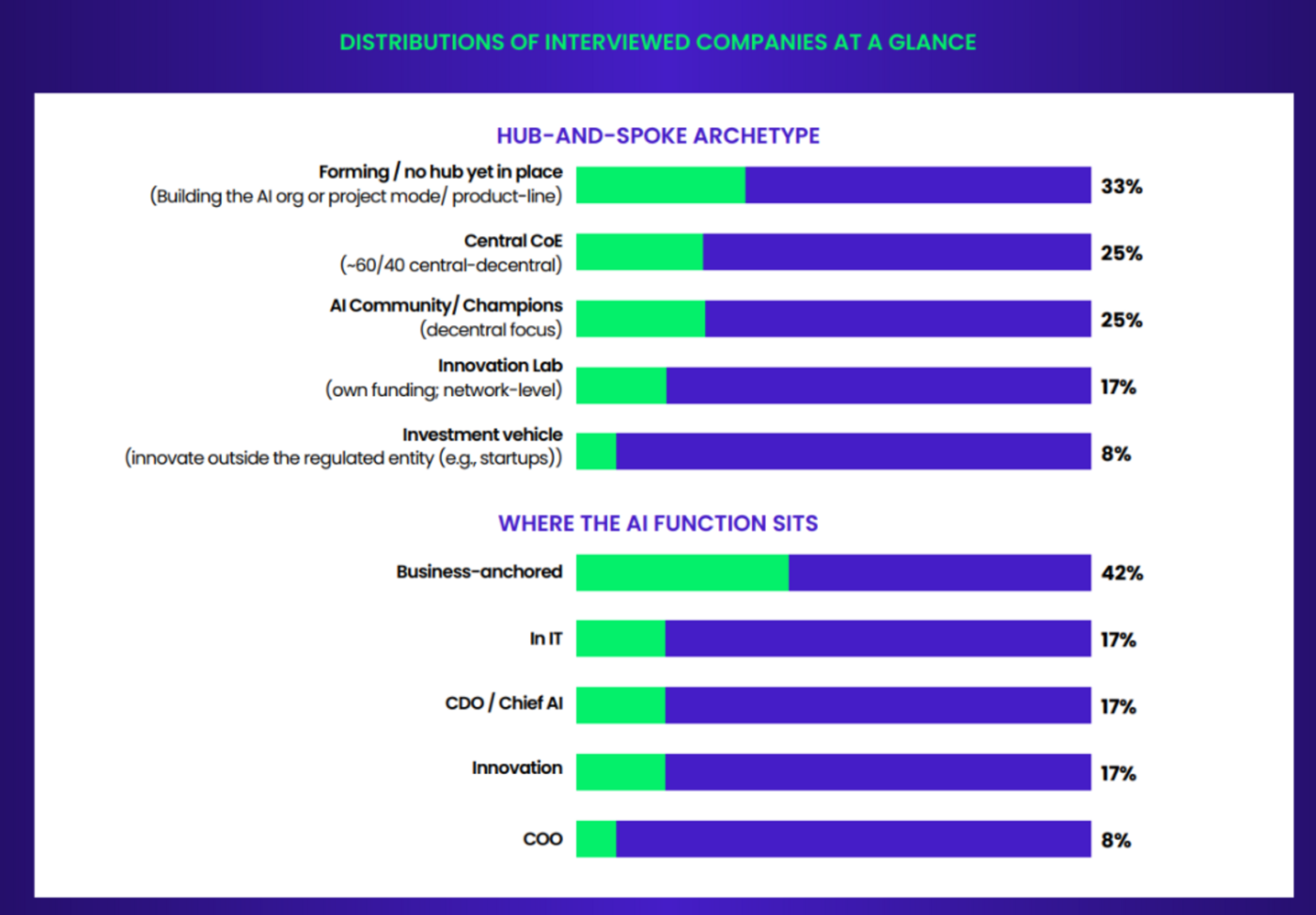
The study also shows that a hub-and-spoke model has become established in most of the institutions surveyed: While central AI units are responsible for governance, platforms, and standards, the business units develop specific use cases. Close collaboration between business and IT, as well as a clear mandate from top management, is crucial to success.
Regulation and Legacy Systems as Structural Obstacles
Even in cases where technical proofs of concept are developed within a few weeks, the path to production often takes many months. Regulatory requirements such as DORA or the EU AI Act, data protection regulations, internal governance processes, and complex legacy systems significantly extend implementation cycles. Furthermore, at some institutions, more than 70 percent of IT capacity is already tied up in ongoing modernization and migration programs—leaving often only limited scope for the actual AI transformation.
While traditional machine learning and robotic process automation are well established in the industry, Agentic AI is still exclusively in the pilot phase. According to the study, proficiency in generative AI is considered a necessary prerequisite: business units that have never worked with AI tools cannot develop meaningful agent-based use cases.
The full study by Wavestone and the University of St. Gallen will be published in 2026 and is based on more than 25 qualitative interviews with business and IT leaders from over 15 banks and insurance companies in German-speaking countries.
For more information on the study: www.wavestone.com