High Marks for ERP Systems
The German consulting firm Trovarit AG has conducted a study on user satisfaction with ERP systems. The conclusion: Most products perform well.


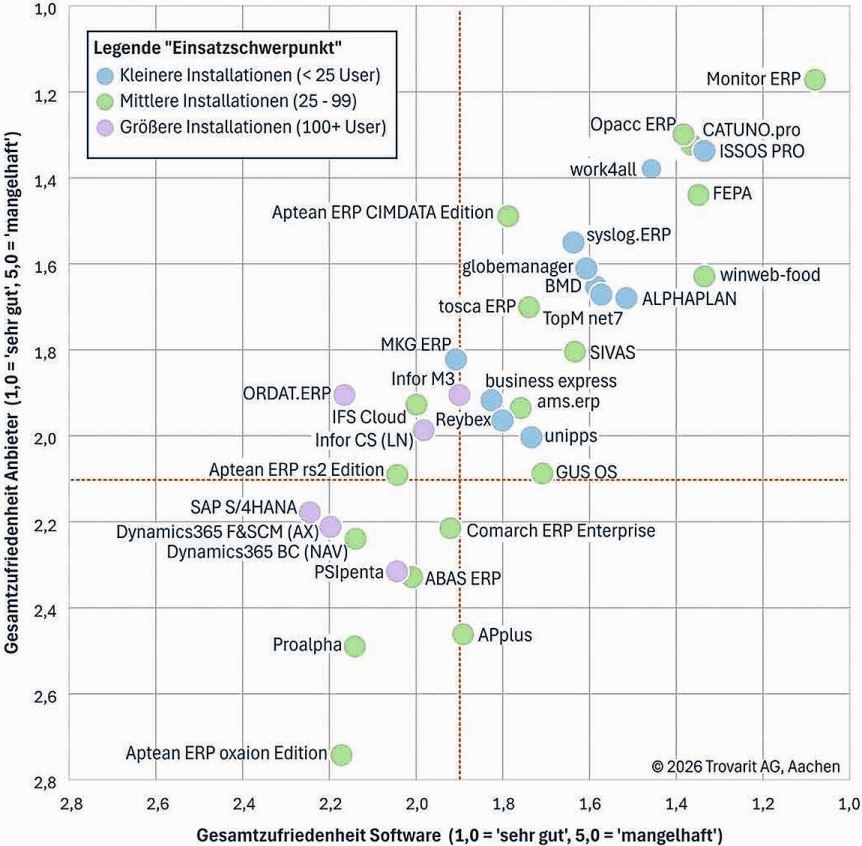
The study «ERP in Practice 2026/2027» by Trovarit evaluated 1,538 ERP installations from Germany (74 %), Austria (15 %), and Switzerland (11 %). A total of 109 solutions were evaluated. Satisfaction remains high: The software solutions received an average grade of 1.89 (on the German grading scale; a grade of 1 is the best), while support received a grade of 2.01. Both scores are slightly lower than they were in 2024. Interfaces, stability, and value for money, for example, received more critical evaluations. Documentation and user support, on the other hand, scored better.
A Wide Range of Applications – Complex Requirements
ERP software has long since ceased to be an isolated use case. Integration into overall systems, data quality, architecture, and the ability to modernize have become increasingly important. This applies to both large-scale solutions such as SAP S/4HANA, IFS Cloud, and Microsoft Dynamics 365, as well as smaller systems. One thing stands out here: the smaller the scope of use, the more satisfied the users are. Solutions with fewer than 25 users achieve an average rating of 1.75, while those with 100 or more users score 2.02. The main reason for this is lower complexity. Work4all, for example, scores particularly well in terms of customer support, value for money, mobile usability, and consulting. Specialized solutions such as ISSOS PRO, syslog.ERP, or unipps often perform better in their respective categories because they are well-suited to specific requirements and the providers bring a wealth of industry knowledge to the table.
Solutions supporting 25 to 99 users offer a particularly wide variety of options. Among these, the Swiss product Opacc ERP performs well. The solution has received very good ratings for its software and support, with high stability and release capability—a track record it has maintained for years. With APplus, the software is impressive, but the support is viewed much more critically. Dynamics 365 Business Central falls short in release capability, reporting, and stability. Proalpha loses ground in both product and service. FEPA is showing positive development, even exceeding its 2022 level. SIVAS and TopM net7 are rebounding after a weak 2024. For large systems such as SAP S/4HANA, the scores are declining moderately, likely due in part to ongoing modernization programs. Users cite the simplification of their processes (60.8 %) and fast access to information (52.3 %) as the most important benefits. Transparency and error reduction are gaining importance. The biggest challenges are ongoing costs (22.9 %), mobility, and interfaces.
Trends and Outlook
At the top of the agenda are usability (93.2 %) and information security (86.5 %). These are followed by resilience, integration, compliance, and data quality. AI has become significantly more relevant: in 2022, 16 % considered it important; by 2026, that number had risen to 57 %. Automatic text and document generation, as well as AI-supported search and knowledge utilization, are highly relevant; master data maintenance, translations, and semi-autonomous process steps performed by AI agents are also frequently mentioned by the surveyed users. Nevertheless, 40.5 % of companies are still in the orientation phase, and only 1.8 % are using AI on a broad scale. Interest is therefore high, but widespread routine operation is still a long way off. The study notes that for many AI applications, ERP nevertheless remains an important functional reference point because it is where central business objects, master data, transactions, and process information converge.
Another important topic remains cloud computing: The cloud is growing, but without a unified target model. As a result, 60.7 % still consider on-premises solutions to be suitable. The private cloud (39.3 %) is clearly ahead of the public cloud (13.7 %). 88.7 % of current public cloud users believe the model will remain suitable in the future. The central question, therefore, is no longer what the ERP system can do. According to the study, what matters most is how well companies manage the interplay between ERP, specialized applications, data, and integration.