Appointment practice of boards of directors in SMEs with great potential for professionalization
Around 88 percent of board members in Swiss SMEs are recruited via internal channels such as personal networks or existing contacts. External platforms or professional service providers, on the other hand, are rarely used. A representative study at the University of Zurich on the evaluation and filling of board positions in SMEs confirms this trend.






In Swiss SMEs, board members are still appointed with a lot of "vitamin B". However, this approach limits the strategic variety, diversity and innovative strength of boards of directors. This is the conclusion of a representative study on the appointment practices of boards of directors in Swiss SMEs, which Pascal Sieder conducted as part of his master's thesis at the University of Zurich. In it, Pascal Sieder shows that there is still great strategic potential for SME boards of directors in establishing targeted and diversified recruitment strategies. This can close skills gaps, professionalize the selection process and ensure long-term competitiveness. These measures and the research work based on the data obtained in this study contribute to further strengthening the effectiveness and sustainability of corporate governance in SMEs in Switzerland. The master's thesis was written between September 2024 and January 2025 and was supervised by Dr. Christoph Wenk Bernasconi from the Finance Executive Education at the University of Zurich. The initiative to realize the study on the topic of the appointment practice of boards of directors in SMEs goes back to Tobias Herren, lawyer at Bratschi AG, Councillor of States Petra Gössi, Raoul Stöhlker, Managing Partner of Stöhlker AG and Dominic Lüthi, founder of VRMandat.com.
Appointments to boards of directors: often not very structured
The survey of 730 board members of Swiss SMEs combines quantitative and qualitative methods. The differentiated analysis by company size and language region sheds light on recruitment channels, competence requirements, evaluation processes and the challenges of competence-based renewal of boards of directors.
As mentioned at the beginning, informal recruitment dominates. Around 88% of new board members are recruited via internal channels, mostly through personal networks. Small companies in particular (fewer than 49 employees) rely on family and personal relationships, while medium-sized companies (50-250 employees) are somewhat more open to external recruitment methods. External channels such as placement platforms, recruitment agencies or networking platforms play a subordinate role and account for around 12% of recruitment.
The skills requirements also vary. The focus is on industry-specific knowledge and strategic expertise. Other sought-after skills include risk management, digitalization/AI and marketing. While medium-sized companies tend to have difficulties finding board members with the desired skills, smaller SMEs tend to struggle with the problem of finding potential candidates in the first place. Diversity therefore only plays a subordinate role in practice. In addition, evaluations usually only take place on an ad hoc basis, for example in the event of strategic realignment or the departure of a member. Smaller SMEs in particular have hardly any structured evaluation processes. The first signs of professionalization are visible in medium-sized SMEs, but there is still great potential for optimization.
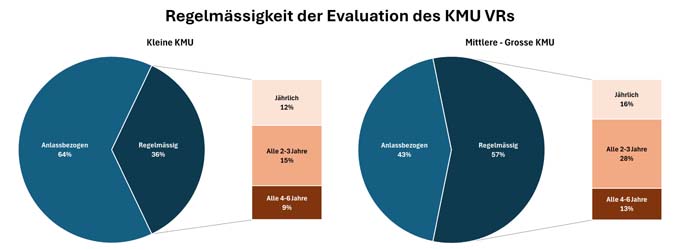
The strong dependence on informal networks, limited time and financial resources as well as the corporate culture slow down the structural development of SME boards of directors. In over 28% of SMEs, less than 10% of board members are independent, which impairs critical perspectives and strategic diversity, according to a further finding of the study.
Regional differences
The study also shows significant differences between the language regions of Switzerland. While companies in German-speaking Switzerland recruit and evaluate more professionally overall, SMEs in French-speaking Switzerland and Ticino rely even more heavily on existing personal networks. The study found a greater awareness among medium-sized SMEs that external candidates can be valuable for the development of the company. This is taken into account, in particular through the increased involvement of external expertise in the search process and the aim of achieving greater diversity on boards of directors.
Professionalization necessary
In summary, the study shows that small companies are strongly focused on short-term operational requirements and therefore have little time for recruiting new members. In contrast, medium-sized SMEs are increasingly using external channels and show corresponding professionalization tendencies. "Further professionalization in the recruitment of board members can tend to increase the innovative strength of Swiss SMEs and improve processes," says Pascal Sieder.
There is therefore still a lot of potential in the professionalization of evaluation and recruitment processes in SME boards of directors. If the company realizes that the work of the board of directors is an important long-term value driver, the willingness to sustainably improve the board members' strategic ability to act will also increase. The more diverse the long-term strategic considerations are in the decision-making processes, the better the future viability of the company. Professionalizing their recruitment and evaluation processes can help SMEs to remain competitive in the long term. This includes
- Strengthening awareness of the strategic role of the BoD as a long-term value driver of the SME.
- Systematic skills assessments to identify existing gaps.
- The conscious promotion of diversity and independence on the Board of Directors.
- The increased use of external platforms and professional service providers.
- Further training opportunities for Board members in order to tackle new challenges in a targeted manner.