Housing and Mobility: Drivers Pay Significantly More
The Comparis RV Price Index shows that housing and transportation costs rose three times as fast as general inflation in August 2026. Drivers are particularly affected, but heating oil consumers are also feeling the sting of steep price increases.


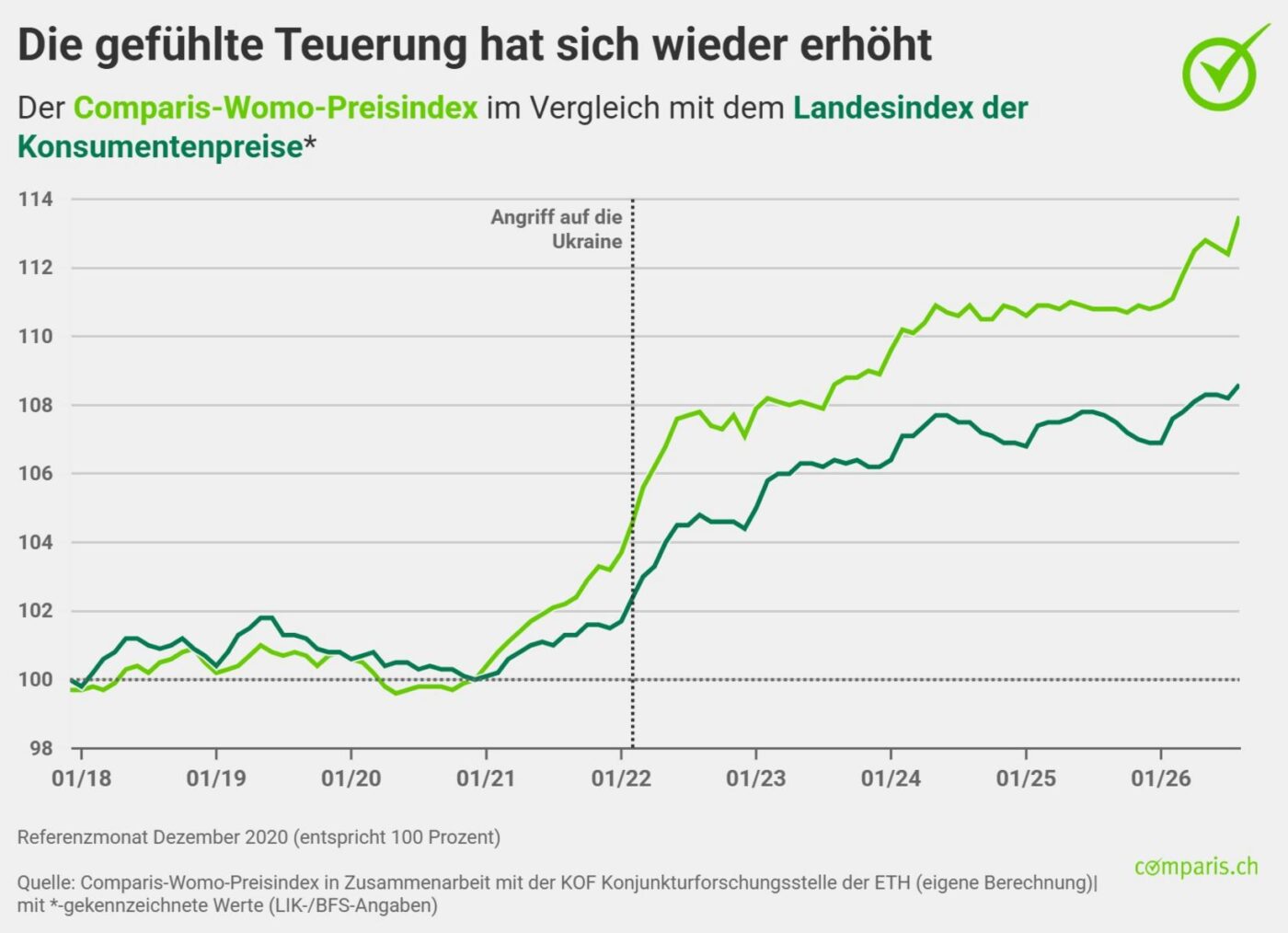
Prices for housing and transportation rose by 2.4 percent in August 2026 compared with the same month a year earlier—three times the general inflation rate of 0.8 percent*. This is shown by the Comparis Womo Price Index, which has been published quarterly since March 2024 in collaboration with the KOF Institute at ETH Zurich. It tracks inflation trends in the housing and transportation sectors.
By comparison, the National Consumer Price Index (LIK) published by the Federal Statistical Office (FSO)—which covers a basket of over 1,000 goods and services—rose by only 0.8 percent*. Heating oil saw a particularly sharp increase, rising by just over 50 percent. Fuel prices for diesel (up 23.3 percent*) and gasoline (up 15.8 percent*) also rose significantly.
«For drivers, it’s not just the clearly visible costs at the gas pump that are rising. Insurance, replacement parts, and repairs are also placing an increasing strain on household budgets. A noticeable improvement in the situation is unlikely in the near future due to the continuing geopolitical uncertainty in the Middle East,» says Comparis financial expert Dirk Renkert.
Additional costs of 1,066 francs for a family
For the average family in Switzerland, housing and transportation account for about 40 percent of their budget for daily consumption. In the housing sector, the Womo Price Index tracks price trends for rents and energy, as well as household goods such as furniture. In the mobility sector, it tracks prices such as those for gasoline or diesel, car ownership, and public transportation tickets.
A 2.4 percent increase in the Womo Price Index means, in concrete terms: If a family spent 2,500 francs a month on rent, 1,000 francs on a car, and 200 francs on public transportation tickets last year, their costs have gone up by about 89 francs a month. Over the course of a year, this amounts to additional costs of 1,066 francs for housing and transportation alone.
It's not just gas that's getting more expensive: Ongoing car costs are rising significantly
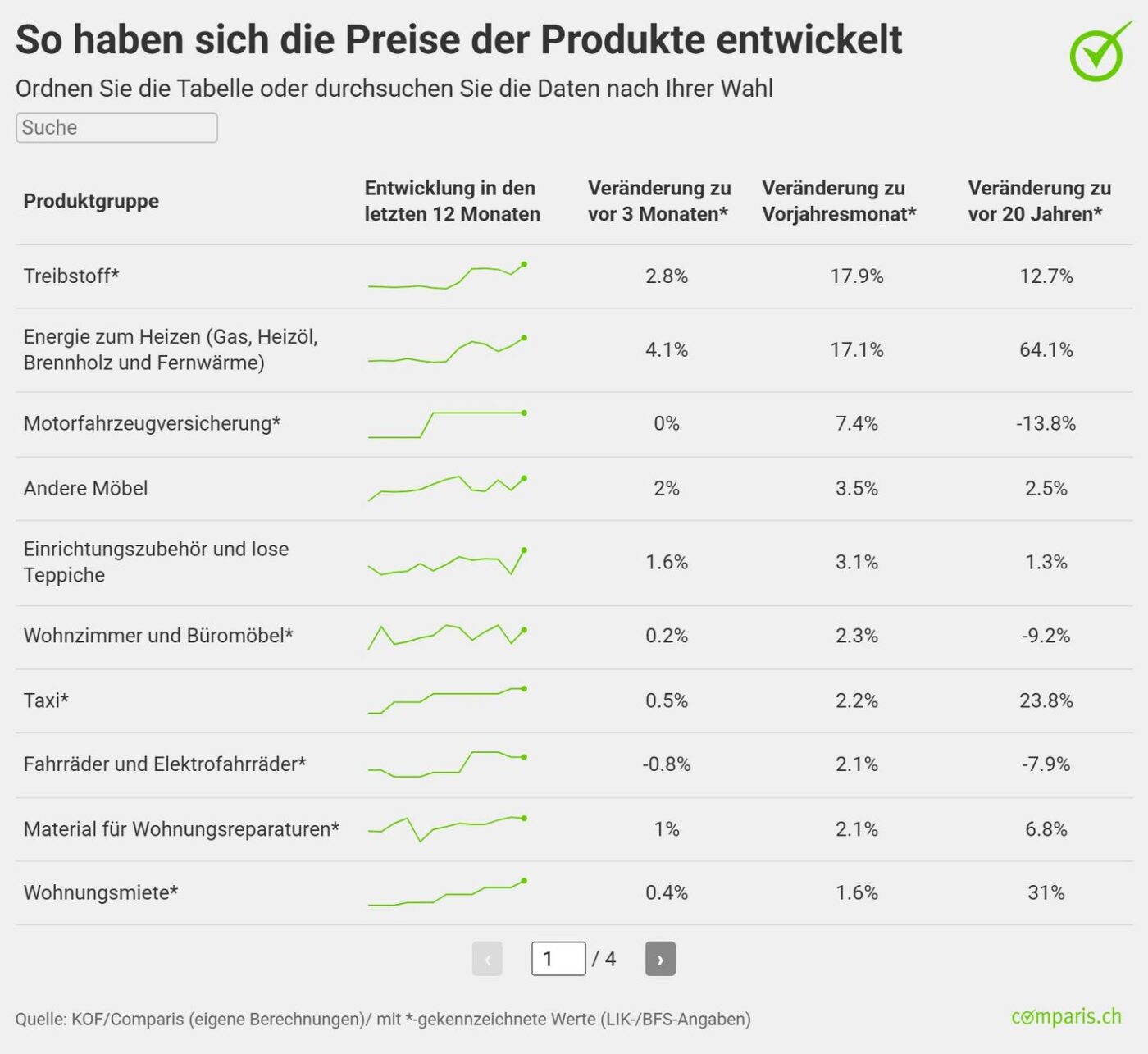
The rise in transportation costs has long been evident beyond just the gas pump. In August 2026, fuel prices were on average 17.9 percent* higher than a year earlier. Diesel prices rose by 23.3 percent* over the course of the year, while gasoline prices rose by 15.8 percent*. At the same time, other ongoing car-related costs are also rising. Auto insurance cost 7.4 percent* more than a year ago. Over a five-year period, auto insurance premiums rose by 18.9 percent*. Spare parts and accessories became 12.6 percent* more expensive, while maintenance and repair services rose by 8.6 percent*. In contrast, new cars and used cars have become 0.8 percent* and 1.5 percent* cheaper, respectively, compared to a year ago.
Given the rising costs, the Comparis financial expert recommends regularly reviewing your potential for savings. Especially when it comes to auto insurance, it can be worthwhile to compare rates on a regular basis.
Heating oil prices have also risen sharply
In addition to significantly higher fuel prices, prices for heating energy—gas, heating oil, firewood, and district heating—have also risen, by a total of 17.1 percent. This made it the product group with the second-highest price increase. A closer look reveals: The individual energy sources have trended differently. Heating oil (up 53.1 percent*) and firewood (up 10.8 percent*) have become significantly more expensive. In contrast, prices for district heating fell by 0.4 percent* and for gas by 3.0 percent*.
«The type of energy source used to heat an apartment currently has a major impact on a household’s financial burden. In the short term, tenants have little control over this. This makes it all the more important to reduce consumption and to build in enough flexibility in the household budget to account for widely fluctuating heating costs,» recommends Renkert.
The price increase for motor vehicle insurance (up 7.4 percent*) was the third-highest compared with the same month last year. In fourth and fifth place were other types of furniture, such as bedroom and garden furniture, up 3.5 percent, as well as home furnishings and area rugs, up 3.1 percent*.
Sharpest price declines over the past 12 months
Twelve months ago, small household appliances cost more than they did in August 2026. According to the Comparis analysis, prices have fallen by 8.1 percent* compared to the same period last year. Prices for other household goods saw the second-largest decline. They were 4.8 percent* lower than in August 2025. Prices also continued to fall for large household appliances (down 4.3 percent*), power tools for home and garden (down 3.6 percent*), and electricity (down 3.0 percent*).
Highest inflation among childless couples aged 65 and older
When broken down by household type, couples aged 65 and older without children experienced the highest inflation in housing and transportation costs over the past 12 months. They are currently facing an inflation rate of 2.5 percent compared to the previous year. In August 2026, the cost of living for them rose again—by 0.7 percent—compared to May 2026.
In purely mathematical terms, single-person households aged 65 and older feel inflation the least in percentage terms. With an index level of 114.0, their perceived inflation in the areas of housing and transportation has risen by 2.2 percent over the past 12 months. In a 3-month comparison, inflation for this group rose by 0.6 percent in August.
The middle-income class is feeling the impact of inflation the most
A look at the income brackets reveals that, compared to last year, the cost of living has risen the most for the middle-income bracket. The Womo Price Index rose by 2.6 percent for this group. Compared to May 2026, inflation stood at 0.6 percent.
The lowest income bracket was the least affected by inflation. Compared to the previous year, prices for this group rose by 2.3 percent. Over the past 3 months, the cost of living for the lowest income bracket increased by 0.6 percent.
Ticino is the region most affected by inflation
Broken down by language region, the picture is as follows: Italian-speaking Switzerland recorded the highest inflation rate compared to the previous year, at 3.0 percent. Compared to May 2026, the price level rose by 0.7 percent.
German-speaking Switzerland and Romansh-speaking Switzerland recorded the lowest year-over-year inflation rate, at 2.4 percent. Compared with three months ago, the cost of living there rose by 0.6 percent in August.
Tips for Consumers
Price differences between gas stations and regions can be significant. If you plan your stops and compare prices, you can noticeably reduce your expenses. If you’ve been with the same insurer for many years, you should pay special attention: Loyalty isn’t automatically rewarded in the insurance market. Especially in a year with widespread premium increases, it’s worth shopping around. Often, it’s not just about lower premiums, but also about finding insurance that better suits your individual situation.
Even simple measures such as proper ventilation, closing shutters and curtains at night, or keeping radiators clear help reduce energy consumption and, consequently, heating costs. It’s also worth checking your heating settings regularly: Lowering the room temperature by just one degree can significantly reduce energy consumption.
*Comparis RV Price Index: The National Consumer Price Index (LIK) measures price changes based on a representative basket of approximately 1,050 goods and services. The LIK was restructured in early 2026 and now comprises 13 main categories—including, for the first time, the main category of insurance and financial services. In contrast, major expense items such as social security premiums or direct taxes are not included. The Comparis Womo Price Index, developed in collaboration with the KOF Institute at ETH Zurich, tracks inflation exclusively in the areas of housing and mobility and also takes into account individual household groups, income classes, and language regions. The data source consists of the LIK and the Household Budget Survey (HABE). The index base is December 2017 (100 percent).
More information: https://www.comparis.ch