Check Point: 49 Percent Increase in Cyberattacks on Swiss Companies
According to Check Point Research’s Monthly Cyber Threat Report, Switzerland recorded an average of 1,528 attacks per week per organization in October 2026, a 49 percent increase compared to the same month the previous year. Additionally, more ransomware attacks were publicly reported worldwide in that month than ever before.



Check Point Research (CPR), Check Point’s security research division, has released its Monthly Cyber Threat Report for October 2026. According to CPR, organizations worldwide experienced an average of 2,550 cyberattacks per week. That is 9 percent fewer than in September, but 32 percent more than during the same period last year. CPR warns against interpreting the month-over-month decline as a trend reversal, as the attack rate remains about one-third higher than it was a year ago.
Cyberattacks on Swiss Companies: A Comparison Across the DACH Region
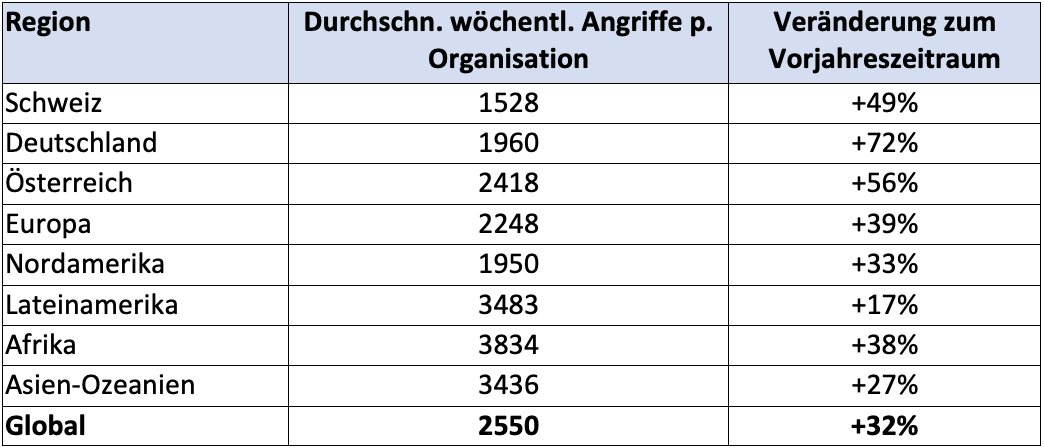
In October, Switzerland recorded an average of 1,528 attacks per week per organization, an increase of 49 percent compared to the same month last year. This figure remains below the European average of 2,248. Germany recorded the sharpest increase in the DACH region with 1,960 attacks (+72 percent), while Austria recorded 2,418 attacks (+56 percent).
For Austria and Switzerland, CPR has also observed increased activity by the Everest ransomware group. This group recently garnered media attention following a cyberattack on the construction company behind the Brenner Base Tunnel. Everest typically gains access through third-party providers and suppliers. Examples include the attack on Stadler Rail via one of the company’s suppliers and the attack on SAP SuccessFactors environments via an HR service integrator. The group’s business model combines data theft and extortion with the sale of initial access, and since October 2023, it has been recruiting insiders.
Education and agriculture are the hardest hit
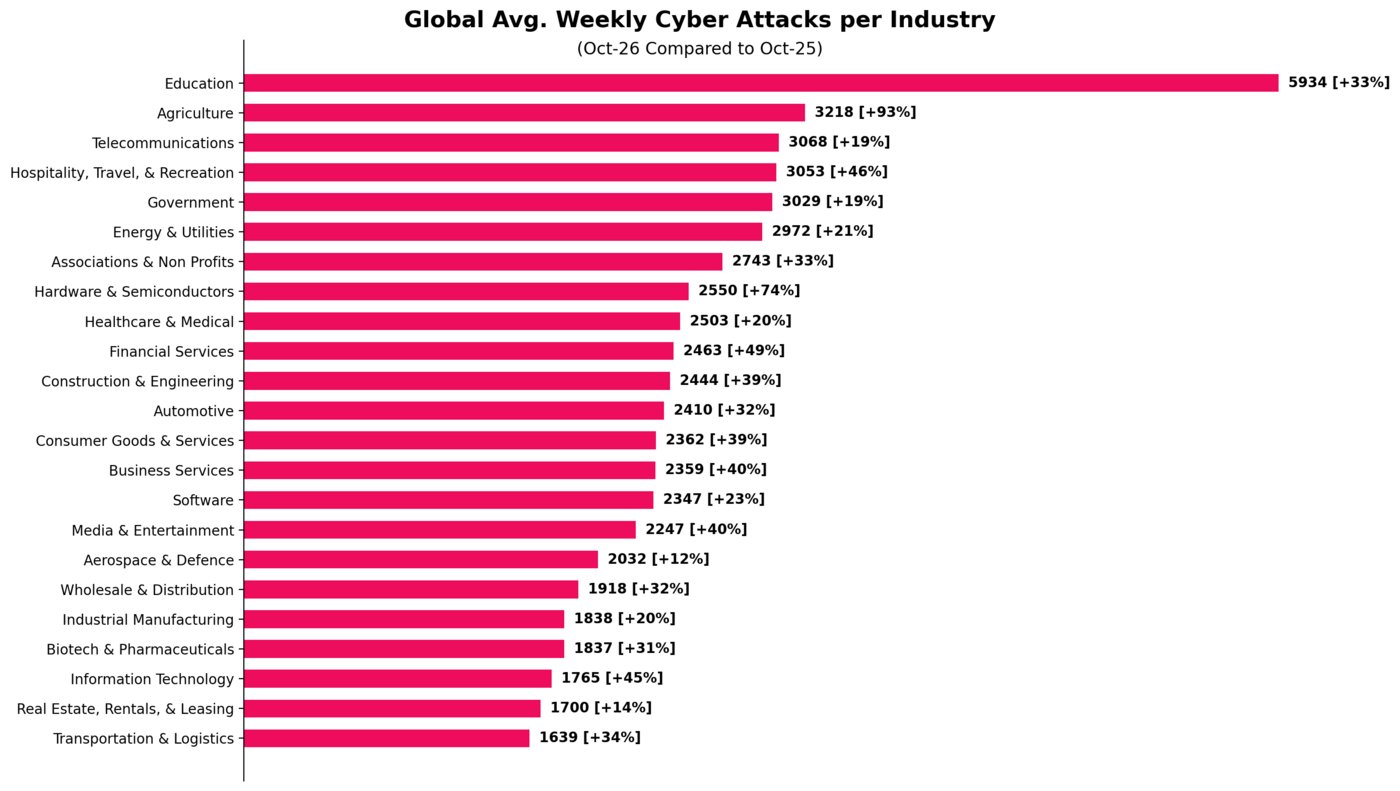
In October 2026, the education sector remained the most heavily affected industry worldwide, with an average of 5,934 attacks per organization per week—a 33 percent increase from the previous year. According to CPR, schools, universities, and research institutions typically have a large number of users and open, widely accessible networks, which could explain the significant gap compared to all other sectors.
Agriculture moved up to second place with 3,218 attacks per week. With a 93 percent increase, it recorded the sharpest rise among the leading industries. Telecommunications followed closely behind with 3,068 attacks (+19 percent). All sectors tracked recorded double-digit increases compared to the previous year. Critical sectors such as government, energy and utilities, and healthcare are also found in the top half of the ranking.
Geographically, Europe once again recorded the strongest growth: With an average of 2,248 attacks per week, the figures rose by 39 percent compared to the previous year. North America saw a 33 percent increase, reaching 1,950 attacks. In terms of attack volume, Africa returned to the top spot for the first time in over a year, reaching 3,834 attacks per week (+38 percent), followed by Latin America with 3,483 attacks (+17 percent) and the APAC region with 3,436 attacks (+27 percent).
Risky GenAI prompts are on the rise, while phishing is on the decline
While the number of attacks declined month-over-month, the opposite trend continued with generative AI: The proportion of risky prompts has risen month after month since August. One in every 35 GenAI prompts in October posed a high risk of exposing sensitive data. The global exposure rate rose to 2.9 percent, up from 2.3 percent in August and 2.5 percent in September. Ninety percent of companies that regularly use GenAI tools were affected. An additional 12 percent of prompts contained potentially sensitive information.
Users at the companies surveyed generated an average of 91 prompts per month, and the companies used an average of seven different GenAI tools. Financial data was the most common type of data, appearing at 71 percent of the companies. Legal and regulatory information, as well as network and IT infrastructure data, were each observed in 70 percent of companies; personnel and HR data in 67 percent; and personal data in 62 percent. These figures represent the percentage of companies in which the respective category was observed, not the percentage of prompts.
The situation regarding phishing eased somewhat: One in every 128 emails (0.78 percent) was classified as phishing in October, down from one in every 91 emails (1.1 percent) in September. Of the phishing emails, 79 percent contained links and 14 percent contained attachments. Malicious links thus remain the primary method of attack, though some campaigns also relied solely on social engineering without any links or attachments.
Ransomware Reaches a New High
In October 2026, 1,063 ransomware attacks were publicly reported—more than ever before in a single month and 35 percent more than in October 2025. These findings come from so-called “ransomware shame sites,” where extortionist groups publicly list their victims. According to CPR, these figures are inherently selective but offer insight into the scale, prevalence, and tactics of the ransomware ecosystem.
Business services were once again the hardest-hit sector, accounting for 31.5 percent of all victims, followed by consumer goods and services (14.9 percent) and industrial manufacturing (11.6 percent). Because service providers often manage data or have system access for multiple clients at the same time, attacks on them frequently have repercussions far beyond the actual victim. North America remained the hardest-hit region, accounting for 48 percent of reported incidents, followed by Europe (22 percent) and the APAC region (18 percent). At the country level, the United States accounted for 44.3 percent of the victims. Germany followed in second place with 5.2 percent, ahead of Canada (4.0 percent).
The Gentlemen remained the most active group, accounting for 13 percent of the disclosed attacks. This ransomware-as-a-service group, which has been active since mid-2025, sells initial access while also offering its partners access to approximately 14,000 already compromised FortiGate devices. It targets Windows, Linux, and ESXi environments. Qilin followed with 12 percent. This established group has been publishing its victims since 2022 and has significantly increased their number since March 2025.
A newcomer caused quite a stir: The extortion group n0n made it into the top 3 just one month after its first appearance in September 2026. It reached 8 percent, up from 2 percent in September, and had already claimed more than 170 victims by early November. Its operators rely on data theft and extortion and make extensive use of AI-powered tools. In the cases observed, they gained initial access not through vulnerabilities, but through weak or stolen credentials.
Marco Pierro, Country Manager for Switzerland at Check Point, explains: «With 1,528 attacks per week, Switzerland saw a 49 percent increase compared to the previous year. This trend is anything but reassuring. I’m particularly concerned about the rise in ransomware: With 1,063 publicly reported victims, a new record was set in October, and new groups are specifically using AI to strike faster and on a broader scale. The fact that the healthcare sector here continues to rank second among the most heavily targeted industries shows where the consequences are most severe. Hospitals and medical practices therefore need protection that prevents attacks rather than merely detecting them.»
Source: Check Point Software