

AI Use Doubles: New Swiss Media Usage Study Highlights Digital Transformation
Four out of five people in Switzerland already use artificial intelligence—that is the most striking finding of the IGEM Digimonitor 2026. The annual study also shows that audio streaming is overtaking traditional radio, digital news reaches nearly the entire population, and gaming is becoming mainstream.





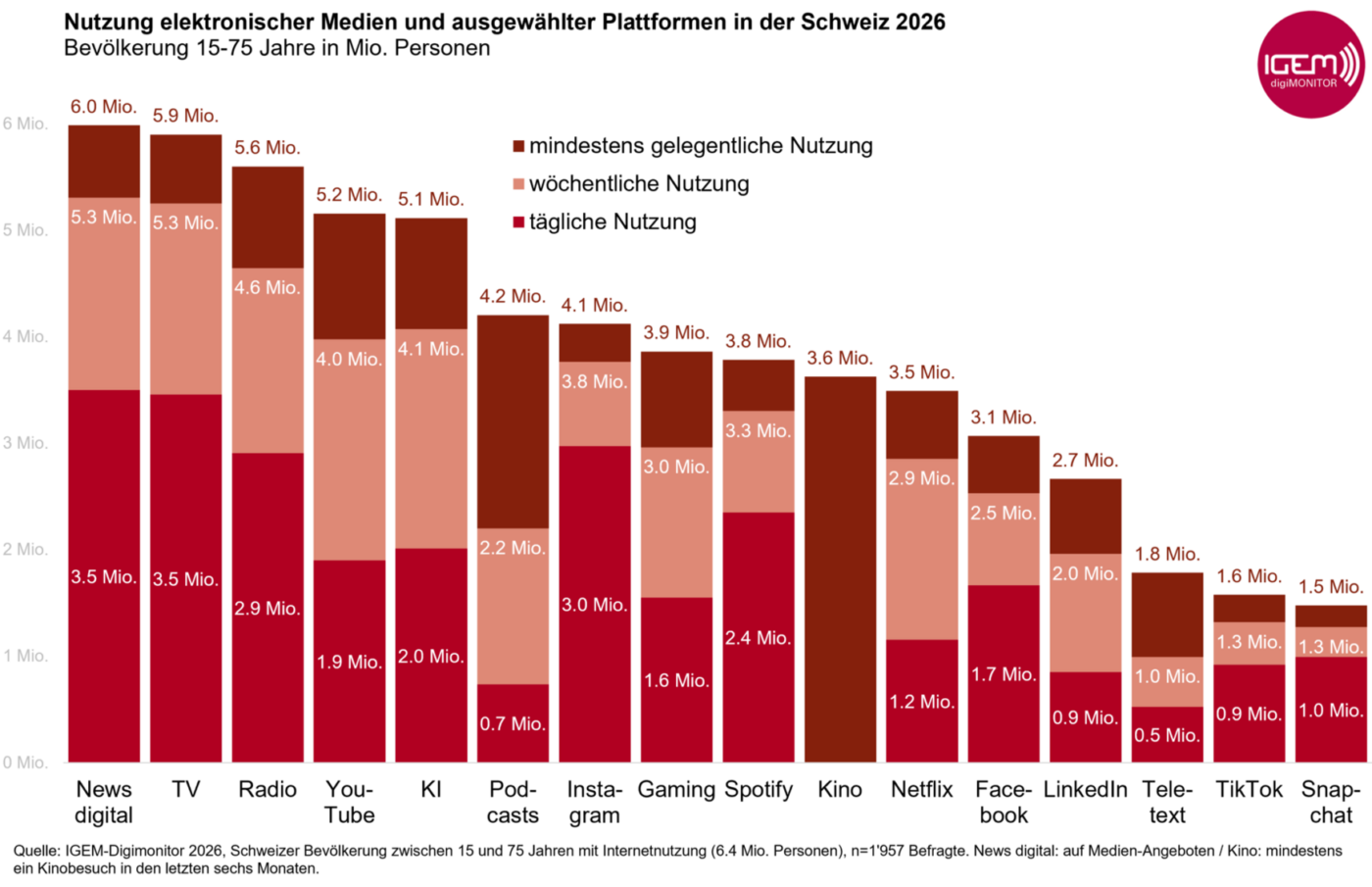
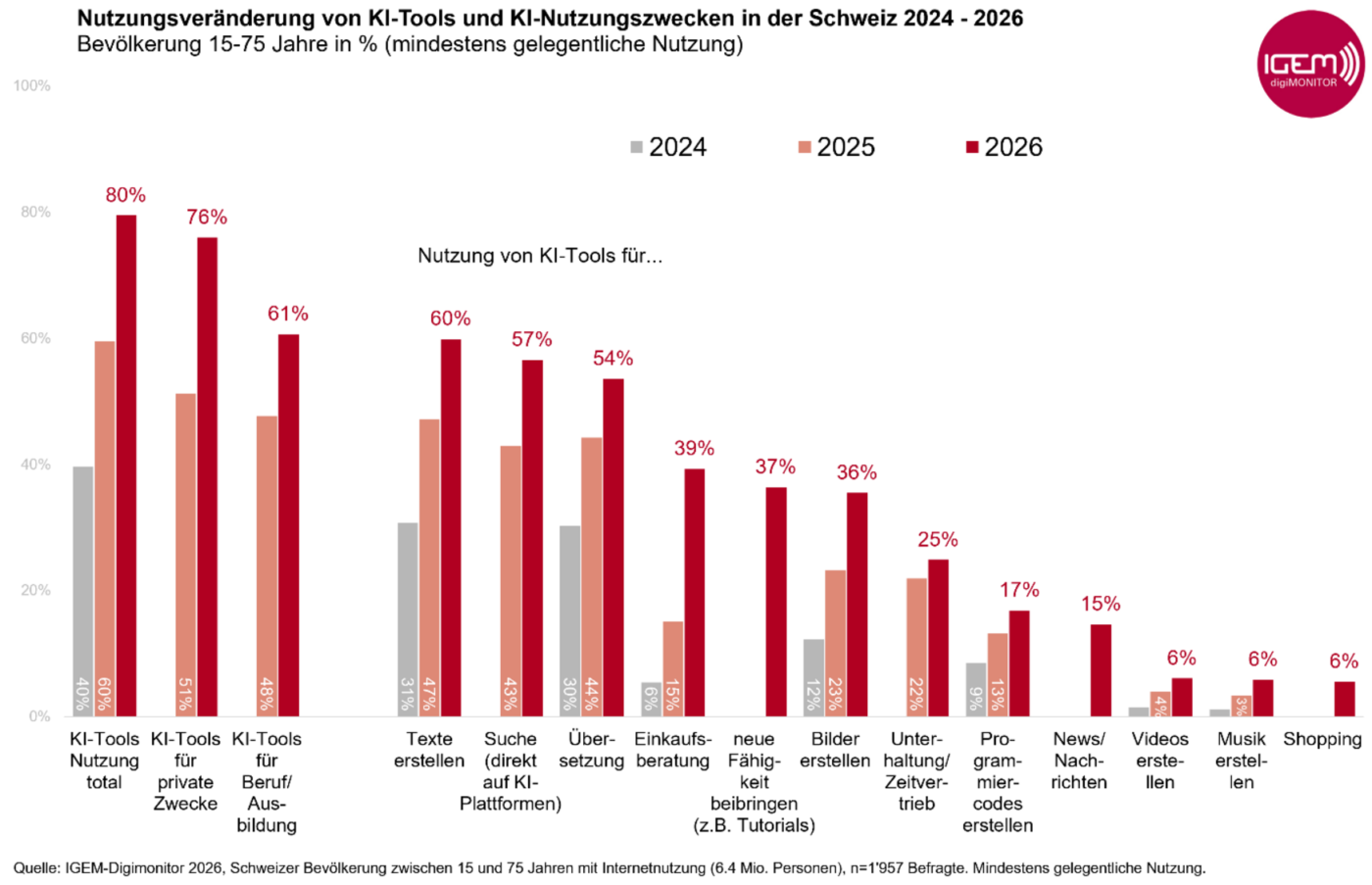
The Swiss media landscape is undergoing rapid change. This is shown by the IGEM Digimonitor 2026, commissioned by the Interest Group for Electronic Media (IGEM) and Wemf. The results are representative of the Swiss population aged 15 to 75 who use the internet—which amounts to approximately 6.4 million people. This year’s survey focuses on the rapid rise of artificial intelligence: AI usage has doubled since 2024, from 40 to 80 percent.
AI Is Becoming an Everyday Helper for Information, Learning, and Shopping
Artificial intelligence has become a part of everyday life in Switzerland in record time. Nearly one in three people already uses AI tools on a daily basis. Adoption is particularly high among 15- to 34-year-olds: 91 percent use AI occasionally, and 44 percent even use it daily. And its use is no longer limited to writing texts or translations. 57 percent use AI for research, just under 40 percent for shopping advice, and AI is also gaining importance in learning through tutorials. At 76 percent, personal AI use is significantly higher than its use in professional or educational settings (61 percent).
AI Is Becoming Part of Search – ChatGPT Remains Number 1
The traditional search engine remains the most widely used tool on the web: 98 percent of the internet-using population uses it at least occasionally, and more than two-thirds use it daily. At the same time, AI is rapidly gaining importance in search: 77 percent already use the AI mode within traditional search engines, and 57 percent conduct targeted searches via AI platforms. This means that AI platforms are used more frequently for search than YouTube (34 percent) or social media (28 percent). Men are more likely to use AI platforms, while women tend to search slightly more often on social media.
ChatGPT is by far the most widely used AI platform in Switzerland: Two-thirds of the population (67 percent, 4.3 million people) use the service at least occasionally, and 17 percent use it daily. Gemini (32 percent) and Copilot (30 percent) follow far behind. Other services such as Meta AI (13 percent), Claude and Perplexity (10 percent each), and Mistral (3 percent) currently play a lesser role.
Digital news reaches almost all of Switzerland
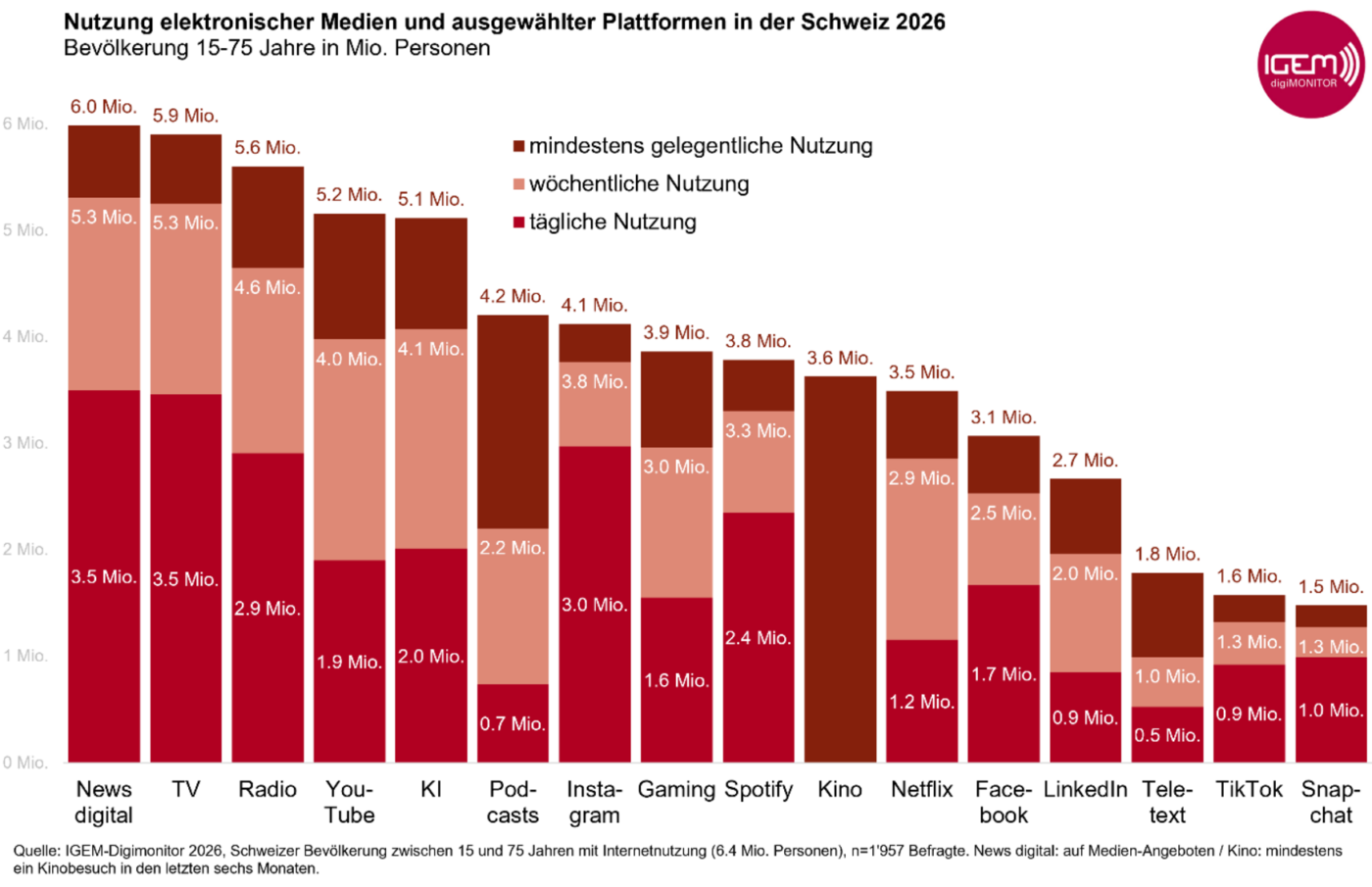
Digital news continues to have a wide reach: 93 percent of the population consumes news on media websites or apps, with more than half doing so daily. News offerings from private Swiss media outlets achieve the highest reach. At the same time, the willingness to pay for digital news offerings is declining across all demographic groups—particularly in French-speaking Switzerland, among men, and among younger people. Among 15- to 34-year-olds, social media is increasingly establishing itself as a news channel: 31 percent of this age group uses social networks daily to get the latest news. For 13 percent, social networks are their sole source of news. Digital Out of Home (DOOH) also plays a role: 70 percent pay attention to news on screens in public spaces.
TV and Streaming, Audio and Radio
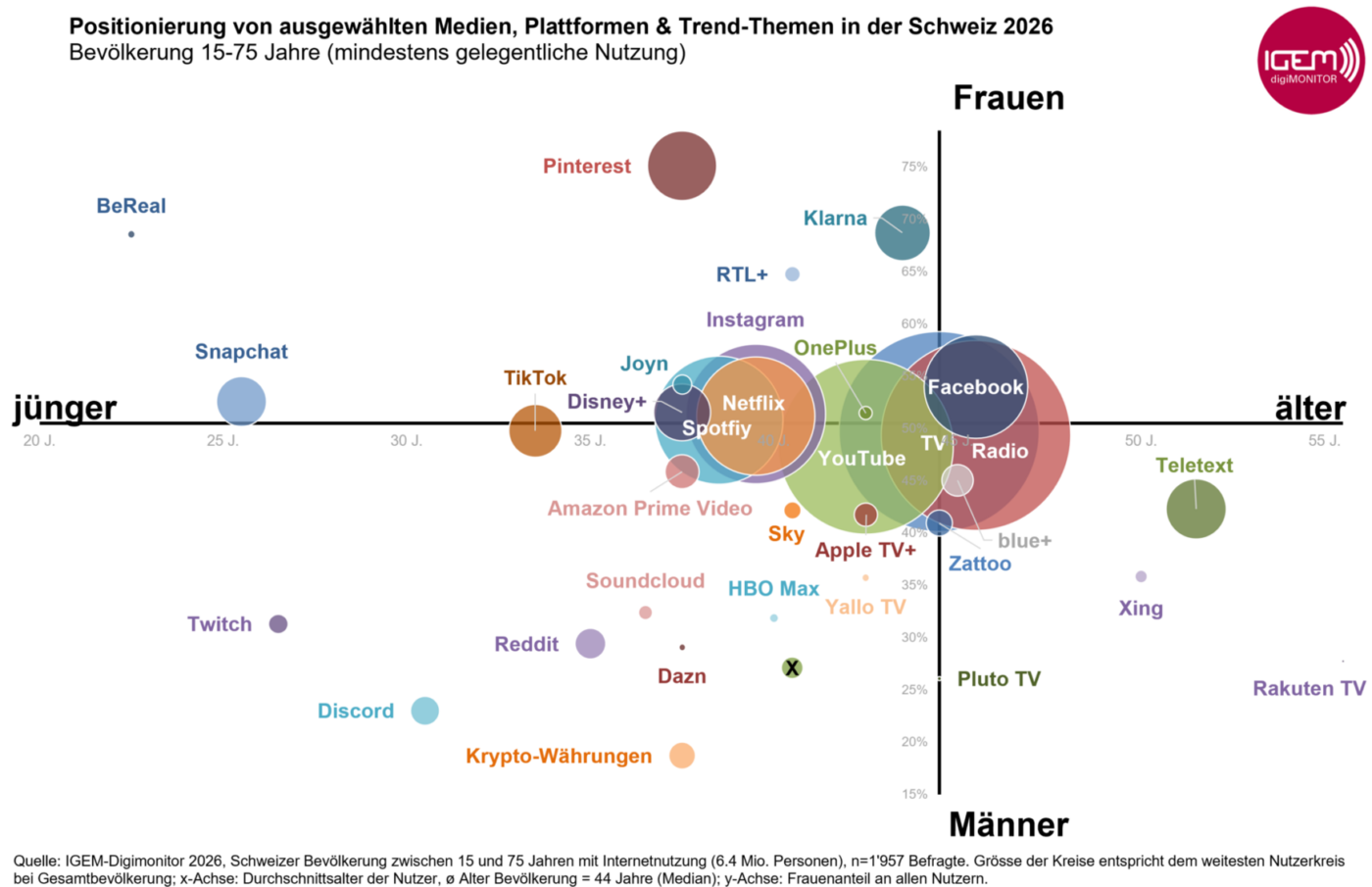
Television remains deeply entrenched in Switzerland: 92 percent use TV services at least occasionally, and 54 percent watch TV daily. Streaming has become established alongside it: 47 percent of the population streams TV or video content daily. With an 80 percent reach, YouTube is the most widely used video platform, followed by Play SRF/RTS/RSI (Play Suisse) at 59 percent and Netflix at 54 percent. Amazon Prime Video has seen the strongest growth over the past three years, with its reach rising from 11 to 16 percent.
In the audio sector, the trend is reversed: streaming is overtaking radio. While daily radio consumption has declined from 52 to 45 percent since 2024, 60 percent listen to music or radio daily via streaming services or radio websites. Spotify is the leading streaming provider; just under one-third of Spotify users use the ad-supported free version. Podcasts are listened to at least occasionally by 65 percent of the population, but with 11 percent daily usage, they lag significantly behind radio and streaming.
Instagram Leads the Way, X Sees Sharp Decline
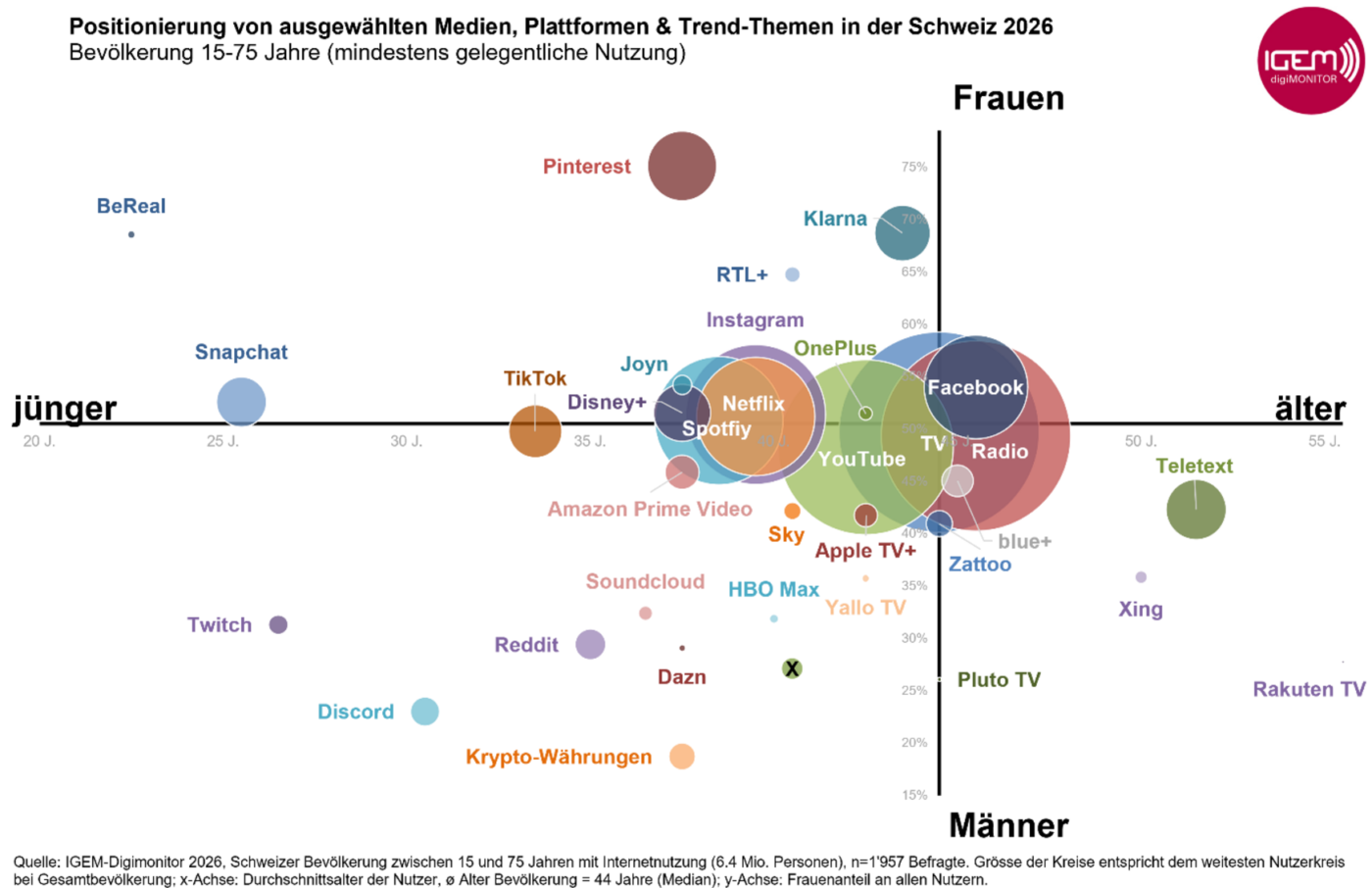
Two-thirds of the population use social media daily. Instagram maintains its top position as the most widely used platform: 45 percent of the population uses Instagram daily, ahead of Facebook (26 percent), Snapchat (16 percent), and TikTok (14 percent). X (formerly Twitter) has lost significant reach: Usage has dropped from 17 to 10 percent since 2024. Among 15- to 34-year-olds, Instagram is clearly in the lead with 72 percent daily usage, ahead of Snapchat (44 percent) and TikTok (31 percent). Social commerce—that is, making purchases directly through social media—remains relatively uncommon, with 18 percent usage.
Gaming, Wearables, and Online Shopping
Gaming continues to gain in importance: 60 percent of the population plays digital games at least occasionally. This growth is particularly evident among people aged 55 and older—one in three women between the ages of 55 and 75 now plays digital games every day. 44 percent play on their smartphones, and 28 percent play on a console at least occasionally.
The smartphone remains the primary digital device: 96 percent of the population uses it at least occasionally. Smartwatch usage has risen from 27 to 32 percent over the past three years. AI glasses, on the other hand, are still a niche phenomenon: only 2 percent of the population uses such devices.
Online shopping is firmly established and is increasingly shifting to mobile devices: 66 percent shop via smartphone, and 64 percent via PC or laptop. When it comes to product information, online stores are the first port of call for 91 percent of consumers. AI platforms are already establishing themselves as a shopping advisory tool (39 percent), on par with YouTube (40 percent) and ahead of social media (36 percent). The prevalence of Chinese shopping platforms is striking: 36 percent of the population already shops on Temu, Shein, or AliExpress—particularly frequently in Ticino (48 percent) and French-speaking Switzerland (43 percent).
About the study
Since 2014, the IGEM Digimonitor has conducted an annual survey on the use of electronic media and devices in Switzerland. The 2026 online survey took place from March through April. On behalf of IGEM and Wemf, Intervista surveyed 1,957 people, including 1,002 in German-speaking Switzerland, 747 in French-speaking Switzerland, and 208 in Italian-speaking Switzerland. The confidence interval is a maximum of ±2.2 percentage points. The results are available free of charge to IGEM members; non-members can purchase the study for CHF 5,000.
More information: www.igem.ch


