Sold-Out AI Conference at Lucerne University of Applied Sciences and Arts: When Communication Needs to Be Rethought
About 140 communications professionals, a packed auditorium, and questions that went far beyond the topic of proper prompting. On November 3, 2026, experts from academia and the professional world discussed the future of their profession at the conference «Between Prompting and Judgment—How AI Is Changing Professional Communication.» The event was hosted by the Institute for Communication and Marketing (IKM) at the Lucerne University of Applied Sciences and Arts and the Central Swiss Public Relations Association (ZSPR).


What will remain of the craft of communication when AI conducts research, writes texts, and develops ideas? How will young professionals learn their trade when machines are already doing most of the work? And how will companies remain visible when their target audiences increasingly receive answers directly from AI systems? These questions were the focus of an evening on November 3 that highlighted just how fundamentally the communications industry is changing right now. Around 140 professionals from companies, agencies, associations, and academia gathered at Lucerne University of Applied Sciences and Arts to explore the opportunities and challenges of artificial intelligence. The fact that the event was sold out underscored the great interest in a topic that has long since become part of everyday professional life. The focus was less on what AI is already capable of today. Rather, participants were concerned with the question of what this development means for people, skills, and the future of professional communication.
Science and Practice: A Joint Exchange
Through this professional event, the Institute for Communication and Marketing at Lucerne University of Applied Sciences and Arts and the Central Switzerland Public Relations Association created a platform that brought together diverse perspectives on the future of communication.
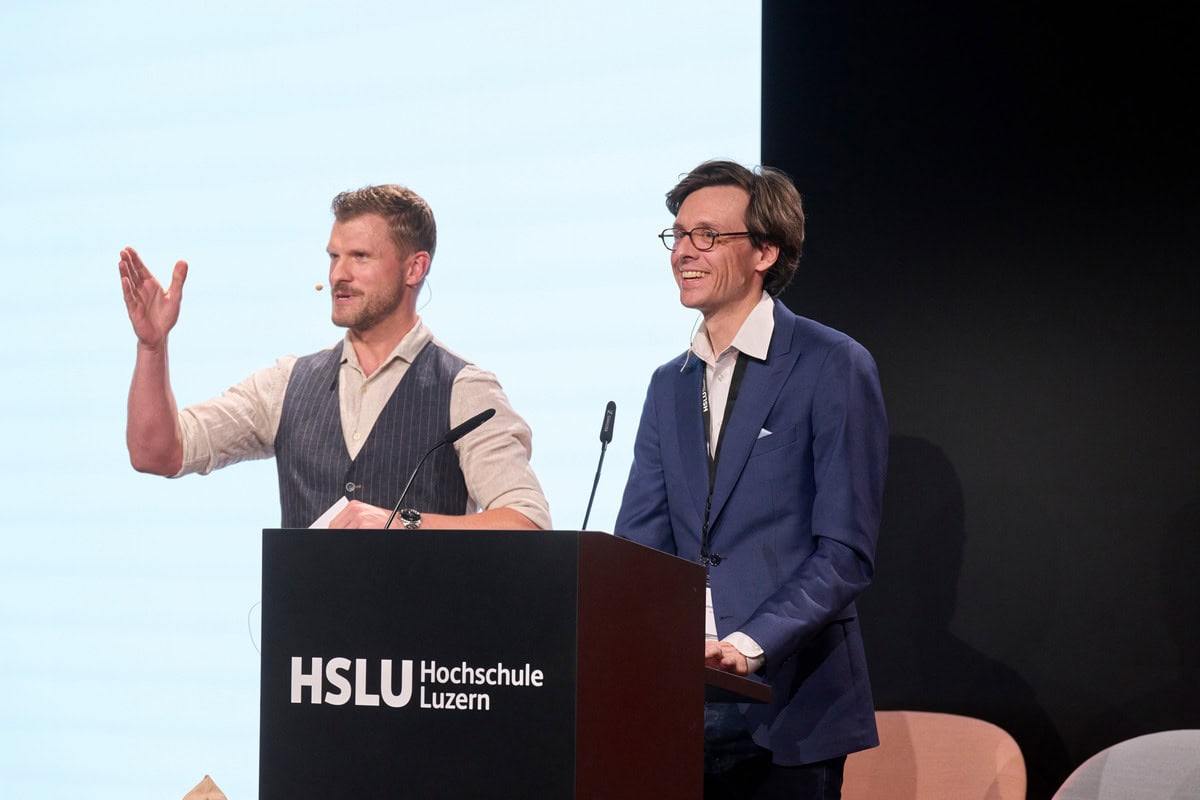
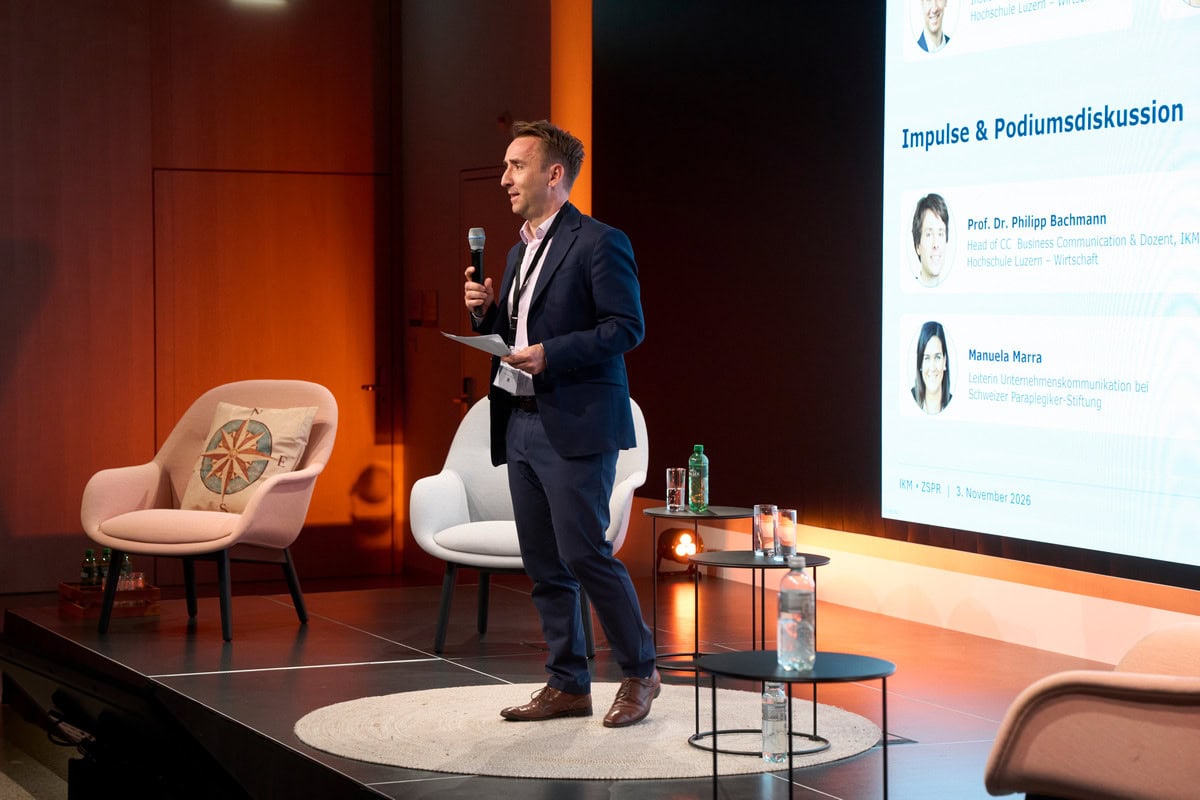
Prof. Dr. Matthes Fleck, Director of the IKM, Prof. Seraina Mohr, Director of the Competence Center for Communication Management at the IKM, and Thomas Odermatt, President of the ZSPR and Head of Communications at the Central Switzerland Chamber of Industry and Commerce (IHZ), represented their respective organizations at the event. Seraina Mohr and Thomas Odermatt co-hosted the evening. Featuring two expert presentations followed by a panel discussion, the program provided an opportunity for new insights, critical questions, and personal exchange within the communications community.
A well-crafted prompt is by no means the same as a well-thought-out idea
Dr. Nadine Stutz, lecturer in digital communication and generative AI and co-director of the CAS AI in Marketing and Communication program at the Lucerne University of Applied Sciences and Arts, provided the first professional insight.
With her presentation titled «A Well-Formulated Prompt Doesn’t Mean a Well-Thought-Out Idea,» she highlighted a skill that remains crucial when working with AI: one’s own judgment. After all, a convincingly worded AI text isn’t automatically factually correct. And a quick answer is no substitute for a well-reasoned decision.
Her presentation made it clear that working professionally with AI requires much more than just good prompts. Communications professionals must scrutinize results, identify connections, and take responsibility for content and its impact. This also includes having the courage to consciously decide not to publish something.
Who will learn the trade if AI takes over the work?
Prof. Dr. Philipp Bachmann, director of the Competence Center for Business Communication at the IKM of the Lucerne University of Applied Sciences and Arts, offered another perspective. Drawing a surprising parallel to horse whisperer Monty Roberts, he made the connection to the leadership and training of communication professionals. In doing so, he posed a question that extends far beyond the communications industry: How do people develop professional skills when the tasks they have traditionally learned to perform are increasingly being taken over by AI?
It is precisely the supposedly tedious steps—researching, drafting, revising, making mistakes, and learning from them—that play a key role in building experience and professional expertise.
This initiative prompted a reevaluation of the training and leadership of communications professionals. After all, as AI takes on more and more routine tasks, companies and universities must be all the more mindful of ensuring that professional skills and critical thinking continue to be developed.
How Can Companies Stay Visible in the Age of AI?
In addition to changes in their day-to-day work, participants also discussed how artificial intelligence affects companies’ digital visibility. Marco Schlauri, founder and CEO of the Zurich-based agency Digital Leverage, shared his expertise in search engine optimization (SEO) and large language model optimization (LLMO).
As people increasingly direct their questions to AI systems, the way information is found and perceived is also changing. Instead of a traditional list of results, users are increasingly receiving a pre-formulated answer. This presents new challenges for communications professionals. In addition to traditional search engine optimization, Generative Engine Optimization (GEO) is gaining importance. Companies must address how their content is incorporated into AI-generated responses and how they can ensure their credibility and visibility in the long term.
A lively discussion about the future of the profession
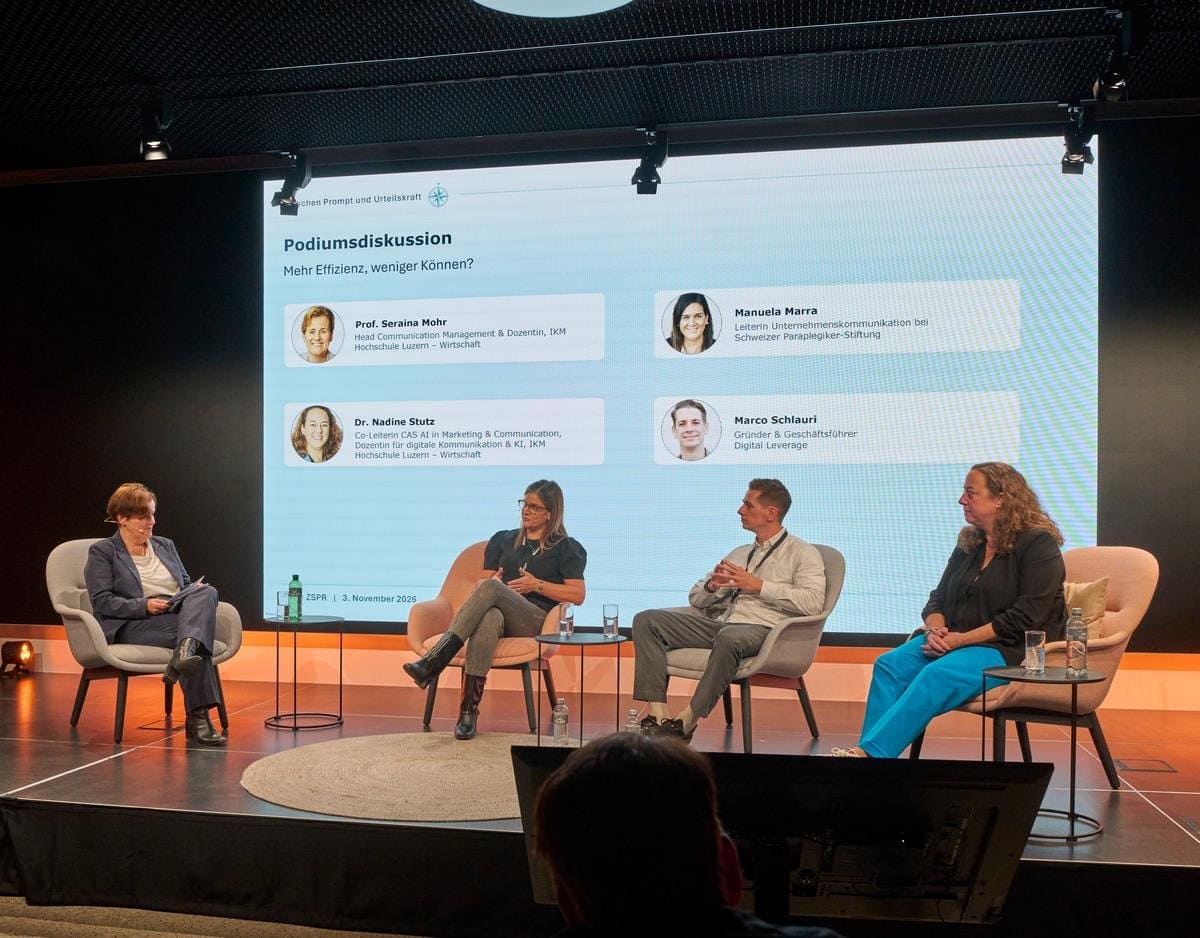
The subsequent panel discussion highlighted just how differently these developments are already affecting everyday communication.
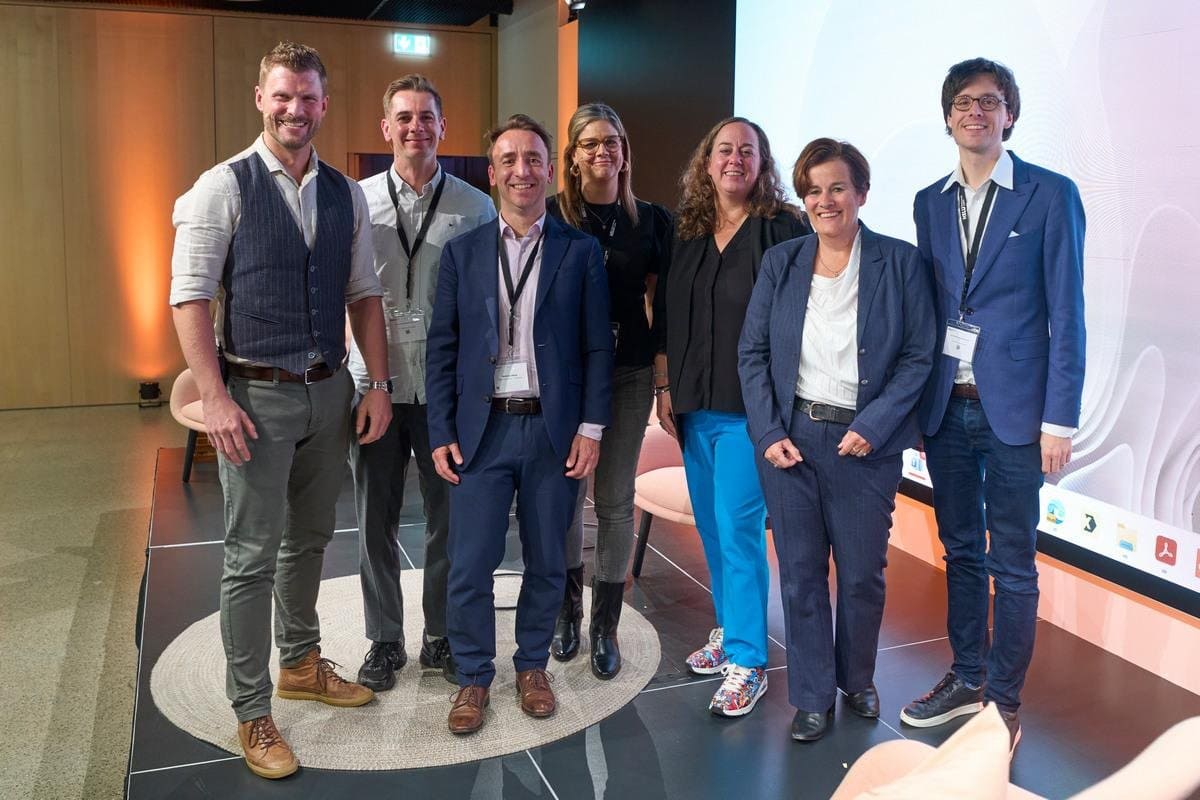
In addition to Nadine Stutz and Marco Schlauri, Manuela Marra, Head of Corporate Communications at the Swiss Paraplegic Foundation, shared insights from a corporate perspective.
Moderated by Seraina Mohr, the panelists discussed changing job roles, new demands on communications professionals, and the responsibilities that remain with humans even in the age of artificial intelligence. The audience also participated by asking questions and sharing their own experiences. It became clear that many organizations face similar challenges: How can AI be used effectively? What skills will employees need in the future? And how can organizations harness technological possibilities without relinquishing their own expertise and judgment?
The discussion continues
The sold-out event demonstrated just how great the need is for guidance and personal exchange in the communications industry. And one thing became clear: AI is transforming our craft. This makes it all the more important that we remain critical, continue to expand our knowledge, and keep thinking ahead together.
There will be more opportunities for this in the future. The IKM looks forward to further events where experts will offer new perspectives and discuss current issues together with the communications community.
Anyone interested in delving deeper into developments in AI as they relate to marketing and communication will find suitable, concise continuing education programs at the Institute for Communication and Marketing at the Lucerne University of Applied Sciences and Arts – Business.