Second life for electric car batteries
Successful conclusion to the CircuBAT research project: the project aims to close the loop between the production, use and recycling of lithium-ion batteries from the mobility sector. To this end, seven Swiss research institutions and 24 companies worked together to develop solutions for greater sustainability at all stages of the battery's life cycle.





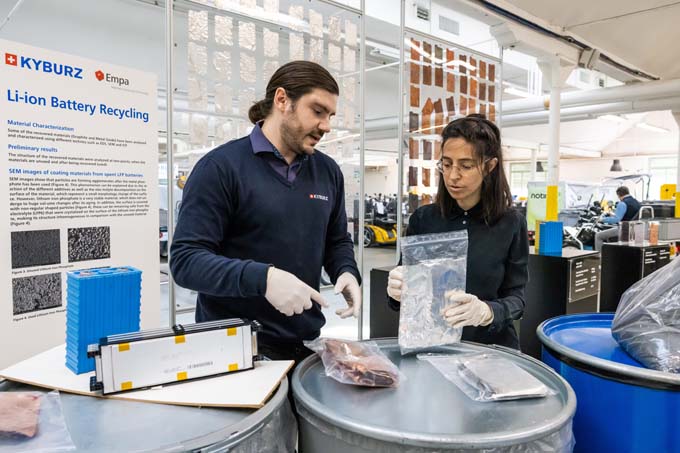
Electric vehicles are key to more climate-friendly mobility. In order to further improve their ecological balance over their entire life cycle, the core component of the vehicles - the lithium-ion battery - offers great potential. This is where CircuBAT comes in. Within four years, a circular economy model for lithium-ion batteries from the mobility sector has been developed. «We have developed innovative solutions that are attracting attention worldwide. Nevertheless, these represent a first step on the way to closing the battery cycle with stations distributed around the globe,» says project manager Andrea Vezzini from Bern University of Applied Sciences BFH.
Cooperation between research and industry
BFH is the leading house in the CircuBAT project. On the scientific side, six other Swiss research institutions are involved: Empa, the Centre Suisse d'Electronique et de Microtechnique CSEM, the University of St. Gallen (HSG), the OST - Ostschweizer Fachhochschule, the Switzerland Innovation Park Biel/Bienne SIPBB and the EPFL (Swiss Federal Institute of Technology Lausanne). A total of 24 companies from business and industry are involved, ranging from materials specialists and manufacturing companies to users and suppliers of electric vehicles. Thanks to this collaboration between science and industry, the project covers all stages of a battery's life and the solutions developed have been tested in application. Several are about to be launched on the market or are being pursued in follow-up projects and start-ups.
Optimization in all areas
The CircuBAT project is looking for solutions to improve sustainability at all stages of the life of lithium-ion batteries. This includes extending the service life of batteries in their first application. This will be achieved through an interactive «Battery Expert System», thanks to which the ageing of a large number of batteries can be compared with each other in an intuitive form, as well as through new concepts for the construction of batteries that make repairs easy. Furthermore, batteries are to be used as stationary energy storage devices after their initial application in mobility. In the project, optimization strategies for the safe and efficient operation of multiple, differently degraded battery packs were implemented in a control system. Finally, the researchers developed automated solutions for sub-steps in de-manufacturing and new processes for direct material recovery so that the secondary raw materials can be added to the production of new batteries and other applications. In addition to these technical issues, the Swiss circular economy model for lithium-ion batteries was developed in the project, thanks to which future volumes, for example for the Swiss second-life battery market, can be estimated. CircuBAT will thus make an important contribution to the decarbonization of mobility in Switzerland and the use of renewable energies.
Two-day conference at the end
The two-day CircuBAT2025 event on November 13 and 14, 2025 marks the conclusion of one of the first projects approved by the Swiss Innovation Agency Innosuisse as part of the Flagship Initiative. The initiative promotes systemic innovation in areas that are relevant to a large part of the economy or society and strives to find solutions to current or future challenges that affect multiple stakeholders and can only be overcome through collaboration.
The final public conference on Thursday afternoon, November 13, 2025, will provide a comprehensive overview of the Swiss circular economy model developed for lithium-ion batteries from the mobility sector. In addition to this general part, speakers from politics and science will provide an overview of the current status of the circular economy in Switzerland and in an international context.
The scientific part of the conference will follow on Friday, offering an in-depth insight into the newly developed Swiss model of the circular economy for lithium-ion batteries and other international projects on this topic. The event will focus on the implementation of the scientific results - with exclusive insights into the project results and personal perspectives from the experts involved.
Sources and further information: