Climate Foundation promotes climate-friendly robotics solution for agriculture
In its second funding round for 2025, the Swiss Climate Foundation is supporting nine climate-effective projects by SMEs with a total of CHF 1.044 million. These include a solution for sustainable agriculture.





Climate innovations and solutions are here to strengthen the energy and climate transformation of Switzerland and Liechtenstein as business locations. The second funding round in 2025 once again shows how SMEs are leading the way with climate-innovative projects. Together with the first funding round in spring 2025 This year, 20 projects are being supported with a total amount of CHF 2.4 million. The following projects are among the solutions currently receiving support.
Raptrac: Autonomous equipment carrier for sustainable agriculture
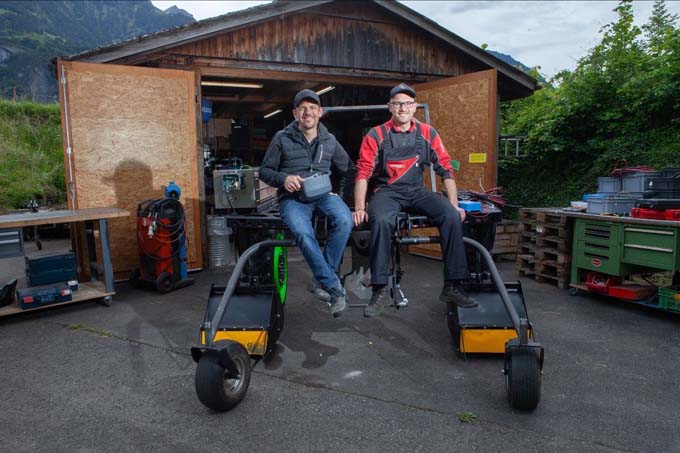
Agriculture has a major impact on the ecological footprint. The Swiss Climate Foundation regularly receives promising proposals on how to tackle the issue of a future-oriented agricultural sector. There is a real boom in the development of lightweight equipment carriers that can be used partially or fully autonomously in fields and farmland. The Urner Raptrac Inc. has developed such a vehicle: «We want to promote climate-friendly agriculture with appropriate automation technology,» says co-founder René Schneebeli. With a lower weight than conventional machines, the machine reduces soil compaction while offering the same functionality and proves in field use that it meets the requirements of visionary agriculture.
Low-carbon recycling of metals from municipal and industrial waste
According to the Federal Office for the Environment, Switzerland is one of the countries with the highest per capita amount of municipal waste worldwide. For waste containing zinc, nickel, copper, silver, or lead, the Valais-based company RedElec Technology SA developed a process in which these metals can be recovered from even very low concentrations using electricity. This is very important for climate protection, as recycling metals contributes significantly to reducing greenhouse gas emissions. The electrochemical recovery of metals from industrial wastewater or incinerated waste requires significantly less chemicals and energy than extraction from ores. The same applies in comparison to existing recycling processes for this type of waste.
CellX Biosolutions AG finds bacteria to break down PFAS
PFAS – per- and polyfluoroalkyl substances – are called „forever chemicals“ because they were long thought to be non-biodegradable. The Zurich-based start-up CellX Biosolutions is now proving the opposite. With the help of its technology and the right bacteria, PFAS can be broken down. «The potential of bacteria is enormous. Their use in PFAS remediation is a game-changer,» says CellX co-founder and microbiologist Estelle Clerc. Today, PFAS in water and soil can almost only be broken down by incineration. This process is very energy-intensive and emits a lot of CO2. With its solution, CellX is therefore not only contributing to the reduction of PFAS pollution, but also to climate protection.
Other supported projects
The second funding round in 2025 will also support technologies and projects from the following SMEs:
- from Saint-Sulpice/VD, Company Sixteen44 SA
- from Pfäffikon/SZ, Thermal Transformer Company
- from Rotkreuz/ZG, smart-me company
- from Le Pâquier/FR, Company ID Technologies
- from Lucerne/LU, Xulux company
- from Zurich/ZH, Peelpack company
Other Swiss or Liechtenstein SMEs that develop innovative and climate-friendly products can also apply for funding. The Climate Foundation decides on applications twice a year, in spring and fall. The next submission deadline is March 1, 2026..