Companies rely on AI as a driver for sustainability
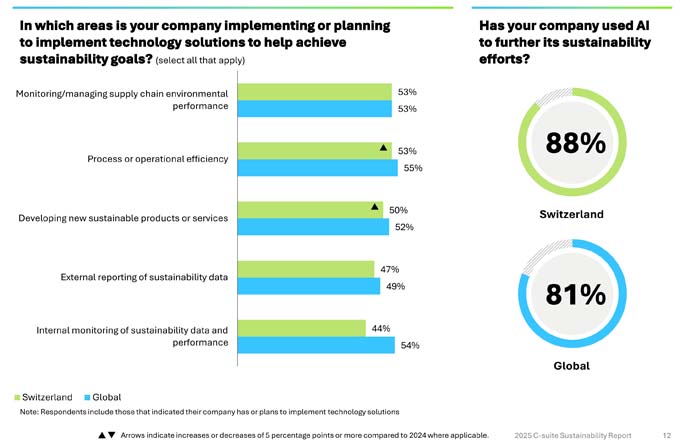
88 percent of Swiss companies already use artificial intelligence to achieve their environmental goals—more than the global average. This is according to the new Deloitte C-Suite Sustainability Report.






Technology has become the top corporate priority in Switzerland (56%), closely followed by sustainability (47%). This shows that the two topics are inextricably linked. 88 percent of Swiss companies surveyed already use AI as a tool for their sustainability efforts – more than the global average of 81 percent. They have recognized that without technology, there can be no measurable sustainability transformation. Technology is primarily used in supply chain management (53%), to increase operational efficiency (53%), to develop sustainable products (50%), and to report on sustainability impact (47%).
AI for recording sustainability indicators
The stronger focus on technology is intended to help companies overcome their biggest current challenge in the area of sustainability: a quarter (25%) of Swiss respondents cite measuring their own environmental impact as the greatest difficulty in implementing planned measures. Data collection is particularly complex in the supply chain. However, modern technologies are increasingly making it possible to integrate sustainability metrics directly into existing business systems in order to systematically record and report on them.
«The high level of AI adoption shows that Swiss companies recognize that technology is the key to measurable sustainability. Efficient application is crucial—specialized AI models instead of energy-intensive universal systems. Those who invest wisely can precisely measure and control their own environmental impact. That is the path from well-intentioned to well-executed,» explains Reto Savoia, CEO of Deloitte Switzerland.
Potential perception as greenwashing
Despite technological advances, critical gaps remain, the survey continues. There are notable differences in the priorities for evaluating sustainability measures: 36 percent of Swiss executives cite brand protection, intellectual property, and risk reduction as the most important decision-making criteria, while only 18 percent prioritize the direct environmental impact of their measures. The global results show exactly the opposite picture. This discrepancy raises questions about the balance between risk management and the actual impact of sustainability measures in Swiss companies.
«The much greater emphasis placed on intangible assets such as brand and reputation compared to direct environmental impact deserves closer attention,» explains Liza Engel, Chief Sustainability Officer at Deloitte Switzerland. «Swiss companies must ensure that the measurable environmental impact of their measures does not take a back seat. The best sustainability strategies combine both: robust risk management and measurable positive environmental impact.»
Investments in sustainability continue to rise
Investment in sustainability remains high: 87 percent of Swiss companies surveyed increased their spending last year, more than the global average of 83 percent. In addition, 83 percent have firmly integrated sustainability into all business processes—a significant increase compared to previous years, when the focus was more on compliance. The financial benefits are also becoming apparent: 58 percent report positive effects of their sustainability measures on sales, while 55 percent cite cost reductions.
«The economic arguments for investing in sustainability are compelling—Swiss companies are seeing clear improvements in efficiency and margins,» says Liza Engel. «The key question remains whether these investments also deliver measurable environmental results. This is where consistent, technology-based measurement systems along the entire value chain can help.»
Climate change remains strategically relevant despite easing pressure
Although climate change and sustainability have slipped down the list of priorities, 70 percent of respondents still expect them to have a significant impact on their business strategy over the next three years – down from 82 percent last year. When asked to name specific tangible impacts on their companies, 36 percent of respondents cited rising costs and increasing scarcity of raw materials, as well as the effects of extreme weather events on their business activities.
At the same time, external pressure on companies in Switzerland to give higher priority to sustainability and climate change is easing: the proportion of executives who feel moderate to high pressure from their stakeholders in this regard fell from 81 percent last year to 74 percent. Particularly striking is that only 34 percent of Swiss respondents feel substantial pressure from their shareholders to become even more committed to sustainability – globally, the figure is 58 percent.
«The weak pressure from shareholders is not a free pass, but rather an obligation to demonstrate entrepreneurial foresight. Swiss companies can now transform themselves from a position of strength. Those who seize this opportunity and consistently use technology to achieve a measurable environmental impact will secure long-term competitive advantages,» Reto Savoia is convinced.
Source: Deloitte