Watt d'Or 2026: Four awards for a new energy world
With the Watt d'Or 2026, the Swiss Federal Office of Energy honors four projects that show what a climate-friendly energy future looks like in concrete terms: from an industrial power-to-gas laboratory and alpine façade solar power production to an electric tractor and a low-tech showcase district.


The winners of the Watt d'Or 2026 have been announced: in Bern at the beginning of January, four projects from all over Switzerland were honored for their exemplary demonstration of how the energy transition and climate protection can be put into practice. The award is presented by the Swiss Federal Office of Energy, which has been using the prize to highlight outstanding achievements in the energy sector for over a decade. This year's award is the last, as the Watt d'Or is falling victim to cost-cutting measures by the federal government.
The award-winning projects once again addressed key questions for the future in 2026: How can renewable energy be stored, buildings constructed in a climate-friendly way, mobility made more efficient and regional resources used? The four award-winning projects provided concrete answers to these questions.
Gaznat: Laboratory for green gas
In the Energy Technologies category, Gaznat's Innovation Lab in Aigle won over the jury with its GreenGas concept. Together with EPFL research groups and start-ups, the company is testing new technologies for sector coupling, decarbonization and seasonal energy storage on an industrial scale on the site of the operations and control center. At the heart of the facility are twelve containers in which photovoltaics, power-to-gas electrolysis, hydrogen storage, CO₂ capture and methanation are brought together. Graphene membranes for CO₂ separation and a methanation reactor with a ruthenium catalyst, which can convert almost all CO₂ into synthetic methane, are particularly innovative.
Endigo: Solar façade in the alpine Rhone valley
In the renewable energy category, endigo Holding AG in Fiesch VS set an example that was also deemed worthy of an award. The new, lightweight timber construction company headquarters combines a conventional photovoltaic system on the roof with an architecturally eye-catching slatted solar façade on the south and west sides. The PV slats consist of specially manufactured aluminum profiles with integrated modules and complementary larch wood elements that blend harmoniously into the alpine surroundings and also serve as privacy and heat protection. With a peak output of 73 kilowatts and around 90,000 kilowatt hours of annual production, the building generates around twice as much electricity as it consumes and feeds the surplus into the regional grid.
Rigitrac: The quiet electric tractor
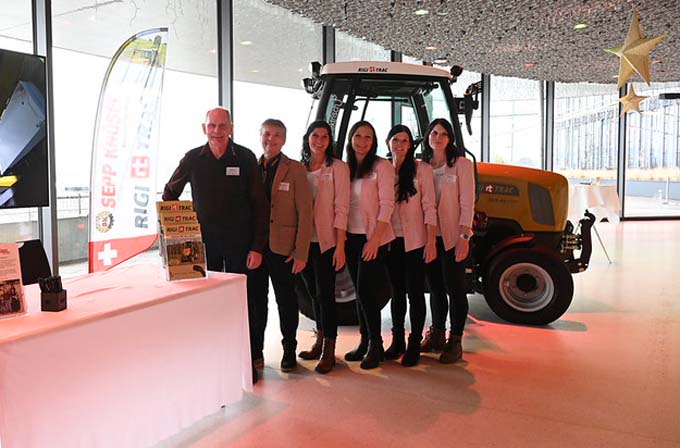
The Rigitrac SKE 40 e-direct electric tractor from the family-run company Rigitrac Traktorenbau AG from Küssnacht am Rigi won the award in the Energy-efficient Mobility category. According to the company, the first production-ready electric tractor with European type approval is emission-free, quiet, manoeuvrable and particularly energy-efficient - ideal for applications where noise and exhaust fumes are undesirable, such as in municipalities, tunnels or halls. Several electric motors only work when they are actually needed, which significantly reduces energy consumption. With a battery capacity of 58 kilowatt hours, the tractor can be used for four to eight hours and can be charged to 80 percent in around two hours thanks to the integrated 22-kilowatt charger.
Planing mill: Quarter as climate laboratory
In the Buildings and Space category, the Hobelwerk site in Oberwinterthur shows how resource-conserving residential construction can work. The building cooperative «mehr als wohnen», Lemon Consult and the Low-Tech Lab have created a district on the former industrial site that combines timber construction, re-use materials, climate architecture and social diversity. Photovoltaic systems on the roofs, heat pumps with wood pellet boilers, predictive energy management and a CO₂-controlled exhaust air system ensure energy-efficient operation and a high level of comfort. Green façades, trees and a sponge city-like rainwater management system improve the microclimate and provide a glimpse of what climate-adapted construction in urban areas can look like.
55 applications - 17 nominations - 4 winners
The Watt d'Or was awarded for the first time in 2007 and is not endowed, so no prize money is paid out. 55 applications were submitted for the Watt d'Or 2026 by mid-July 2025 and evaluated by a team of experts. In the end, 17 entries were nominated for the final round. From these, the jury, chaired by jury president Susanne Vincenz-Stauffacher, selected the winning projects in the four Watt d'Or categories.
Source: Swiss Federal Office of Energy SFOE