Greenovation Summit 2026: Sustainability in Action
On September 10, 2026, companies from Eastern Switzerland gathered at Galledia’s 3rd Greenovation Summit in Gossau, hosted by Blumer Lehmann, to highlight ways to put sustainability into practice. The highlight was the presentation of the Greenovation Award to Reco Systems, InnoWay, and Ebnat, as well as Gadget Entertainment and OpenAir St. Gallen.


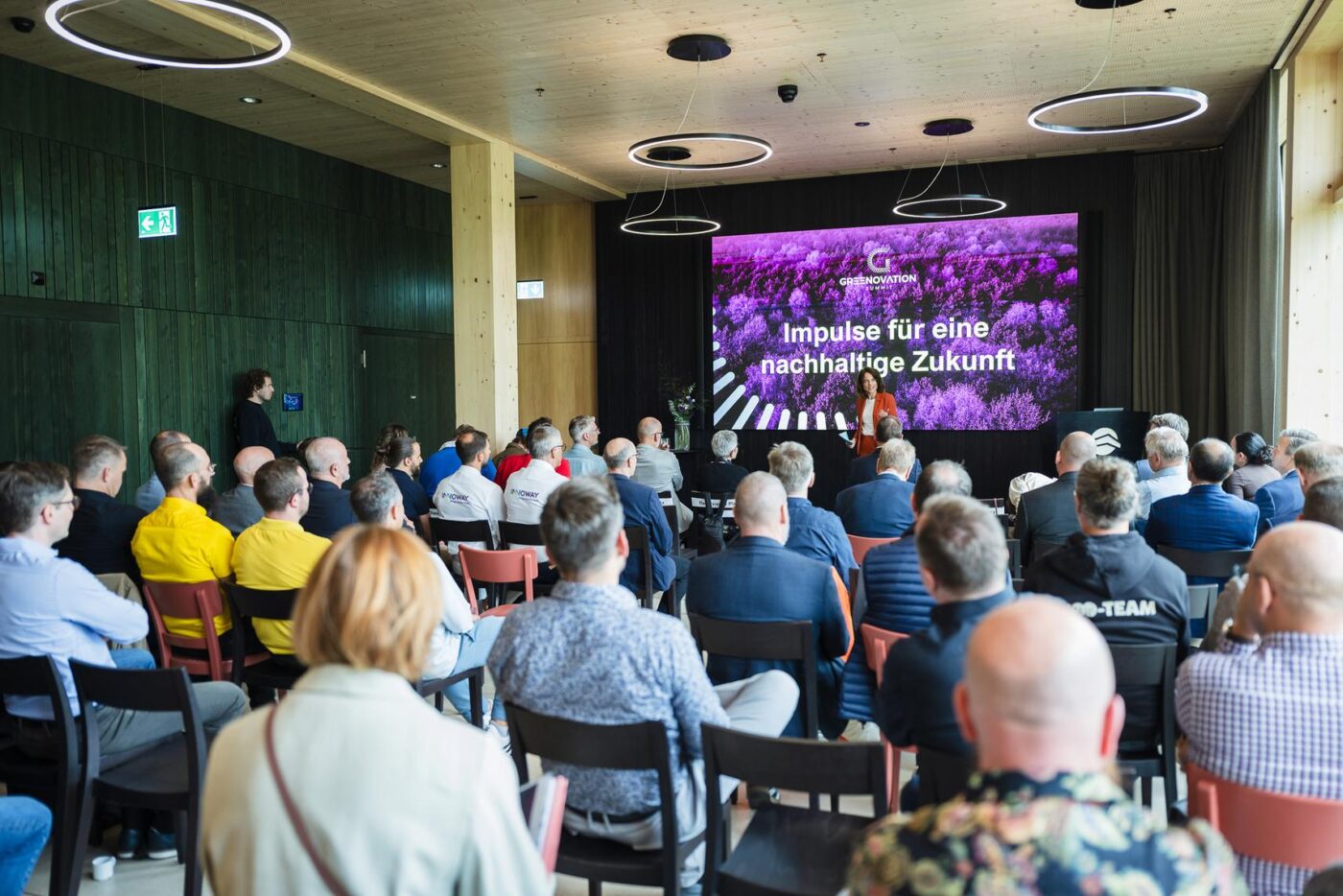
On September 10, 2026, the business community of Eastern Switzerland gathered at the timber construction pioneer Blumer Lehmann in Gossau for the 3rd Greenovation Summit. Various presentations highlighted ways to effectively implement sustainability. A highlight of the networking event was the presentation of the Greenovation Awards. In the three categories—Product, Project, and Organization—companies were honored for demonstrating how active sustainability, regional value creation, and entrepreneurship go hand in hand.
The word «sustainability» has come to sound overused and is now bandied about indiscriminately. Galledia’s third Greenovation Summit took place on Friday, September 10, 2026, at the headquarters of Blumer Lehmann—a leading international timber industry and timber construction company—in Gossau, the summit used concrete examples to explore how companies in Switzerland can implement sustainability—often referred to as «grandchild-friendliness.».
«A Little More Every Year» at Blumer Lehmann
Katharina Lehmann, CEO of Blumer Lehmann, kicked things off. According to Lehmann, wood as a building material can make a significant contribution to decarbonization in the construction industry and, with its many beneficial properties, is very much in vogue. She wants the company to provide positive momentum. When asked for advice for companies, she recommended measuring their own carbon footprint and rising to the challenge. Just as in fitness training, she explained, this allows companies to measure and see their progress—«a little more each year.».
Thanks to Martin Kyburz, a rechargeable battery has four lives
In Switzerland, Swiss Post uses its yellow three-wheeled electric delivery carts to travel throughout the country and deliver mail to mailboxes. This is one of the successes of Martin Kyburz, founder and CEO of Kyburz Switzerland. When a vehicle needs to be taken out of service, it is converted and serves as a practical means of transportation for private individuals. This is only possible because the company focused on intelligent design from the very beginning. Pure materials can be separated, replaced, recycled, or disposed of properly. The batteries from the scooters, which are no longer powerful enough for the road, are then used in new devices to store solar power. In the end, there’s even a fourth life: the components are transformed into small batteries. Martin Kyburz advocates stepping outside one’s comfort zone when it comes to innovation, remaining persistent, and weathering controversy: «Fear blocks thinking.».
Buildings constructed according to ecological principles and designed to store carbon dioxide
The experiences of the host company, Blumer Lehmann, illustrate the momentum behind the buzzword «sustainability.» In his presentation, Markus Rutz, Managing Director of the Wood and Modular Construction Division and a member of the company’s executive board, outlined the company’s approach to projects. Here’s an example: Instead of constructing false ceilings out of solid wood (or concrete), the company built cassette modules into which the clay—generated on-site during excavation—is compacted. This allows the clay to be used directly on-site.
The Portable Toilet Reinvented and Valuable Fertilizer Discovered
Jojo Casanova came up with the idea in India. While working in development cooperation, he helped maintain and empty composting toilets. The result was no waste: Feces are composted over several months—not inside the toilet—at temperatures that kill pathogens. What remains is humus, just like the kind you spread in the garden. Casanova’s Kompotoi requires no water and no sewer system. In 2016, he launched Kompotoi with about 50 toilets on the market. Today, the Winterthur-based company operates about 1,400 of the roughly 30,000 mobile toilets in Switzerland and collects 150 metric tons of solid waste and over 250,000 liters of urine annually.
From Oil-Fired Heaters to Heat Pumps—A Project Facing Obstacles
What do the mayor of Diepoldsau and the mayor of Uzwil have in common, aside from their official positions? They support the statewide «100 in 100» initiative. This initiative means that a municipality aims—with the help of additional funding—to ensure that, within 100 days of the initiative’s launch, fossil-fuel heating systems in 100 homes are replaced with climate-friendly alternatives. There are many obstacles along the way, such as the time it takes to obtain permits, cost considerations, fundamental doubts, and the ability and willingness of local contractors to participate.
Karin Aerni described the challenging undertaking: There had been plenty of concerns from all sides. Lucas Keel from Uzwil, the fifth-largest municipality in the canton of St. Gallen, completed a total of 86 conversions in 100 days, mostly to heat pumps—an impressive result.
Can you hear the signs? Climate change has arrived in Switzerland
Speaker Gianina Viglino-Caviezel, co-founder and CEO of Ai-on, provided examples of the local impacts of climate change. She noted that the rise in temperature in Switzerland has actually been twice as high as the global average for years. While it is difficult to measure sustainability efforts, and comparing the results with monetary targets is even more complex, the path to sustainability that achieves an impact can be demonstrated through its effectiveness—and costs can thus also give rise to opportunities. It is important to know what one can and wants to do, and then one can play to one’s strengths. It is not about saving the world, but about making a contribution, no matter how small it may be in the big picture.
It's not about wanting; it's about doing
Behavioral economist Gerhard Fehr of FehrAdvice & Partners explained how climate protection really works. After all, good intentions do not necessarily translate into effective action. What really works? Even though 71 percent of companies have firm intentions, only 4 percent actually make changes. One reason is that 61 percent do not systematically monitor their energy consumption. «And you can’t change what you don’t see.» So it’s not about wanting to, but about doing. Getting feedback is key here: «Feedback beats appeals.» Only those who shape the situation can change behavior. Fehr outlined ways to do this. «Experience instead of explanation»: Once you’ve experienced it, you no longer need an argument. «Show who’s already doing it»: People take their cues from what they see around them. «Default option instead of a call to action»: People choose what’s preset—without pressure, without restrictions.
Three Greenovation Award Winners
In the «Product» category, Reco Systems from St. Gallen won the award for its «Recoloop» system. Pragmatism trumps complexity here: In small and medium-sized businesses, consistent waste separation often fails due to space constraints and fluctuating waste volumes. This is where Recoloop comes in: The Recoflex collection station flexibly adjusts its volume to match the actual flow of recyclables. The full trash bin is picked up, and at the end of the year, the customer receives a detailed report on the recycled materials that were disposed of.
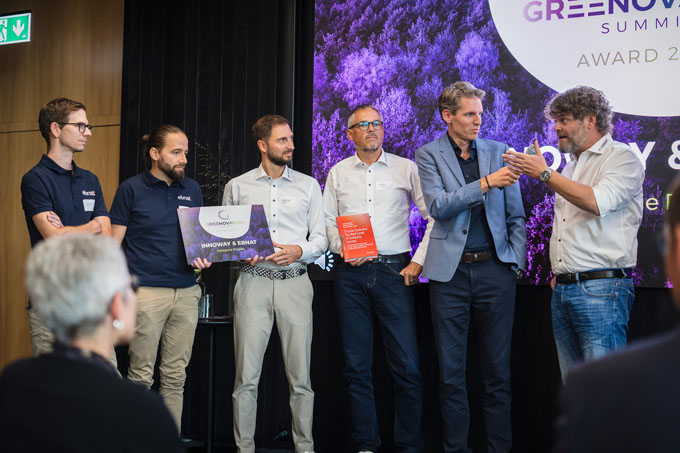
In the «Project» category, partners InnoWay from Eschlikon in Thurgau and Ebnat from Toggenburg demonstrate genuine cooperation and a circular economy based on short supply chains. Instead of purchasing anonymous recycled material on the global market, the two companies use used plastic buckets from the Swiss food service industry. The containers are collected within a radius of just 35 kilometers, processed into high-quality regranulate at InnoPlastics, and then transformed by Ebnat into a new product line of cleaning and household items using precision injection molding.
In the «Organization» category, the trophy went to Gadget Entertainment and OpenAir St. Gallen as pioneers in transparency and accountability. Major events face enormous challenges when it comes to their carbon footprint. With its «Green Gadget» sustainability program, the agency is squarely facing this responsibility head-on.
Initiatives for Sustainable Economic Development
The Greenovation Summit 2026 has once again highlighted the tremendous innovative potential of Eastern Switzerland. Transformation is most successful where regional partners join forces, challenge existing paradigms, and view sustainability not as a mandatory exercise but as an opportunity.
The Greenovation Summit is Eastern Switzerland’s conference on sustainable and innovative entrepreneurship. The event brings together decision-makers from SMEs, startups, and established companies and provides a platform for inspiration, knowledge sharing, and networking. The focus is on concrete, real-world experiences and solutions that directly help companies move forward.
Source: www.greenovation-summit.ch