From suitability for grandchildren to digital models
On October 23, 2025, the second Greenovation Summit, a sustainability conference for decision-makers from SMEs in Eastern Switzerland, took place at the Cubic Innovation Center of Bühler AG in Uzwil.





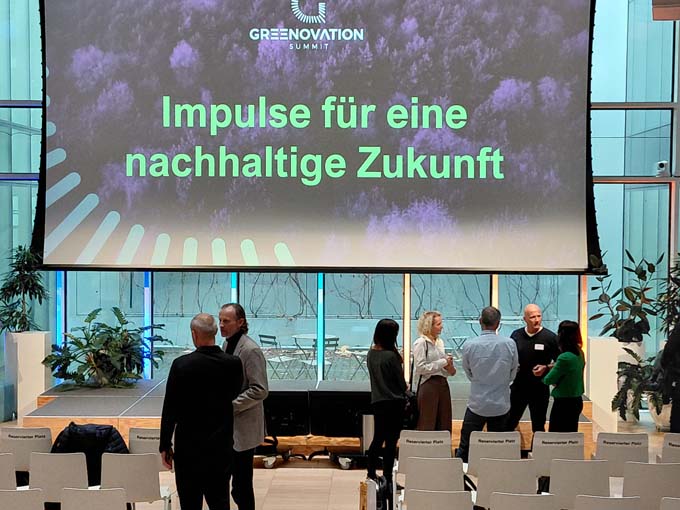
For the second Greenovation Summit, the organizers were once again able to count on Bühler AG's hospitality. Naturally, it was CEO Stefan Scheiber who got the guests in the mood for the conference. In his opening address, he looked back on a «stormy summer»: on the one hand, the death of patron Urs Bühler had to be mourned and the tariff increases for exports to the USA had to be acknowledged. On the other hand, the company was also able to celebrate the successful performance of apprentices at SwissSkills. Despite headwinds in terms of sustainability, Bühler, as the global market leader in grain processing, wants to continue to take responsibility for climate protection and innovation, as Stefan Scheiber emphasized.
Managing for grandchildren
The program then began with a presentation by Pascal Loepfe-Brügger, CEO of Appenzeller Alpenbitter AG. He replaced the term «sustainability» with «suitability for grandchildren». Because for him, responsible business means acting in a long-term and intergenerational manner. «For us, a quarter has 25 years, not three months,» says Loepfe-Brügger. With projects such as a new high-bay warehouse made from the company's own wood, which massively reduces transport routes, and a stable financial policy, he showed how ecological, social and economic thinking work together. Even during the pandemic, employees have been retained and trust has been strengthened - values that remain central to Loepfe-Brügger.
Marc Stoffel from 42 Hacks AG then presented innovative approaches to sustainable mobility. The start-up, which is organized as a cooperative, develops data-based solutions to optimize commuter traffic and enable companies such as Bühler and Stadler to achieve climate-friendly mobility. Artificial intelligence analyzes movement data and shows how commutes can be made more efficient and environmentally friendly. The data shows that only a few large employers are responsible for the majority of commuter traffic. They therefore have a particularly large leverage effect when it comes to reducing traffic.

Innovation for a greener future
In the Breakout Sessions experts presented practical ideas: Ina Walthert from AMAG explained the automotive company's path to climate neutrality by 2040, including through photovoltaics, battery recycling and bidirectional charging. Christian Locher from OST University of Applied Sciences promoted «Design for Sustainability» - a concept based on functional simplicity rather than short-lived styling. Martin Bachofner from the Pestalozzi Children's Foundation warned that social sustainability should not be neglected: Education and personal responsibility are key to a fair future.
In the second part of the presentation, Sascha Rohner from FrugalTec AG presented a resource-saving solution to the looming global food crisis with his vertical farming concept. Modular, recyclable systems are designed to save water, energy and space - true to the motto: «Create more value with fewer resources.» He drew a comparison: 8500 plants grown with vertical farming require around 17,000 liters of water per year and 20 m2 of space. Cultivated conventionally, these plants would require around 700 m2 of space and use 170,000 liters of water per year. Despite the obvious advantages of vertical farming, Sascha Rohner says it is currently difficult to find investors to scale the business effectively.
Finally, Andrea Riege, co-founder of AI-COM.ch, gave insights into the future of the AI-supported creative industry. Her example of a digital model illustrated how artificial intelligence is increasingly merging real work and digital identities. It is now possible to create a «digital twin» of a real model that can be used anywhere in the world for realistic fashion shoots. According to Andrea Riege, the computing power required for this is also ecologically disproportionate to the cost of a «real» shoot.
Greenovation Award as the final point
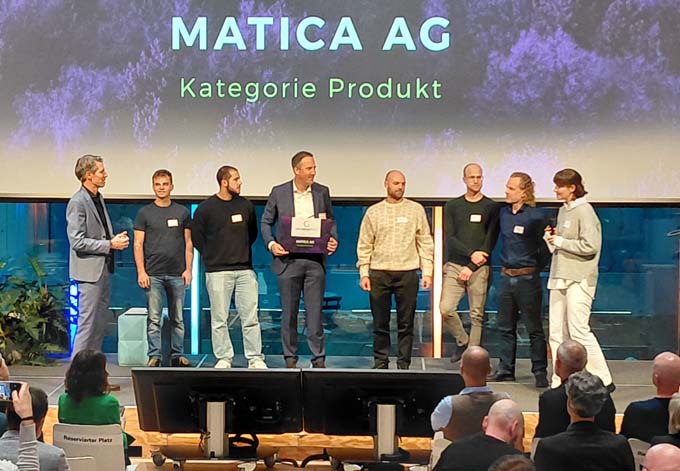
The Summit ended with the presentation of the Greenovation Awards to particularly innovative companies. The awards went to Matica AG for the development of a Storage solution for solar energy («Products» category), Skat Consulting in the «Services» category and the aforementioned 42 Hacks in the «Projects» category. Both the organizer Galledia Event AG and moderator Mona Vetsch emphasized the practical nature of the event: the aim was not only to inspire, but also to implement concrete ideas for a grandchildren-friendly economy and a future worth living.
More information: Greenovation Summit