2025 start-up balance sheet: More new companies than ever before – but also more bankruptcies
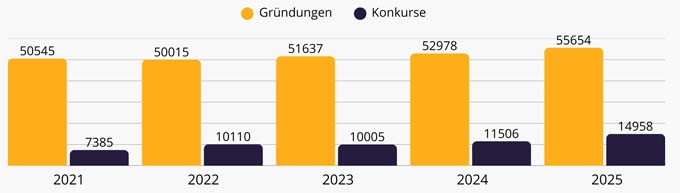
In 2025, Switzerland is showing exceptionally high business momentum. A total of 55,654 new companies were founded – at the same time, the number of bankruptcies rose significantly, with a change in the law considered to be the main driver.






Last year saw more companies founded in Switzerland than ever before: 55,654 new companies were registered in Switzerland in 2025, exceeding the record level of 2024 by 5.1 percent. These figures were presented by the Institute for Young Entrepreneurs (IFJ) in its annual report. According to the IFJ, this figure is 34.7 percent higher than ten years ago – an indication of a sustained high level of entrepreneurial activity. The IFJ's analysis describes this development as an expression of a ’vibrant economy„ in which renewal and structural change are taking place in parallel.
Industries and regions: Where companies are being founded—and where they are not
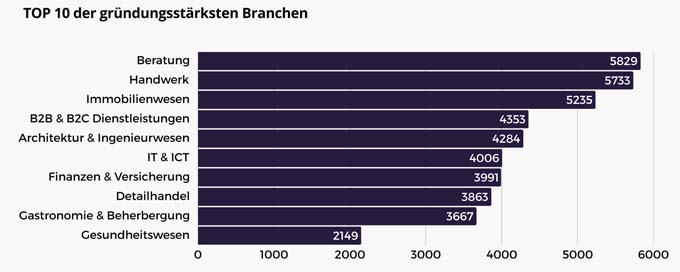
In 2025, most new businesses were in the consulting (5,829), skilled trades (5,733), and real estate (5,235) sectors. These were followed by B2B/B2C services (4,353) and architecture/engineering (4,284), while IT/ICT (3,991) and finance/insurance (3,863) were also among the sectors with high start-up rates.
Regionally, start-up activity grew most strongly in Central Switzerland (+13.3 percent), followed by Zurich (+5.7 percent) and Northwestern Switzerland (+5.6 percent). Ticino was the only major region to record a decline (-2.5 percent). At the cantonal level, Zug (+19.0 percent), Appenzell Innerrhoden (+17.1 percent), and Obwalden (+16.9 percent) were the clear winners, while Uri (-13.5 percent), Glarus (-8.5 percent), and Appenzell Ausserrhoden (-7.5 percent) were among the worst performers.
Start-ups vs. bankruptcies: two records, one pattern
However, the founding balance sheet for 2025 is clouded by rising insolvency figures. The IFJ analysis shows a total of 14,958 bankruptcies for 2025 (11,915 of which are due to insolvency proceedings and 3,043 due to organizational deficiencies, according to figures from the Creditreform creditors’ association). At the same time, the IFJ also points out that the marked increase is largely due to a change in the law as of January 1, 2025, which means that public creditors must also pursue bankruptcy more consistently.
An analysis by Dun & Bradstreet comes to a similar conclusion. From January to the end of November 2025, it counted 8,343 insolvency proceedings opened against registered companies – an increase of 50 percent over the previous year. The analysis shows that bankruptcies rose particularly sharply in Central Switzerland (+61 percent), the Espace Mittelland region (+56 percent), and Ticino (+52 percent). In terms of sectors, IT (+73 percent), business services (+71 percent), and holding/investment companies (+70 percent) were particularly affected. Dun & Bradstreet identifies the main cause as the aforementioned change in the law.
Outlook: Robust – but under pressure
Both analyses suggest that Switzerland will experience both an entrepreneurial spirit and accelerated consolidation in 2025: many start-ups will face stricter enforcement of outstanding claims and increasing pressure to adapt. According to Dun & Bradstreet, this will increase pressure on companies in the short term, but in the long term, the reform should contribute to greater transparency and fairer competitive conditions. The IFJ does not view the parallelism of high start-up and bankruptcy figures as a contradiction, but rather as a sign of adaptability—reliable framework conditions remain crucial in order to turn many start-ups into sustainable companies.
Sources: IInstitute for Young Entrepreneurs IFJ / Dun & Bradstreet