Global country risks fall despite intense trade tensions
The credit insurer Allianz Trade has published its Country Risk Atlas for the third time. It assesses the economic prospects, risks and opportunities in 83 countries.


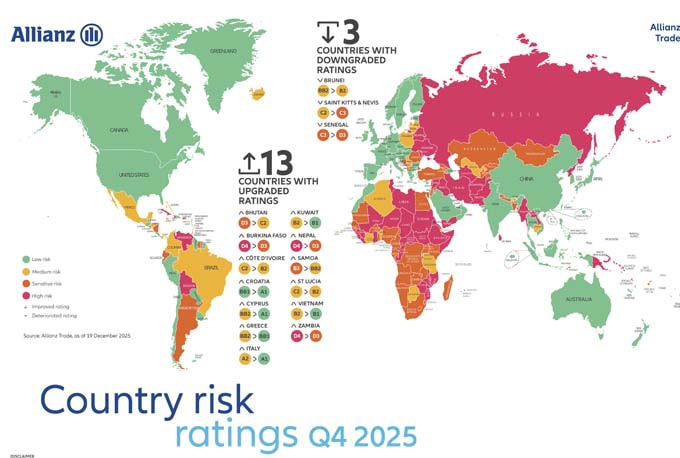
In its new Country Risk Atlas, Allianz Trade notes an easing of the global risk environment - despite high geopolitical tensions and trade conflicts. In 2025, 36 countries were upgraded, while only 14 were downgraded; the positive trend is therefore weaker than in the previous year, but remains intact. The winners include Argentina, Ecuador, Hungary, Italy, Spain, Turkey and Vietnam, whose improved ratings are primarily attributed to more robust macroeconomic fundamentals and supportive fiscal and monetary policies. In many emerging markets, better financing conditions, stronger currencies and higher commodity prices allowed for an easing of transfer and convertibility restrictions, while in Europe and the Asia-Pacific region, falling inflation, more stable policies and better trade balances increased resilience.
Tripling of downgrades compared to 2024
At the same time, the broad improvement masks considerable medium-term risks, particularly because the number of downgrades has almost tripled compared to 2024. The downgrades of France, Belgium and the USA, which are now each rated A1 and together represent a significant part of the global economy, are particularly significant. The risk there is still considered low, but the deterioration signals structural vulnerabilities - from strained public finances and current account deficits to a challenging medium-term macroeconomic environment. Allianz Head of Trade Aylin Somersan Coqui warns of risk clusters in large economies that account for around a third of global GDP, many times more than those countries where the outlook has improved.
Switzerland with low country risk
Switzerland has maintained its AA rating in this environment and thus remains a location with low country risk. Following a recovery in 2024 with growth of 1.4%, uncertainty over US trade policy and weaker investment were the main factors holding back growth in 2025, while a reduction in newly introduced US tariffs on Swiss goods negotiated in mid-November stabilized the outlook towards the end of the year. GDP grew by around 1.23% in 2025, driven by export-related pull-forward effects, but held back by subdued investment activity and subdued consumer sentiment; private consumption remained the mainstay, while government consumption is likely to grow only moderately due to austerity constraints. For 2026 and 2027, Allianz Trade expects growth of 1.4% and 1.6% respectively, while corporate insolvencies remain high: following an increase of 18% in 2024, insolvencies continued to rise in 2025 and are only expected to fall by 6% and 11% respectively in 2026 and 2027.
Meanwhile, inflation in Switzerland remains well below the SNB's target value. In 2024, it amounted to 1.1%, dampened by the strong franc and lower energy prices; in 2025, inflation was practically zero at 0.2%, supported by cheaper imports, low energy prices and lower rent increases. For 2026, Allianz Trade expects an inflation rate of 0.4% and a moderate increase to 0.7% in 2027, while the strong franc and low energy prices continue to have a disinflationary effect and the SNB is likely to leave its key interest rate at 0% throughout the forecast period.
Ambivalent picture for companies
From the companies' point of view, this creates an ambivalent picture: on the one hand, they are benefiting from an overall decline in country risks and more robust framework conditions in many markets, while on the other hand, the accumulation of downgrades in large economies is forcing them to take a much more selective, country-specific approach to risk management. Allianz Trade advocates a forward-looking approach that goes beyond the rating headline and continuously monitors transfer and convertibility risks, fiscal developments and trade policy risks in particular in order to identify turning points at an early stage and protect assets.
Source: Alliance Trade
This article originally appeared on m-q.ch - https://www.m-q.ch/de/globale-laenderrisiken-sinken-trotz-intensiver-handelsspannungen/