Transformation in Swiss companies: too slow and not consistent enough
Over 60 percent of Swiss companies feel that their own transformation is too slow. A new study by Lucerne University of Applied Sciences and Arts shows: Generative AI has arrived in everyday working life, but measurable economic added value is still lacking for most.






Business transformation remains a highly relevant topic for Swiss companies. Technological change, changing customer needs, economic pressure, geopolitical tensions and new regulatory requirements often have a simultaneous impact on companies. However, when it comes to practical implementation, many fall short of their own requirements - as shown by the new Business Transformation Survey 2.0 from Lucerne University of Applied Sciences and Arts, for which almost 400 decision-makers from Swiss companies in various sectors and of various sizes were surveyed.
Implementation remains the biggest challenge
For the majority of respondents, the transformation is not progressing fast enough. «Companies want change, but many are not implementing it with the necessary speed and consistency,» says study author Jan Schlüchter. Although transformation initiatives are launched, there is often a lack of clear responsibilities, sufficient resources and consistent progress measurement and control. Many companies get stuck in individual initiatives or pilot projects without systematically scaling them up.
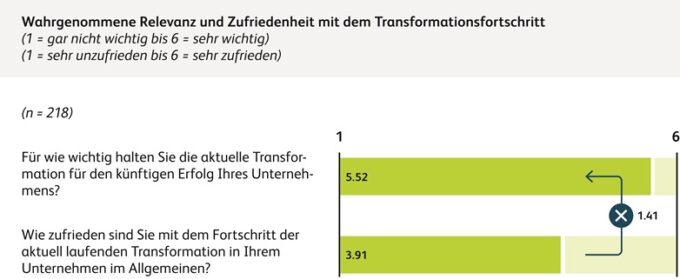
Compared to the first survey from 2022, the gap between companies has widened further. «The differences are particularly evident in leadership, communicative support, learning ability and the sustainable anchoring of changes,» says Schlüchter.
Generative AI: employees are further ahead than their organization
Generative AI is clearly gaining in importance as an additional impetus for transformation - due to delivery bottlenecks as well as efficiency and performance pressure. It has already become part of everyday working life in many companies. At the same time, the study shows that many companies are not yet able to achieve measurable economic added value from it. «Many employees are more advanced in dealing with generative AI than their organization. The ability of companies to implement generative AI in concrete applications, processes and value creation is lagging behind,» says Schlüchter.
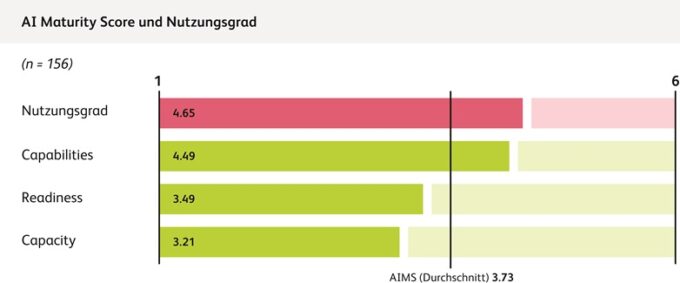
According to respondents, companies can be categorized as «beginners» or «explorers» in terms of their AI maturity; only a few are «AI champions» so far. The more advanced a company is in terms of generative AI, the higher the perceived goal achievement of the transformation.
AI in procurement: strategically planned, operationally only implemented to a limited extent
The gap is particularly clear in purchasing. A supplementary survey of 74 procurement experts - mainly from the manufacturing and retail sectors - shows that the motivation to use AI is high: The motivation to use AI in procurement is high. AI is seen as an opportunity to further develop the role of procurement into a strategic value driver by making potential and alternatives in the procurement market visible, identifying risks earlier and creating more transparency along the supply chain. However, a lack of expertise, limited resources and unclear responsibilities make consistent integration into existing processes difficult. «The bottleneck is therefore not in the will, but in the organizational capability and scaling,» says Jan Schlüchter.
It's not the technology, but the leadership that counts
The study makes it clear that it is not the companies with the greatest awareness of the problem that transform successfully, but those that manage, implement and anchor change more consistently. «Transformation is not a collection of individual projects, but a management task that must be consistently managed and anchored in the organization,» says Schlüchter.
This leads to a clear conclusion for managers: it is not the availability of new technologies that determines success, but the ability to translate them into sustainable value creation. The study identifies ten specific recommendations for action. The strongest levers lie in visible and decisive leadership, clear shared orientation, open communication about progress, regular measurement and a culture that allows learning and failure as part of development.
The study was conducted by the Institute of Business and Regional Economics (IBR) at the Lucerne School of Business as part of an Innocheck project together with Efexcon and in collaboration with procure.ch.
Further information on the study and the Lucerne University of Applied Sciences and Arts: www.hslu.ch