Bitcoin and Others: Nearly One in Five People in Switzerland Owns Cryptocurrency
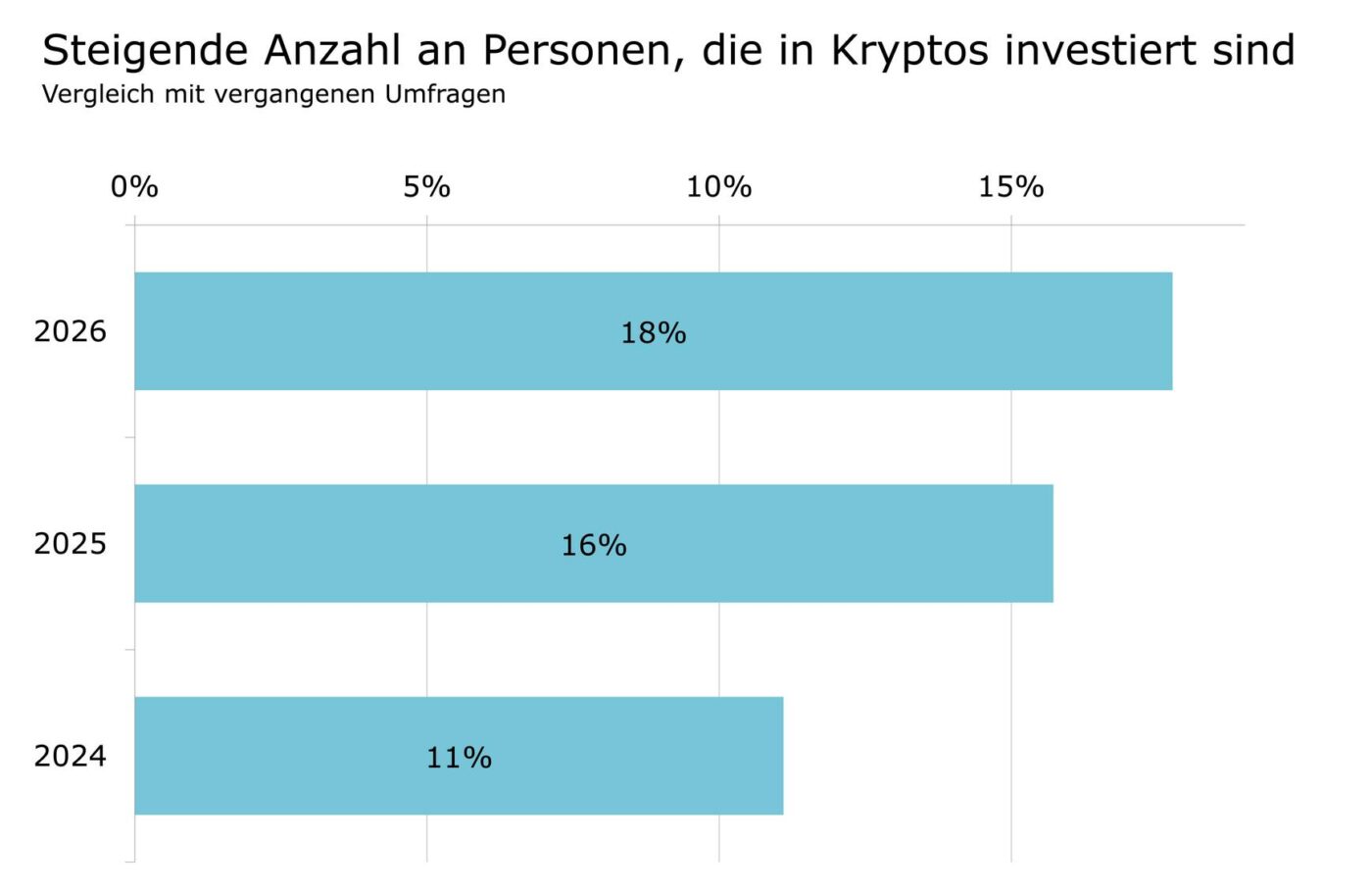
Cryptocurrency investments have become significantly more widespread in Switzerland: About 18 percent of the population currently holds Bitcoin and other cryptocurrencies—two percentage points more than last year. This is shown by a new study from the Lucerne University of Applied Sciences and Arts, conducted in collaboration with Luzerner Kantonalbank.






Crypto investments are no longer a niche topic in Switzerland. According to a new study by the Zug Institute for Financial Services (IFZ) at the Lucerne University of Applied Sciences and Arts, conducted in collaboration with Luzerner Kantonalbank, approximately 18 percent of respondents currently hold crypto investments such as Bitcoin —two percentage points more than the previous year and significantly higher than the figure from 2024, when it stood at 11 percent. Extrapolated, this means that approximately 140,000 investors joined the market last year. The study is based on a representative survey of 1,772 people aged 18 and older from German-, French-, and Italian-speaking Switzerland.
Once you invest, you stick with it
Despite this growth, 70 percent of respondents consider it unlikely that they will start or resume investing in the next two years, or rule it out entirely. However, those who are already invested in crypto think differently: «Just under 60 percent of this group can imagine making additional crypto investments in the next two years,» says study director Prof. Dr. Andreas Dietrich. Past experience has proven to be by far the strongest indicator of future investments—more so than age, gender, or income, and this holds true across all generations.
Trust Beats Price
Crypto investors want solutions that are affordable, functional, and intuitive to use. When making specific investment decisions, however, they place greater weight on the provider than on the price. A decision-making experiment using randomly varied portfolio profiles shows that doubling the annual fee from 0.6 to 1.2 percent has virtually no impact on the decision. What matters far more is who is offering the investment: respondents would invest a median of 31 percent of a hypothetical profit with a cantonal bank, but only 21 percent with a pure crypto platform. «Crypto investments are thus perceived less as an exotic niche topic and more as a mainstream financial product with high expectations for security, efficiency, and user-friendliness. And when it comes to this investment decision, trust trumps price,» says Dr. Patric A. Huber, co-author of the study.
Significant Interest in Advisory Services Among Banks
This presents an opportunity for financial institutions: 15 percent of respondents said they would be somewhat or very likely to seek crypto advice from their own bank. Extrapolated to the Swiss population, this corresponds to several hundred thousand to about one million people. Interest is unevenly distributed: at 27 percent among Generation Z and 21 percent among millennials, it is significantly higher than among older generations. Of those currently investing, a good third would take advantage of such advice. For non-investors, a lack of knowledge is the main factor holding them back from getting started—just over half of those who have never invested say they know too little about the subject.
Many are jumping in at the wrong time
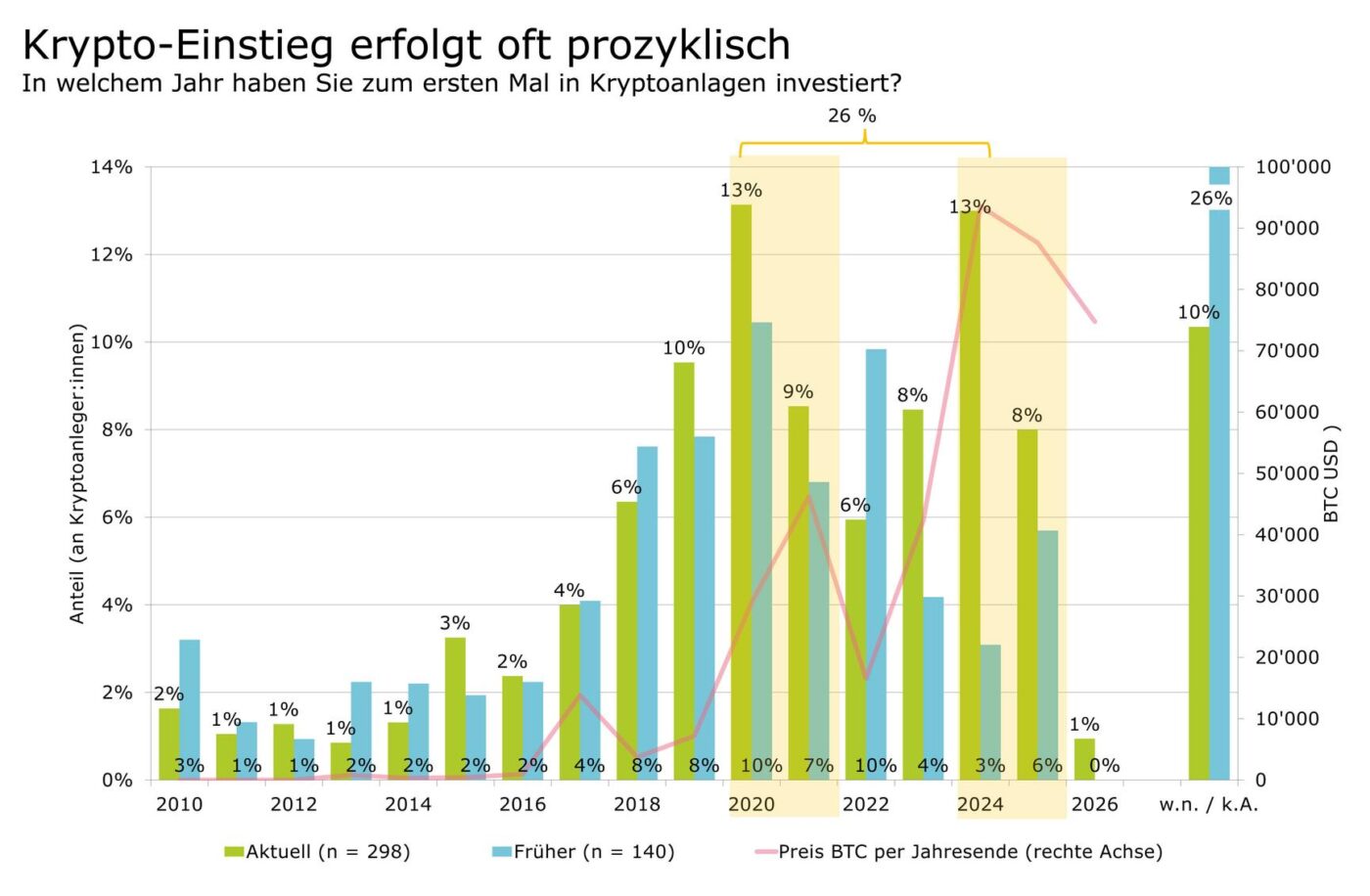
Market cycles have a significant impact on crypto investment behavior in Switzerland. New investments tend to be concentrated during periods of sharp increases in the Bitcoin price, such as during the bull market of 2020 and 2021 or the ETF-driven rally of 2024 and 2025. As a result, entry into the market is often procyclical—when prices are already rising and public attention is high—while countercyclical entries during periods of weakness are rare. This increases the risk of unfavorable entry points and subsequent losses. Current investors report profits 57 percent of the time, compared to 43 percent among former investors. This points to what is known as “survivorship bias”: those who were successful remain invested; those who incurred losses are more likely to exit the market.
Blockchain Research at Lucerne University of Applied Sciences and Arts
Cryptocurrencies such as Bitcoin are based on blockchain, a decentralized digital technology for storing and transferring value. The Lucerne University of Applied Sciences and Arts is researching this technology beyond the investment perspective. Together with the University of Lucerne, it has been part of the Blockchain Zug – Joint Research Initiative since 2024. The canton of Zug is contributing a total of 39.35 million Swiss francs toward the initiative’s start-up costs over a five-year period. The goal is to make Zug a world-leading center for blockchain research.
Source: www.hslu.ch