100 Years of the Swiss MEM Industry: Resilience Despite Ongoing Crises
A new study by Swissmechanic and Bak Economics traces a century of industrial history in Switzerland’s machinery, electrical, and metalworking industry for the first time. The conclusion: Despite global economic crises, Swiss franc shocks, and pandemics, the MEM sector has more than septupled its real value added since 1925—yet the challenges facing SMEs are becoming more complex.






The Great Depression, two world wars, oil shocks, the financial crisis, the Swiss franc shock, a pandemic, and geopolitical tensions: Hardly any other industry has faced crises as regularly over the past 100 years as the Swiss mechanical, electrical, and metalworking industry (MEM). Nevertheless, it remains one of the cornerstones of Switzerland as an industrial hub. This is the conclusion reached by a new study by Swissmechanic and Bak Economics, which comprehensively analyzes a century of industrial history for the first time.
Sevenfold increase in value over 100 years
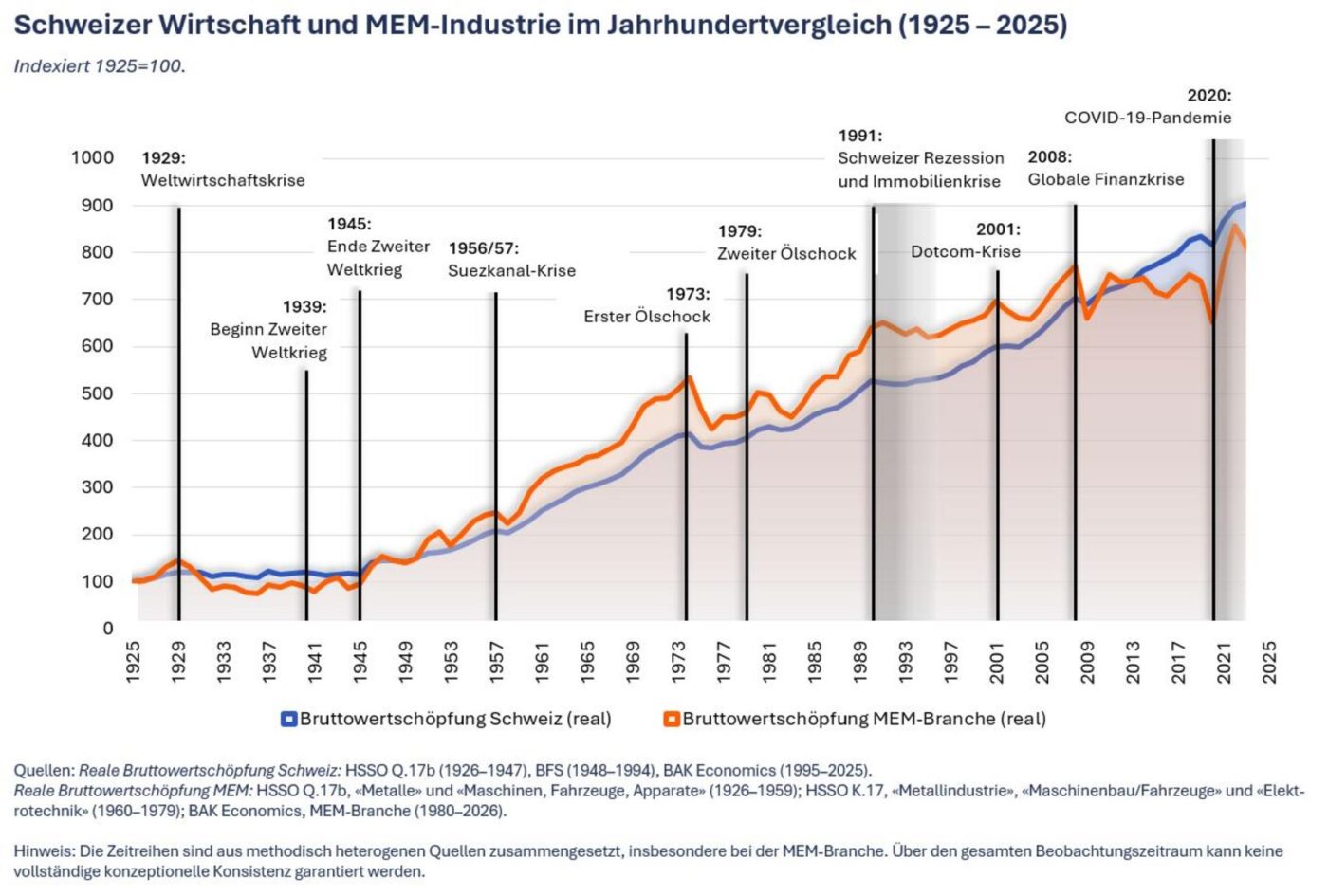
A historical analysis shows that, despite numerous economic and political crises, the Swiss MEM industry has increased its real value added more than sevenfold since 1925. Today, the MEM sector contributes an average of about 7 percent to Switzerland’s GDP, employs about 7 percent of the country’s workforce, and accounts for a significant portion of the country’s goods exports, with an export share of just over 24 percent (2025). As recently as 1990, this share stood at 44 percent—since then, the chemical and pharmaceutical industry has replaced the MEM sector as the leading exporter and now accounts for 53 percent of goods exports.
The data thus paint a more nuanced picture than the frequently cited argument about a general decline in the industry. Rather, the study demonstrates the industry’s extraordinary adaptability across generations.
From the Postwar Boom to the Franc Shock
Looking back over 100 years reveals a pattern of recurring shocks followed by recoveries. When the data series begins in 1925, Switzerland was in a phase of cautious consolidation following World War I. The MEM sector initially grew rapidly but was then hit hard by the Great Depression of 1929: Between 1929 and 1932, real MEM value added plummeted by nearly 40 percent—about six times more sharply than the economy as a whole. The end of the war in 1945 brought a remarkable rebound: Value added rose by just under 40 percent in 1946, driven by an industry spared by the war that served European demand, which was further fueled by the American Marshall Plan beginning in 1948.
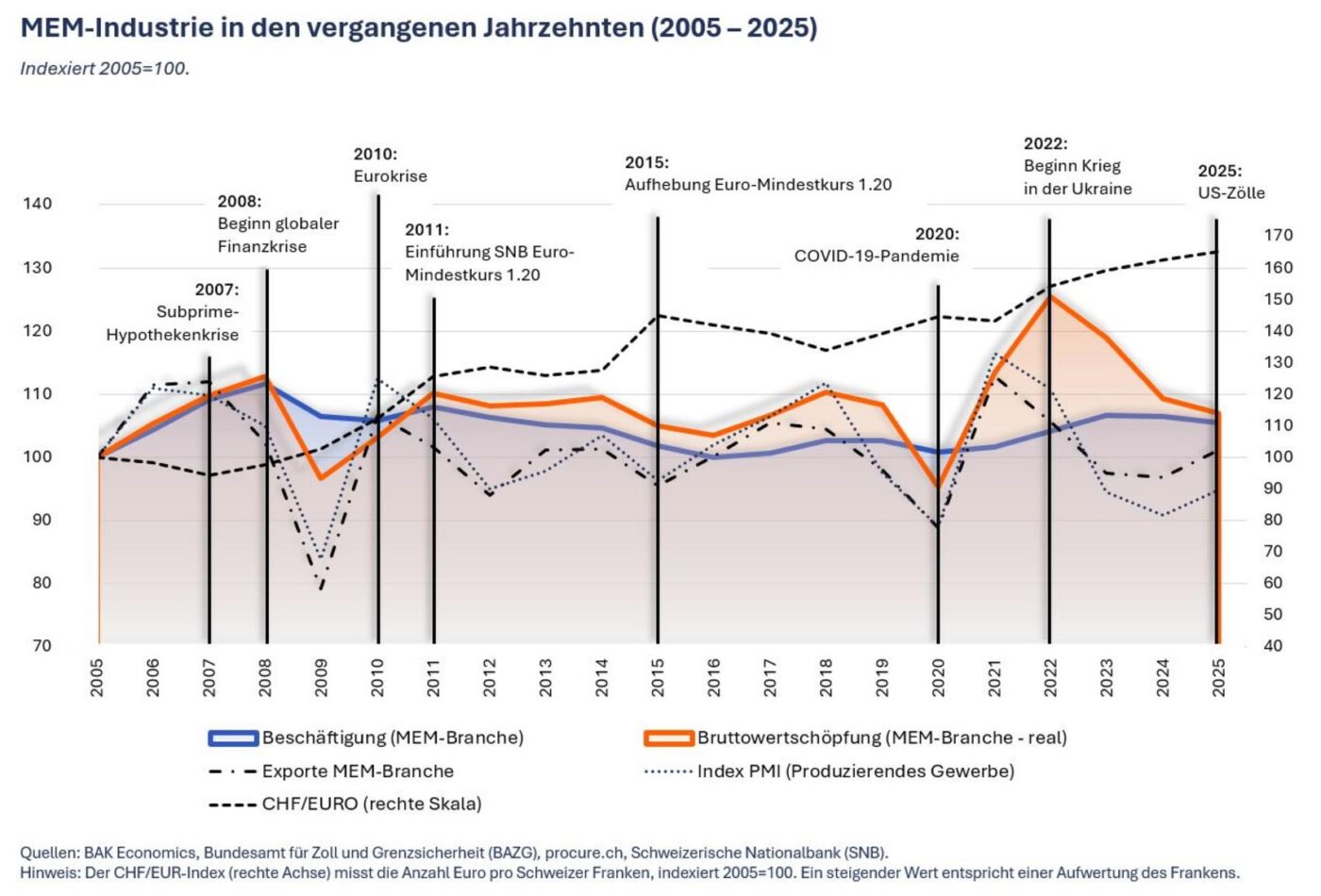
The postwar decades up to 1974 were the golden years of Swiss industry. The first oil shock in 1973 brought the euphoria of growth to an abrupt end, followed by a recession in 1975 that saw value added in the MEM sector decline by about 13 percent. In the 1990s, the Swiss real estate crisis hit the industry once again. The global financial crisis of 2009 brought the fifth-largest slump of the entire observation period: a 14 percent decline in real value added and a 20 percent drop in exports. The Swiss franc shock of 2015—the Swiss National Bank’s surprise removal of the minimum exchange rate against the euro—put the export-oriented industry under immediate margin pressure.
Short-time work as a proven safety net
A recurring pattern over the past two decades: Employment has proven to be the most structurally stable indicator. While value added and exports plummet sharply in times of crisis, workforce reductions remain comparatively moderate. The reason for this is the short-time work program, which played a decisive role in retaining skilled workers in companies—and thus laying the foundation for rapid recoveries—during both the 2009 financial crisis and the 2020 COVID-19 pandemic. Thus, while MEM value added plummeted by 12 percent in 2020, employment fell by only 2 percent. The rebound in 2021 was correspondingly strong: a 19 percent increase in real value added.
SMEs Under Structural Pressure
At the same time, the trend did not unfold the same way for all companies. The study reveals a significant structural shift within the MEM industry: Larger companies were better able to hold their ground over longer periods, while SMEs in particular faced greater pressure to adapt and compete. Between 2013 and 2023, the total number of companies in the MEM sector declined by about 8 percent. Micro-enterprises with fewer than 10 employees saw a decline of about 10 percent, while small enterprises with 10 to 49 employees saw a decline of about 6 percent. Medium-sized and large companies, on the other hand, have grown.
The economic barometer, compiled quarterly by Swissmechanic and Bak Economics, also shows that since 2023, the lack of orders has become the dominant concern for MEM SMEs. At the same time, persistent margin pressure is eroding investment opportunities: A large majority of companies reporting financial constraints on future investments cite a lack of equity capital as the main reason. If necessary investments are not made, this not only jeopardizes the company’s long-term viability but also complicates business succession.
Challenges are becoming more complex
While companies in the past usually had to respond to individual crises, today various stress factors are at play simultaneously. Exchange rates, energy prices, geopolitical uncertainties, a shortage of skilled workers, and a tight order situation are increasing the complexity, particularly for small and medium-sized enterprises. The U.S. tariffs imposed in April 2025, which abruptly raised the cost of doing business in the American market, are further exacerbating the weakness in demand.
«The Swiss MEM industry has proven its strength time and again. The decisive factor has never been the absence of crises, but rather the ability to continually adapt to new conditions,» says Erich Sannemann, director of Swissmechanic. For the association, the study is therefore much more than a historical retrospective: «The challenges are changing. That is why an industry association must also continue to evolve. Our task is not only to guide companies but also to represent their interests in an even more targeted manner and to support them effectively in an increasingly complex environment.»
To ensure that the Swiss MEM industry remains competitive in the future, reliable framework conditions are needed: guaranteed market access, a competitive energy policy, minimal regulatory burdens, and planning certainty for companies.
Source: www.swissmechanic.ch