Swissmechanic Economic Barometer: Economy Is Picking Up—Skilled Labor Shortage Persists
Swiss MEM SMEs are showing the first positive signs of economic recovery: The business climate index has reached its highest level since spring 2024, and capacity utilization is back to its long-term average. At the same time, the shortage of skilled workers is once again coming into focus—and vocational training is gaining importance as a strategic tool.






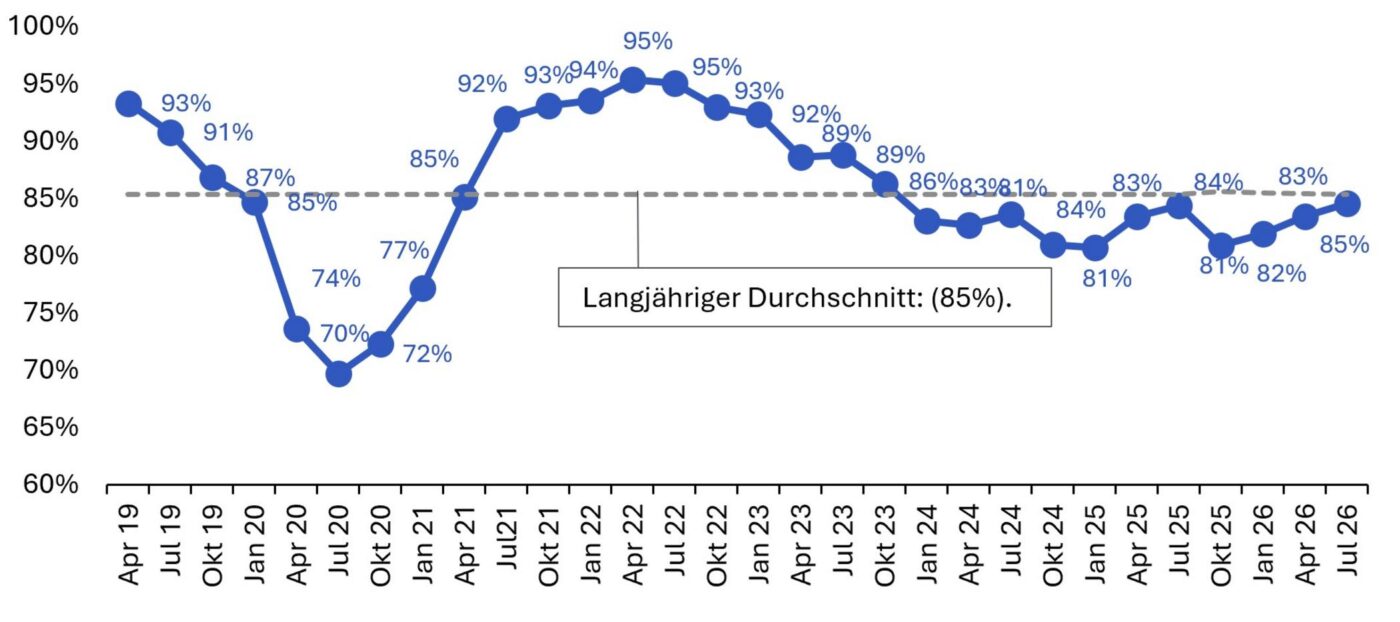
The economic situation for Swiss mechanical engineering, electrical, and metalworking SMEs (MEM SMEs) improved slightly in the second quarter of 2026. The Swissmechanic Business Climate Index rose to around minus 20 points, reaching its highest level since spring 2024. Exports are also growing for the fourth consecutive quarter, capacity utilization has returned to its long-term average of 85 percent for the first time since the end of 2023, and the use of short-time work has fallen to a low of just 9 percent. Nevertheless, about two-thirds of companies continue to assess their business situation as somewhat or very unfavorable.
Recovery in Order Intake and Revenue
Looking back at the second quarter of 2026, a noticeable recovery in order intake became apparent: About 38 percent of companies reported an increase in order intake compared to the previous year—a significantly higher figure than in previous quarters. More than one-third of companies also reported an increase in revenue. Such a high proportion was last recorded in the first quarter of 2023. The Purchasing Managers’ Index (PMI) has been above the expansion threshold since March 2026 and remained there in July at 53 points—a significant signal of a possible trend reversal after more than three years in contractionary territory.
However, EBIT margins remained under pressure at a significant number of companies: About four in ten companies reported a decline in margins in the second quarter of 2026 compared with the same quarter of the previous year, while just over one in five companies saw an improvement.
«Our companies are once again demonstrating their resilience,» says Nicola Tettamanti, president of Swissmechanic. «The initial positive signs are encouraging. However, a sustainable turnaround requires stable economic policy conditions and reliable prospects for our SMEs.»
Skilled Labor Shortages Are Returning – Order Book Remains the Biggest Concern
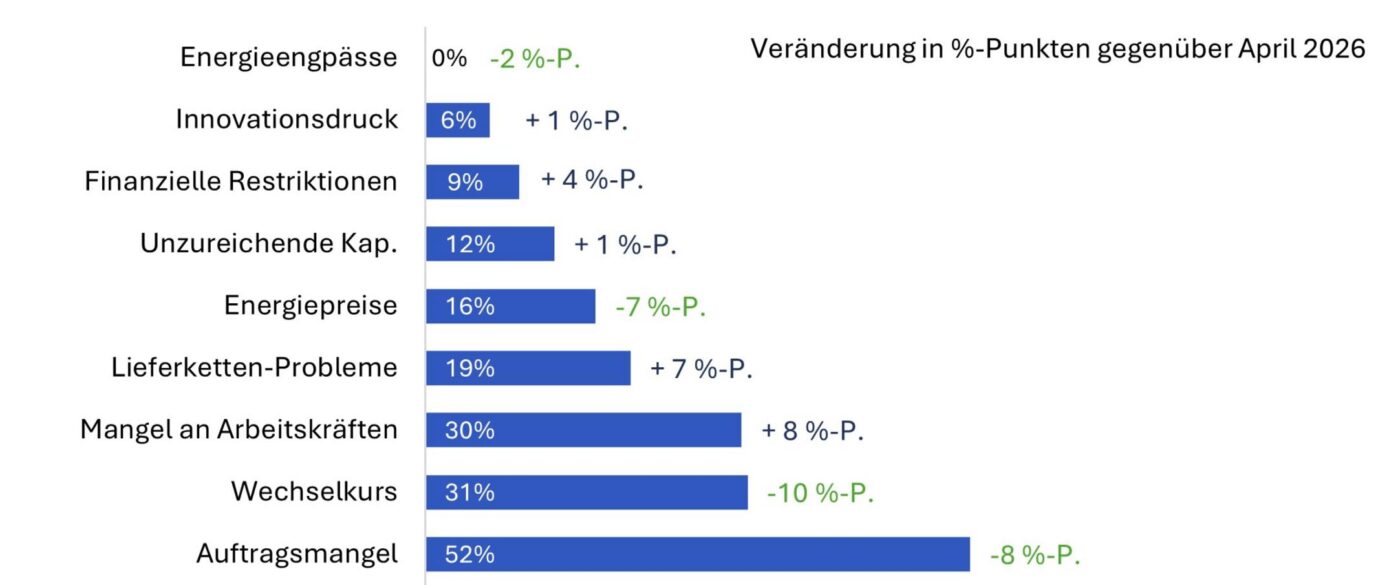
At 52 percent, the order situation remains the biggest challenge for businesses, but its significance has noticeably decreased compared to the previous quarter (–8 percentage points). The return of the skilled labor shortage is striking: At 30 percent—an increase of 8 percentage points compared to April 2026—it is now nearly on par with exchange rate fluctuations (31 percent). Supply chain issues have also increased, while energy prices have again become significantly less of a concern following the sharp rise in the previous quarter.
Erich Sannemann, Director of Swissmechanic, sums it up: «The shortage of skilled workers doesn’t start with open positions. It starts when apprenticeship positions can no longer be filled by the right young people. Those who invest in vocational training today are securing the skilled workers of tomorrow.»
Vocational Training as a Strategic Tool for Securing a Skilled Workforce
For the first time, the Business Barometer addresses the topic of vocational training in MEM SMEs. The results are clear: About two-thirds of the companies surveyed provide training to apprentices. For 37 percent of these companies, apprentices are a central pillar of their human resources strategy; for another 27 percent, they are a relevant but not central component. The motivation is clearly driven by the need to secure a skilled workforce: 88 percent of companies that provide training cite this as the main reason, followed by social responsibility (60 percent) and tradition (24 percent).
The retention rate is quite high: At more than one-third of the companies, over half of the apprentices remain with the company after completing their training, and at about 28 percent of them, nearly all do. At the same time, a good one in five companies reports that less than half of the trainees they have trained remain with the company.
Recruiting suitable apprentices is becoming more difficult
The downside is evident in recruitment: About 73 percent of companies rate the search for suitable apprentices as somewhat or very difficult. Companies cite applicants’ insufficient academic performance (just under 50 percent) and too few applications overall (40 percent) as the biggest hurdles. In open feedback, they also repeatedly point to competition from the high school track: Too many suitable young people are opting for high school or college. Several companies also complain that apprentices quickly transfer to higher vocational schools after completing their training—which not only incurs costs for the training companies but also means that the trained specialists are not retained within the industry.
For the majority of companies, training is an important—but not entirely sufficient—component in meeting their need for skilled workers: 70 percent rate its contribution as “partial,” while just under 17 percent rely primarily on external recruitment. One-third of companies expect an increasing need in the future for skilled workers from their own ranks of apprentices.
Outlook: Stability Prevails, Risks Remain
For the third quarter of 2026, the majority of companies expect orders, revenue, and margins to remain largely unchanged. About three in ten companies anticipate declines in order intake and revenue, while just over one in five expects an increase. On the labor front, a large majority plans to keep headcount steady. The macroeconomic environment remains challenging: The war in Iran is weighing on global energy production and dampening economic growth. BAK Economics forecasts 0.8 percent growth in seasonally and holiday-adjusted Swiss GDP for 2026; a recovery to 1.4 percent is expected for 2027.
Source: www.swissmechanic.ch