Is Europe Falling Behind? A Warning from the Field
Economic advisor Jane Enny van Lambalgen warns that Europe is falling further and further behind the U.S. She cites the high public-sector share of the economy and the ever-increasing regulatory burden as the main causes. She calls for a regulatory reset in Europe and a renaissance of entrepreneurship.


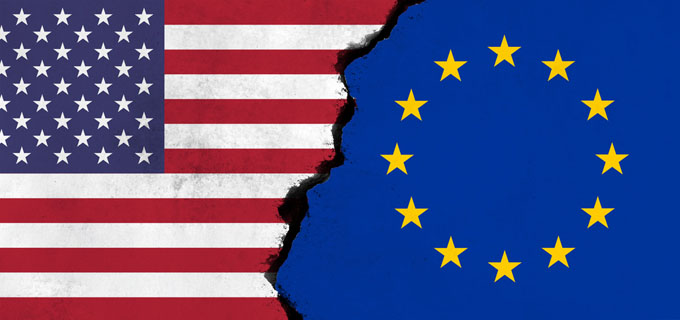
«The economic and technological gap between Europe and the U.S. is continuing to widen,» warns Jane Enny van Lambalgen, CEO of the consulting and management firm Planet Industrial Excellence. She says the continent’s dwindling economic power will have a massive impact on the well-being of the European population. «We are in the process of squandering the future of our children and our children’s children.»
Only four European tech giants rank among the top 50 worldwide
Van Lambalgen cites the Draghi Report on European competitiveness: Only four of the world’s 50 largest technology companies are based in Europe. As positive examples, she mentions ASML—without whose EUV technology no modern semiconductor factory can operate— SAP, whose software is used by 99 of the world’s 100 largest companies; Spotify, with over 777 million monthly active users; and Schneider Electric, the global market leader in energy management with a 40 percent penetration rate among Fortune 500 companies.
But these examples remain exceptions. «Over the past ten years, not a single company in Europe has emerged that has risen to become a market-dominating global player, whereas in the U.S. during that same period, eight companies have gone from zero to over one trillion dollars in market capitalization. »Europe doesn’t have a single company with such a high market valuation,” van Lambalgen notes.

High public spending and excessive regulation as barriers to growth
The expert cites the high public-sector share of the economy and rampant bureaucracy as key reasons for Europe’s lag. Government spending in the EU amounts to about 49 percent of gross domestic product, compared with just 39 percent in the U.S. Added to this is a dense regulatory landscape—ranging from sustainability reporting to the EU taxonomy and supply chain due diligence, all the way to regulations governing the use of artificial intelligence. «Europe urgently needs to shift toward a more market-oriented economy rather than government intervention at the expense of taxpayers,» van Lambalgen urges.
The OECD notes that the U.S. has minimal administrative requirements for startups, strong research capabilities, and a regulatory environment that facilitates business formation and the allocation of capital and labor to productive sectors. In Europe, by contrast, an incomplete single market, rampant bureaucracy, special national rules, and lengthy approval processes hinder the growth of global technology companies. Van Lambalgen sums it up: «Europe invents a lot, but doesn’t scale enough. The U.S. turns technology into a business more quickly; Europe, too often, turns it into a regulation first.»
A Regulatory Reset as a Way Out
As a remedy, the management consultant calls for a European regulatory reset: New regulations should be subject to a mandatory competition, innovation, and small-business impact assessment before they are introduced. For every additional reporting requirement, at least two equivalent requirements must be eliminated. Regulations should have expiration dates and be extended only if their benefits are demonstrably greater than the economic costs. Approval procedures for industrial facilities, energy infrastructure, data centers, and research projects must be fully digitized, consolidated, and subject to binding decision deadlines.
«Reducing bureaucracy must not remain a political ritual in which every regulation that is eliminated is followed by three new ones,» van Lambalgen warns. «Companies must once again be able to deploy their skilled workers to focus on customers, products, and technologies. Prosperity isn’t created in government agencies, but where people take risks, build businesses, finance innovations, and win over customers.»
Entrepreneurship as a Cultural Mission
For van Lambalgen, the economic policy reset is also a cultural issue. Entrepreneurs should not be viewed primarily as the recipients of new regulations, but rather as drivers of innovation and social progress. This includes more economic education, a positive image of responsible entrepreneurship, and more attractive conditions for founders. «In the U.S., people take responsibility for their own lives because the government encourages and demands personal responsibility. In Europe, however, the high public-sector share of the economy has led to a »comprehensive insurance’ mentality that holds the government responsible for everything and anything.”
Her conclusion is clear: «Europe must decide whether it wants to shape technological change or merely regulate it. If it succeeds in reducing bureaucracy, directing government spending toward investments in the future, mobilizing capital, and completing the single market, Europe can catch up again. Without a renaissance of entrepreneurship, however, the gap with the U.S. will continue to widen—with devastating consequences for growth, social security, and the ability to take political action.»
Jane Enny van Lambalgen is a founding partner and managing director of Planet Industrial Excellence. She is also a member of United Interim and the Diplomatic Council, a global think tank with consultative status at the United Nations. She was named «Top Interim Manager of the Year» in both 2025 and 2026.