Turnaround Management: Corporate Turnaround Specialists Share Practical Tips for Avoiding Bankruptcy
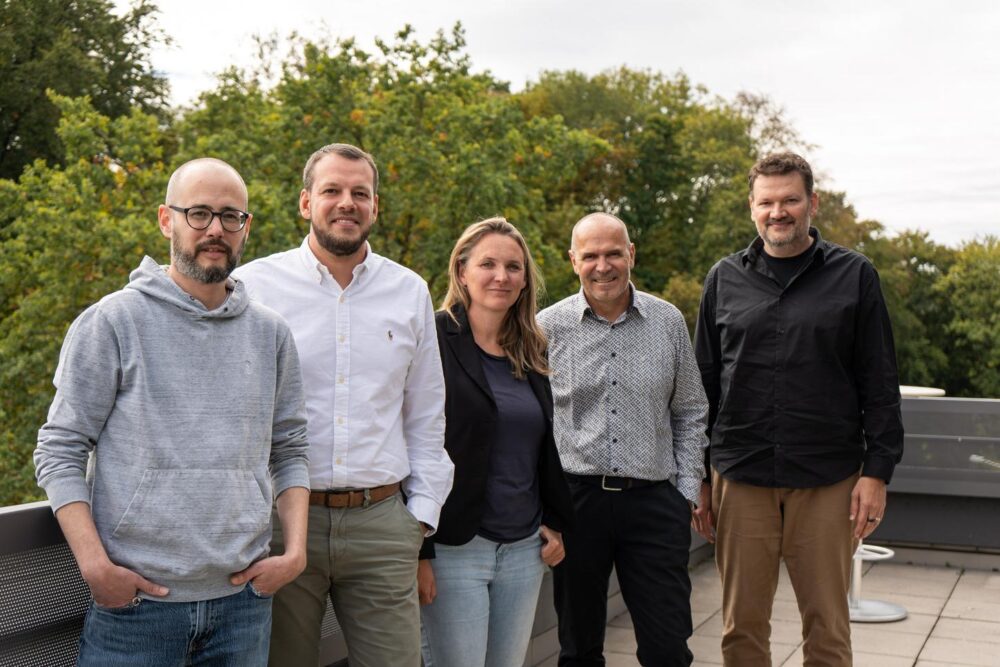
More than 24,000 corporate bankruptcies last year and warning signs that are often overlooked: The new book *Turnaround Management: Restructuring in Practice*, edited by Dr. Harald Schönfeld (United Interim), shows how companies can regain their ability to operate after facing existential crises. Eight experienced interim managers share insights from their professional experience.


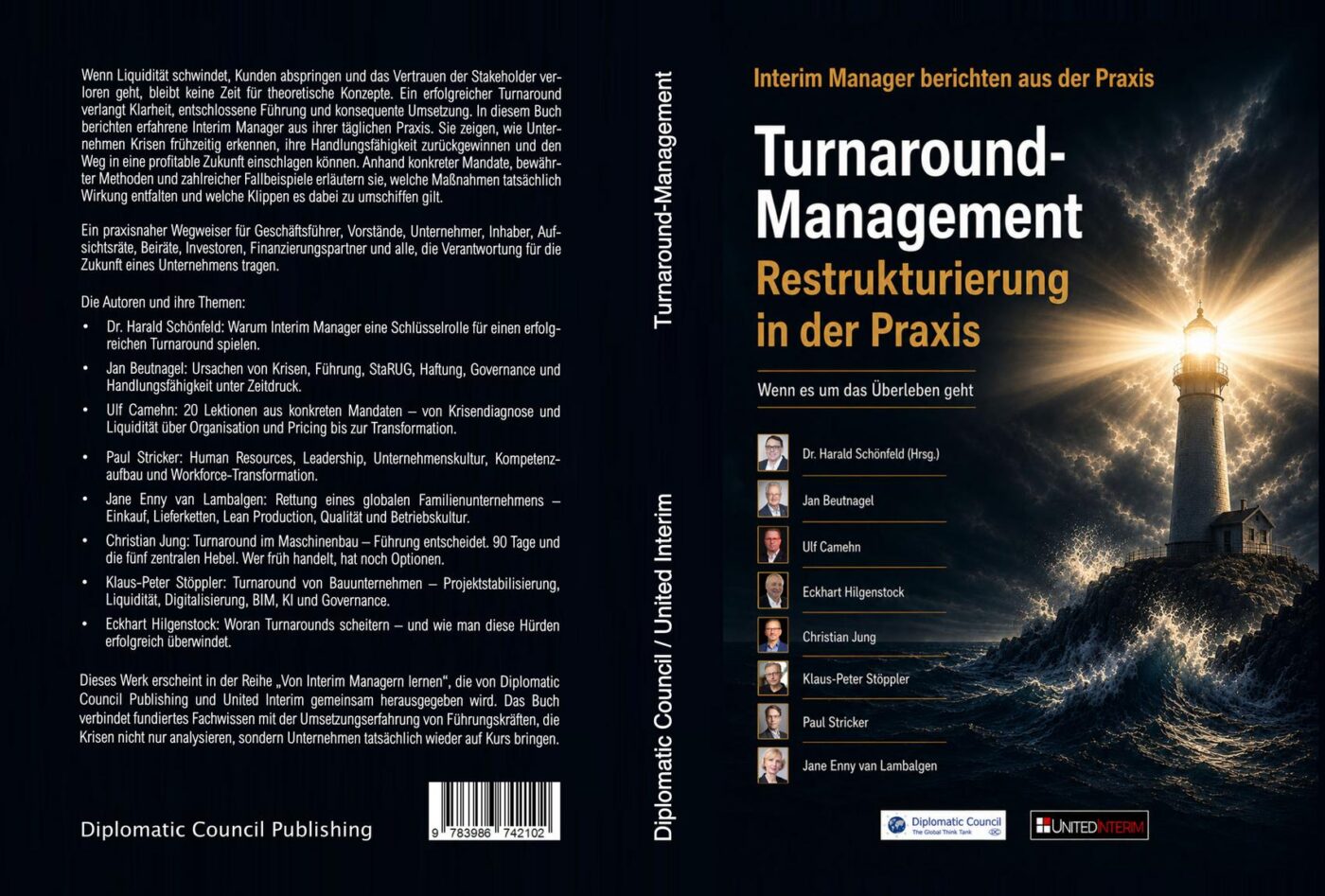
More than 24,000 corporate bankruptcies last year, a rescue rate of just 33 percent for larger companies in financial distress, and warning signs that were often overlooked for years: The new book *Turnaround Management: Restructuring in Practice* examines why companies fall into existential crises and explains which strategic and operational steps can restore their ability to function. Eight seasoned interim managers with decades of experience share insights from their professional practice: Jan Beutnagel, Ulf Camehn, Eckhart Hilgenstock, Christian Jung, Klaus-Peter Stöppler, Paul Stricker, and Jane Enny van Lambalgen.
The editor, Dr. Harald Schönfeld, CEO of the management community United Interim—which represents most interim executives—explains: «Turnarounds are among the most demanding challenges in corporate management. Unlike transformations, which aim for growth or innovation, turnarounds are about sheer survival. Liquidity is at risk, suppliers are demanding advance payment, banks are calling in credit lines, customers are defecting to competitors, and the best employees are leaving the company. In such situations, professional crisis management, quick decisions, and the consistent implementation of often painful measures are required.»
The authors are all practitioners. They have personally shouldered responsibility in crisis and change situations as interim CEOs, CROs, COOs, CFOs, managing directors, plant managers, HR directors, restructuring managers, as well as members of advisory boards and supervisory boards. In this book, published by the Diplomatic Council think tank, they have compiled for the first time their experience from decades of professional practice as «corporate rescuers.» Their contributions combine analysis with implementation in the manufacturing, mechanical and plant engineering, automotive, construction, logistics, retail, services, and international organizations sectors.
«We didn't see it coming»
«We didn’t see this coming» is, according to turnaround professionals, one of the most common phrases they hear when they take on a new assignment to rescue a company. In many cases, the reasons for the decline are similar: failure to adapt to market changes, recognizing the dire situation too late, inefficient corporate management, top management’s resistance to advice, insufficient focus on actual customer needs, a lack of willingness to innovate, neglect of sales and marketing, and poor financial management.
«Sometimes the management mistakes are truly hair-raising,» Jan Beutnagel remarks in astonishment. «In many cases, I wish they had called on me for help a year—or at least half a year—earlier,» adds his colleague Klaus-Peter Stöppler. Paul Stricker has identified flawed human resources policies as a common cause of a company’s decline. «The truth about a company’s situation can be found in day-to-day operations, not in the organizational chart,» says Ulf Camehn. «Entire industries, such as mechanical and plant engineering, are currently riding a tsunami that is simply overwhelming many fair-weather captains at the top of these companies,» analyzes Christian Jung. «We are currently experiencing a devastating wave in which the decline of one company drags other businesses down with it,» says Jane Enny van Lambalgen, pointing to a chain reaction of bankruptcies in the German economy. «The earlier, faster, and more consistently action is taken, the greater the chances of breaking free from the downward spiral,» says Eckhart Hilgenstock, urging company leadership to take corrective action in a timely manner.
In their joint book, the authors don’t wait until it’s too late; instead, they present concrete measures that company executives can use to identify negative trends early on and change course before a crisis arises. After all, since 2021, company executives in Germany have been required under the Corporate Stabilization and Restructuring Act (StaRUG) to continuously monitor developments that threaten the company’s continued existence, take corrective action, and inform the relevant governing bodies. In the event of insolvency, there is a maximum deadline of three weeks to file for bankruptcy; in cases of excessive debt, the deadline is six weeks. In the book, Jan Beutnagel explains how these strict requirements can be met through a long-term master plan operating on a rolling 90-day cycle, which includes a robust liquidity forecast and an active risk register. He describes in detail the four pillars of a robust management system. In the book, Ulf Camehn describes 20 lessons drawn from real-world restructuring and turnaround cases in small and medium-sized enterprises. He says: «There are certain patterns that recur time and again in crises. Some of them are unpleasant, and that is precisely why it is particularly valuable to be aware of them.» For example, the third lesson can be summarized as follows: «Those who bear managerial responsibility must know when legal tipping points are reached, which decisions can become problematic, and when external legal expertise is indispensable.» Or lesson twelve: «In many cases, cost-cutting programs alone only prolong the decline. Sustainable turnarounds reinvest in the right areas to drive growth.»
«The first warning signs usually come from the sales department when the sales pipeline shrinks, close rates decline, and sales cycles lengthen,» Eckhart Hilgenstock noted. «But since revenue is often still stable even as momentum is already shifting, these early signals frequently fail to reach top management or are interpreted as temporary market weakness, even though the business model has long since begun to falter.»
Systematic Approach and Practical Relevance
This work meets two requirements simultaneously: the need for a systematic approach and the need for practical relevance. Readers are provided with a structured overview: root cause analysis, courses of action, legal and liability-related aspects, liquidity, leadership and responsibilities, internal and external communication, speed in decision-making and implementation, business model transformation, changes in corporate culture, human resources, competencies, and employee retention, organizational stability, and resilient processes. The book systematically explains how executives can recognize an impending crisis early on. But going far beyond that, the authors provide a tried-and-true roadmap—complete with a toolkit—to turn a faltering company around and avoid insolvency. Point by point, drawing on their own experiences, the interim managers reveal the measures they consistently use to avert the seemingly inevitable and get a company back on track. In doing so, they also address the different roles of the various stakeholders: owners, executive management, and the advisory or supervisory board. «When the worst comes to the worst, it backfires if management relies on a token advisory board consisting, for example, of the company’s tax advisor, a lawyer who is a friend, and a family friend, rather than independent individuals with leadership experience,» explains Klaus-Peter Stöppler, who regularly advises companies in the construction industry as a member of their advisory board.
Eckhart Hilgenstock summarizes another insight: «Many companies respond to crises by launching too many projects at once. That is precisely what leads to overload, friction, and operational confusion. Successful turnarounds, on the other hand, focus on a few key levers with high impact. Three to five priorities are usually more than enough. Focus reduces complexity, increases speed, and improves execution. Especially under pressure, the rule is: Less is more.»
Specific examples from the authors' everyday professional lives
Time and again, the authors cite specific examples from their everyday professional lives. Jan Beutnagel recounts the story of a supplier with approximately 120 million euros in revenue that ignored market changes for three years and, after another 18 months, slipped into an existential crisis that could only be resolved with external help from an interim manager. Jane Enny van Lambalgen explains how an international family-owned company maneuvered itself into a crisis over the course of several years due to serious mistakes in purchasing, production, and quality assurance—and how it was turned around through concrete measures addressing these problem areas. She gives an example: «To keep procurement costs low, the purchasing department ordered far too many units that weren’t needed at all. The excess inventory was neither written down nor scrapped. While this may help with bank evaluations, it’s essentially a ticking time bomb.» Paul Stricker describes how, as the HR manager in charge at a company, he worked with the regional sales manager to accelerate local market approval by establishing a cross-functional team that transparently structured all steps, dependencies, and timelines—thereby creating an approach that was subsequently adopted group-wide. In the book, Jan Beutnagel uses a concrete example from the automotive industry with specific figures to illustrate that while cost cutting creates the liquidity needed during a crisis, it is no substitute for a sustainable business model or operational restructuring. Paul Stricker has repeatedly observed in projects that the «human factor» is often neglected in restructuring and turnaround efforts. He gives an example: «When job cuts occur, it affects not only those who receive notice of termination but also has a direct impact on those who remain. Motivating the workforce in this situation is only possible if a positive vision for the company is communicated in a credible manner.»
The lessons from this book apply to all industries; nevertheless, two sectors of particular importance to Germany are addressed separately: mechanical and plant engineering, and the construction industry. Christian Jung structures the industrial turnaround into a 90-day model, ranging from stabilization through targeted interventions to reduce risk factors to scaling up along the success curve. He says: «The challenges in mechanical and plant engineering—from declining order volumes in the automotive sector to new competition from China—are catching many long-established companies off guard. Those who take action will tap into the markets driven by megatrends: semiconductors, medical technology, defense technology, and automation. There are plenty of concepts. What’s missing is leadership: decisions and consistent implementation—not after months of analysis and countless board meetings, but right now. Those who act early have options. Those who wait lose the time they don’t have.»
Klaus-Peter Stöppler outlines a five-phase model specifically designed for construction companies in crisis. He says: «A turnaround in the construction industry is not merely a crisis response, but an ongoing management task. It involves continually combining operational stabilization, organizational restructuring, and strategic development. Problems rarely arise solely on the construction site; they also occur in management, communication, transparency, and prioritization. Anyone who wants to get the company back on track must therefore take a more fundamental approach than focusing on individual projects or short-term measures—though, of course, this applies not only to the construction industry.»
Digitalization, Artificial Intelligence, and Automation
Throughout the book, the authors explain how the strategic use of digitalization—particularly artificial intelligence—and automation can help companies reinvent themselves. They note: “No topic is currently being discussed more intensively in executive suites than artificial intelligence.” And no topic is so consistently underestimated in the day-to-day operations of many small and medium-sized businesses. AI is not a surefire success; it requires a clean database, clear use cases, and, above all, leadership that determines where AI truly creates value and where it merely ties up resources. This is all the more true in crisis situations: AI initiatives without a clear return on investment are a distraction during a turnaround. But when used correctly—for example, in production control, liquidity planning, or sales analysis—AI can be a key catalyst for bringing a company out of crisis.
Publisher Dr. Harald Schönfeld is surprised: «Many companies don’t even consider bringing in an interim manager to avert the worst, or they take this step so late that nothing can be salvaged.»
Book: «Turnaround Management: Restructuring in Practice,» Dr. Harald Schönfeld (ed.), Jan Beutnagel, Ulf Camehn, Eckhart Hilgenstock, Christian Jung, Klaus-Peter Stöppler, Paul Stricker, Jane Enny van Lambalgen, 312 pages, ISBN 978-3-98674-210-2, Diplomatic Council Publishing.
For more information, contact United Interim