
Natural hazards: Insurance presents facts and figures on the most important threats

The season of summer storms with wind, rain and hail begins in Switzerland every year from around mid-June. An analysis of data from Helvetia Switzerland shows how damage caused by natural events has developed between 1990 and 2024. The conclusion: the accumulation of severe weather events in recent years is indeed exceptional.


Natural damage has increased over the last three decades, according to an analysis by the insurance company Helvetia. (Image: Pixabay.com)

Switzerland, with its numerous mountains, bodies of water and exposed location in the center of Europe, is highly exposed to natural events. Expanded and growing settlement areas and infrastructures - some in high-risk locations - increase the resulting financial risk for policyholders and insurers.

Accumulation of natural damage in the last 10 years

In the public and media perception, the last few years in particular seem to have been characterized by severe weather. However, a look at the long-term data series shows that loss-intensive years occur at regular intervals. However, the conspicuous accumulation of natural hazard events in the years 2021 to 2024 is unusual in this form. This observation is supported by statistics compiled by Helvetia based on internal storm and damage reports on natural hazard losses in Switzerland. Between 1990 and 2024, the frequency of the most important natural events as well as the annual loss amount and the development of the average costs per event category were recorded. 

The total number of severe weather events remained largely constant until the mid-2010s - apart from the particularly lossy years of 1999 (storm Lothar) and 2005 (widespread flooding in the Alpine region). In the last ten years (2015-2024), however, there has been a significant increase in both the number of individual events and the cost of damage. The number of reported claims rose by 126% compared to the first decade (1995-2004). The financial expenses for damage repair increased by 133% in the same period.

Number of natural hazard events and their costs on the rise

When looking at the individual causes of damage, it is noticeable that the number of the most important natural events - such as storms, floods, hail, landslides and rockfall - has increased across the board. The increase is least noticeable in the case of floods and inundations: Despite the high media presence of such events, there has only been an increase of 26% over the last ten years. The volume of damage rose by 33 percent in the same period. The main reason for this is primarily the increase in the value of insured buildings and goods. At the same time, the investments made by the federal government, cantons and local authorities - several billion francs in flood protection since 2005 - have had an effect: they have prevented far greater damage. Nevertheless, floods and inundations were responsible for around a quarter of the damage caused in Switzerland between 2015 and 2024.

Hail as the primary cost driver

The trend in hail damage is particularly striking - both for individual and major events. The number of reported hail damage claims rose by 366% in the last ten years compared to the reference period, and the amount of damage even increased by 490%. With a share of over 51% of all claims paid by Helvetia between 2015 and 2024, hail has become the primary cost driver in the area of natural hazards in Switzerland. For Patrick Rohner, Head of the Non-life Claims Center at Helvetia Switzerland, this development cannot be explained solely by more frequent hail events: "In addition to the increased frequency and intensity of hail events, the increasing size of the hailstones is primarily responsible for the exponentially growing loss amounts." According to Rohner, another factor is the increased value of the vehicles and buildings affected, as well as the structural investments that have been ongoing for around ten years - in solar systems, for example.

In the areas of storm and landslide/rockfall/rockslide, the number of damage reports also increased compared to the two observation periods - by 38% and 24% respectively. It is worth noting that in both categories, the amount of damage has increased significantly more than the number of events: The amount of damage caused by storms increased by 50 percent, and in the landslide/rockfall/rockslide category by as much as 72 percent.

Event

Number of claims 1)

Annual loss amount 1)

Storm

+ 38 percent

+ 50 percent

Landslide/rockfall/rockslide

+ 24 percent

+ 72 percent

Hail

+ 366 percent

+ 490 percent

Flood

+ 26 percent

+ 33 percent

All natural events 2)

+ 126 percent

+ 133 percent

1) Development between the comparative period 1995 to 2004 and the comparative period 2015 to 2024.

2) Storm, rockfall, landslide, snowslide, snow pressure, avalanche, high water/flooding, hail, wind.


Connection with climate change

According to Adrian Kollegger, Head of Non-Life and member of the Executive Management of Helvetia Switzerland, there is an obvious link between claims development and climate change: "We expect claims sums to increase further in the future as a result of climate change. The ongoing warming is not only leading to more frequent and more intense storms; the melting of the permafrost in the Alps in particular is fundamentally changing the threat situation. Instead of classic flood events, surface events such as landslides, debris flows, rockfalls and rockfalls will increasingly occur."

Increasing urbanization, the expansion of infrastructure and the development of new areas will further increase the risks in the coming years - both in Switzerland and worldwide.

Damage modeling must continue to evolve

So far, the insurance industry has been able to anticipate future developments through sound modeling and manage premiums accordingly within the regulatory framework set by FINMA (ES_AVO). Models for natural hazard losses are continuously optimized tools that can be used to quantify potential losses. They combine historical data on natural hazards with information on the exposure and vulnerability of people, buildings, infrastructure and other assets in order to assess the impact of potential loss events and disasters.

However, relying solely on historical data is no longer sufficient to design sustainable insurance cover for extreme events. Predictive models, the use of artificial intelligence and the global exchange of knowledge between insurers and reinsurers are becoming increasingly important for this challenging task. 

Future threat scenarios must be incorporated even more strongly into risk modeling in order to ensure risk-appropriate and therefore sustainable premiums for insurers and customers, particularly in the unregulated area of natural hazards. In addition, policyholders, insurers and the state will have to invest even more in prevention and advice in the future. Personal support and advice from local branches will continue to play a central role in this. They know the damage potential of their respective region best and are available quickly in the event of a claim - for example with in-depth damage analysis, the provision of hail drive-ins or unbureaucratic immediate assistance.

Source: Helvetia

This article originally appeared on m-q.ch - https://www.m-q.ch/de/naturschaeden-versicherung-praesentiert-zahlen-und-fakten-zu-den-wichtigsten-bedrohungen/

Ransomware: Almost every second company pays - often after negotiation

The IT security service provider Sophos has published its annual "State of Ransomware 2025" report. The survey of 3,400 IT and cyber security managers in 17 countries reveals one particularly striking result: Almost 50 percent of the companies attacked paid a ransom to the cyber criminals to recover their data. What is even more interesting is that over half of these companies apparently negotiated with the cybercriminals and paid a lower amount than the original demand.

According to a study by Sophos, every second company pays a ransom for the decryption of their data affected by ransomware. (Image: Depositphotos.com)

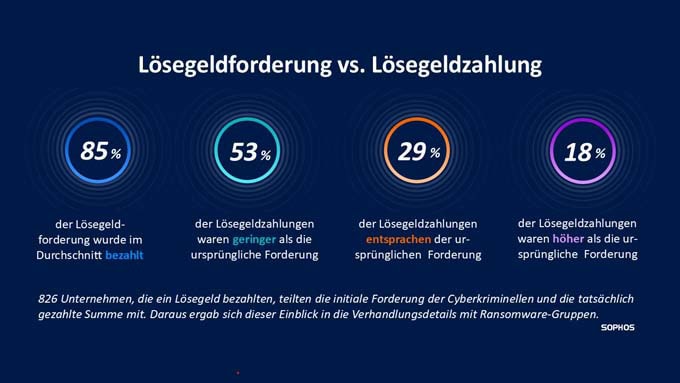
According to the recently published "State of Ransomware 2025" report by Sophos, almost half of the companies surveyed have already paid a ransom. The average amount of the ransom is around 1 million US dollars (€ 869,591). What is new is that 53 percent of companies have negotiated a lower amount than the original demand. Nevertheless, this is the second-highest rate of payment for ransom demands in six years (the highest level was 56% in the 2024 report). In the latest report, the willingness of victims in Germany (63%) and Switzerland (54%) to pay was above average.

Companies negotiate ransom payments

Despite the high percentage of companies that paid the ransom, more than half (53%) paid less than originally demanded by the cybercriminals. The affected companies in Germany (47%) and especially in Switzerland (65%) also showed their negotiating skills with the cybercriminals and also paid lower amounts than originally demanded.

Source: Sophos

The average ransom demand fell by a third between the reports of the last two years from an international perspective. At the same time, the average ransom payment fell by 50 percent. This development shows that companies are increasingly successful in minimizing the impact of ransomware attacks.

Ransom demands and payments vary greatly by country

Worldwide, the average ransom demand (median) was 1,324,439 million dollars (€ 1,159,905). At country level, however, the median demand amounts vary greatly; here are some examples:

  • 600 thousand dollars (€ 525 thousand) in Germany
  • 643 thousand dollars (€ 563 thousand) in France
  • 4.12 million dollars (€ 3.61 million) in Italy
  • 5.37 million dollars (€ 4.7 million) in the UK
  • 2.0 million dollars (€ 1.75 million) in the USA

The ransom sums paid regionally in the sample countries amount to:

  • 412 thousand dollars (€ 361 thousand) in Germany
  • 232 thousand dollars (€ 203 thousand) in France
  • 2.06 million dollars (€ 1.8 million) in Italy
  • 5.20 million dollars (€ 4.55 million) in the UK
  • 1.50 million dollars (€ 1.53 million) in the USA

Vulnerabilities and scarcity of resources are significant risk factors

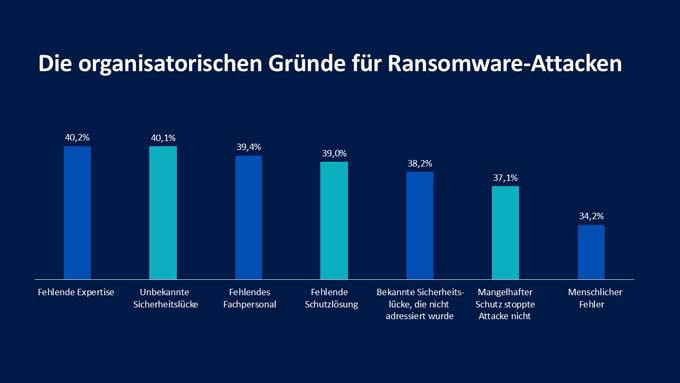
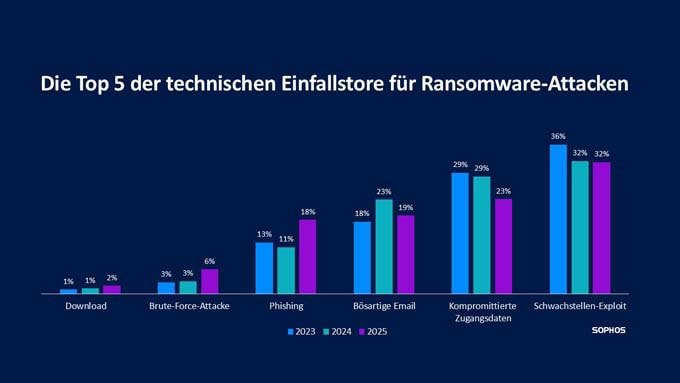
For the third time in a row, exploited vulnerabilities were the most common technical cause of attacks. 40% of all ransomware victims surveyed stated that the attackers exploited a vulnerability they were unaware of. In Germany and Switzerland, this situation is even worse at 45% and 42% respectively. This illustrates the ongoing difficulties companies have in recognizing and securing their attack surface.

Source: Sophos

63% of the companies surveyed worldwide confirm that resource problems were a factor in their falling victim to the attack. Companies in Germany (67%) and Switzerland (72%) are even above the international average in this respect. Globally, a lack of specialist knowledge was cited as the most important operational cause in companies with more than 3,000 employees. Companies with 251 to 500 employees were most likely to struggle with a lack of human resources or capacity.

Source: Sophos

Internal and external resources are crucial

"In 2025, most organizations see the risk of falling victim to a ransomware attack as a part of everyday business. The good news is that thanks to this increased awareness, many organizations are equipping themselves with additional resources to limit the damage. This includes hiring incident response specialists who can not only reduce ransomware payments, but also speed up recovery from an attack and even stop attacks in progress," said Chester Wisniewski, Field CISO at Sophos. "A real game changer in the fight against ransomware is focusing on the root causes of the attack potential. These include, above all, exploited vulnerabilities, a lack of transparency regarding the attack surface in the company and too few resources. We are seeing that more and more companies are realizing that they need help and are turning to MDR (Managed Detection and Response) services to defend themselves. This cybersecurity service, in conjunction with proactive security strategies such as multi-factor authentication and patching, makes a decisive contribution to preventing ransomware in the first place."


Best practices for effective protection against ransomware and other cyberattacks:

  • Taking action to eliminate common technical and operational causes of attacks, such as exploited vulnerabilities. Tools such as Sophos Managed Risk can help companies to determine their risk profile and minimize their risk in a targeted manner.
  • Ensure that all endpoint devices (including servers) are equipped with special anti-ransomware protection.
  • Provision and testing of an incident response plan. Good backups and regular practicing of data recovery play an important role in this.
  • 24/7 monitoring and detection. If companies do not have the necessary internal resources, trusted Managed Detection and Response (MDR) providers can help to meet these requirements.

Source: Sophos

This article originally appeared on m-q.ch - https://www.m-q.ch/de/ransomware-fast-jedes-zweite-unternehmen-zahlt-oft-nach-verhandlung/

LSA celebrates its 90th anniversary and new board members

Leading Swiss Agencies celebrated its 90th anniversary at this year's general meeting. The event provided an opportunity to exchange views, look back and elect three new board members.

From left: Pascal Winkler, Claudia Ziltener and Daniel Jörg are new members of the board of the LSA Association

The members of Leading Swiss Agencies (LSA) elected Claudia Ziltener (thjnk Zurich), Daniel Jörg (Team Farner) and Pascal Winkler (Publicis Groupe Switzerland) to the Board of Directors at their meeting on Wednesday, June 25 at the Razzia in Zurich.

"I am delighted to be involved in the association that showed me the way into the industry. In particular, I would like to promote partnership-based cooperation between agencies and clients as well as the promotion of young talent in our industry. The latter is particularly close to my heart, as I was able to experience for myself how valuable honest support can be and how enriching it is to work with young talents who will carry our industry into the future," says Claudia Ziltener, member of the management team at thjnk Zurich.

Daniel Jörg, Chief Innovation Officer at Team Farner, adds: "We need to become bolder and more visible as an industry. I want to work on the LSA Board to strengthen our self-image as agencies, make our services more visible and reposition the value of creative communication - for more impact, more pride and more future."

"I am involved in the LSA because I believe that creative excellence comes from the interaction of all disciplines. As a strategist, I see it as my task not only to provide guidance, but also to empower everyone involved to make their contribution to a strong industry with a shared impact," says Pascal Winkler, Chief Strategy Officer of Publicis Groupe Switzerland.

Mark Burow (formerly of Dentsu Creative DACH) and Pablo Koerfer (formerly of Farner Consulting) were duly dismissed from the Board after eight and two years respectively. The LSA would like to thank both of them for their commitment and many years of service to the association and the industry.

Review and insight in a new form

A fully digital annual report was presented to members for the first time. This provides a transparent and clear overview of the LSA year in figures, our events and the LSA network. The report can be viewed online.

The Swiss Medtech Award 2025 goes to Qumea

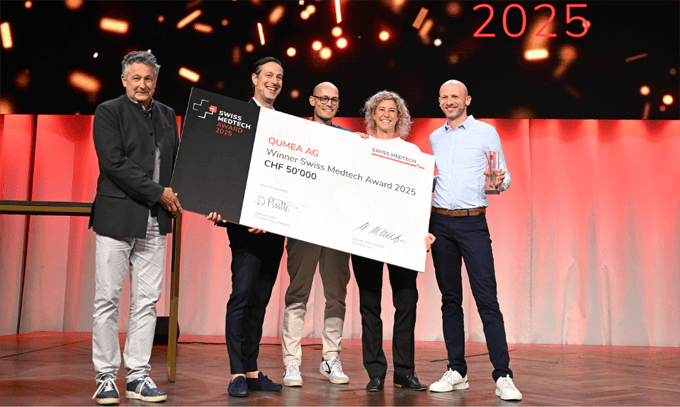
The Solothurn-based digital health company Qumea wins the Swiss Medtech Award 2025. The scale-up beat two other finalists and impressed the jury with its innovative solution for contactless, radar-based motion analysis in care rooms.

Proud winner of the Swiss Medtech Award 2025: The company Qumea from Solothurn. (Image: zVg / Qumea)

The Swiss Medtech Award is presented annually by the industry association Swiss Medtech and is endowed with CHF 50,000. It recognizes projects that combine medical innovation, marketability and benefits for the healthcare system. The association represents the interests of over 700 medtech companies in Switzerland and is committed to their international competitiveness and optimal framework conditions.

At the forefront of digitalization

For the Solothurn-based scale-up Qumea, winning the award is a great recognition. CEO and co-founder of the company Cyrill Gyger emphasizes that he is delighted to have won the highly endowed prize. The award shows that digital change has also arrived in the traditional medtech sector and that the industry is working intensively with new technologies. "It makes us proud to be at the forefront of actively shaping the digital transformation in the medtech industry with Qumea and providing impetus for the future," says Gyger.

CTO Jonas Reber also underlines the signal effect of the jury's decision: "Artificial intelligence and medtech are growing ever closer together - just as precision mechanics or miniaturization have driven innovation in the past. I am very pleased that we can contribute to this change with Qumea."

Radar detects movements and alerts if there is a risk of falling

Qumea has developed a solution for digital mobility monitoring in care rooms. The system records anonymous radar-based movement data, evaluates it, visualizes it and automatically provides information about dangerous situations. Patient privacy is protected as no cameras or microphones are used. In acute care, an average reduction in falls of 74 % was achieved. According to Qumea, this sets a new standard in proactive and preventative patient care.

The award was presented on June 25, 2025 as part of the Swiss Medtech Day 2025 in Bern - the leading platform for the Swiss medical technology sector, where experts from industry, research and healthcare network every year. In addition to Qumea, evismo, with a solution for diagnosing heart, sleep and stress disorders, and Bonebridge, a provider of innovative implants for the treatment of bone fractures, were also nominated for the award.

Source and further information: Qumea

This article originally appeared on m-q.ch - https://www.m-q.ch/de/der-swiss-medtech-award-2025-geht-an-qumea/

Goldbach and Go Wit: retail media ecosystem

Together, they want to build a retail media ecosystem in Switzerland and offer retailers and advertisers innovative retail media solutions.

The advertising marketer Goldbach and the AdTech company GoWit, which specializes in commerce and retail media, are entering into a pioneering partnership and combining Goldbach's established local advertising network with GoWit's retail media advertising technology.

The partnership gives retailers and advertisers access to an omnichannel self-service advertising platform that allows them to integrate retail media solutions faster than ever before. Retailers can monetize their digital advertising inventory while maintaining full control over their media assets.

Advertisers, in turn, come into contact with customers where they are most likely to make a purchase. The partnership is an important step for the advertising marketer: "Retail Media is representative of the rapid change in digital advertising as a whole and the increased demands of our clients," says Stefan Wagner, Managing Director of Goldbach Audience. "And so I am all the more pleased that we have found the ideal partner in this area with GoWit and its globally proven advertising technology."

He is convinced that GoWit's technology will enable even more effective use of data and therefore more efficient campaigns for advertisers. Emrah Adsan, CEO of GoWit, sees it the same way: "With the enormous dynamics in the Swiss advertising market, Goldbach is the perfect partner and offers our advertising technology a huge network". This will enable them to create a complete retail media advertising solution that will benefit retailers, advertisers and agencies alike. "After working together over the past few months, we are convinced of the added value we can offer retailers and advertisers in Switzerland". The next step is to attract more retailers and brands to the platform in order to continuously expand the inventory and reach.


The Goldbach Group companies market and broker advertising in the TV, radio, print, online, outdoor advertising and performance marketing sectors. The focus is on simple information, consulting and booking processes. In order to reach end consumers at the right time, in the right place and in the right context, Goldbach pursues a consistent multi-channel approach. The Goldbach Group is based in Küsnacht and is a TX Group company. 

GoWit is a leading AdTech company on a mission to democratize retail media advertising and make it accessible to retailers and marketplaces of all sizes. With a 15-minute self-service integration, the GoWit platform enables clients such as Carrefour, Heureka Group, Kingfisher, Toters Delivery, Mumzworld and Teknosa to build and scale their high-margin advertising business without complex technical hurdles or additional fees. With omnichannel ad formats, contextual targeting, an automated bidding algorithm and real-time analytics, GoWit provides effective advertising solutions and campaign management tools to deliver impressive results and maximize revenue. 

Com-Sys and Infoguard combine their cyber expertise

With immediate effect, Communication Systems GmbH (Com-Sys) will be operating under the new name InfoGuard Com-Sys GmbH and will in future use the brand suffix "An InfoGuard Company". The Swiss cyber security company is thus now making its long-standing collaboration with InfoGuard visible to the outside world, both visually and by name.

Combined cyber expertise (from left to right): Thomas Meier, CEO InfoGuard; Daniel Heinzig, Managing Director Com-Sys; Peter Letter, Chairman of the Board of Directors InfoGuard. (Image: InfoGuard AG)

The change of name creates what it claims to be one of the most powerful groups of experts for cyber security in the German-speaking world. This includes over 350 employees, a comprehensive 360° cyber security portfolio and a Security Operations Center (SOC) staffed around the clock in both Germany and Switzerland. The vision of the two companies is clear: to protect organizations in the DACH region with state-of-the-art and comprehensive cyber security and make the world more digitally secure every day.

Bundled cyber expertise with added value for customers

By bundling the cyber expertise of Com-Sys and InfoGuard, customers gain better access to international resources. The integration into the InfoGuard Group opens up an expanded cyber security portfolio, access to international teams of experts, standardized processes and state-of-the-art technology - including the two high-security SOCs in Switzerland and Germany. As an officially BSI-qualified APT response service provider, InfoGuard Com-Sys also offers an even more professional response to security incidents through a specialized and one of the most experienced CSIRT (Computer Security Incident Response Team). New services such as Managed Detection & Response (MDR), in-depth consulting as well as highly specialized and comprehensive penetration tests and red teaming services are now also available throughout Germany.

Management structure and further corporate development

Daniel Heinzig remains Managing Director of InfoGuard Com-Sys GmbH. In addition to Daniel Heinzig, Ralf Haubrich, Chief Revenue Officer (CRO), InfoGuard Com-Sys GmbH, Thomas Meier, CEO, InfoGuard AG, and Peter Letter, President of the Board of Directors, InfoGuard AG, form the management of InfoGuard Com-Sys GmbH. "This merger is an investment in our future and that of our customers," says Daniel Heinzig, Managing Director of InfoGuard Com-Sys. "We don't just want to keep pace with developments in the cyber world - we want to play an active role in shaping them." Thomas Meier, CEO of InfoGuard, agrees: "This step marks a significant milestone for InfoGuard - and above all for our customers. With the expanded team of experts, new locations and our comprehensive portfolio, we are ideally positioned. Our goal is clear: together we will do everything we can to ensure that our customers are protected in the best possible way today and tomorrow."

Source and further information: www.infoguard.ch

This article originally appeared on m-q.ch - https://www.m-q.ch/de/com-sys-und-infoguard-buendeln-ihre-cyber-expertise/

Sustainability as a driver of innovation: DACH region leads the way

A new study shows that companies are increasingly anchoring sustainability strategically at the core of their business model. The DACH region is leading the way.

It's no longer just about the "green economy": sustainability has been proven to be a driver of innovation, especially in the DACH countries. (Image: Akram Hossain / Unsplash.com)

Companies from Germany, Austria and Switzerland are setting new standards in the implementation of European sustainability regulations - primarily thanks to their high level of digitalization and automation. The new study "The State of Sustainability Reporting in Europe" of the software company osapiens shows that 88% of the companies surveyed in the DACH region already use digital solutions to implement regulatory requirements, a third (29%) of which are even fully automated. In all other regions (Nordics, Spain, France, Italy, Benelux), this proportion is 9%.

This technological lead is paying off: 85% of the companies surveyed in German-speaking countries believe they are now ready to meet the new requirements of the Corporate Social Responsibility Directive (CSRD) and the EU Supply Chain Directive (CSDD). Across Europe, the figure is only 41 percent. Automation improves data quality, speeds up evaluations and increases legal certainty.

Regulation as a driver of innovation

Despite ongoing discussions about sustainability regulations, around 97% of DACH companies currently see regulatory requirements as a driver of innovation and competitiveness. This is significantly more than in any other region in Europe (82 percent). 

The report is able to show where reporting pressure has provided innovation impetus. 65% of respondents were able to improve their product developments as a direct result of ESG requirements, while 64% reported more efficient processes. 63 percent benefit from better market positioning. Many German-speaking companies therefore clearly see regulations as an opportunity for the future.

Data access and quality determine success

Despite their digital lead, many DACH companies face structural challenges when it comes to data management: 41% report a lack of integration between ESG and financial reporting, while 36% still record relevant key figures manually and in a time-consuming manner. Added to this are regulatory complexity (35%), a lack of real-time transparency (34%) and problems with data quality (29%).  

Even if the willingness to digitize is high, many companies still lack the necessary basis. 38% of DACH companies see the fragmentation of their ESG data across various internal and external sources as the biggest challenge. 33% complain about a lack of specialist expertise, while 31% struggle with the integration of automated ESG solutions into existing systems. For 29 percent, high implementation costs represent an additional hurdle.  

Digital maturity gives companies a clear competitive advantage. In the DACH region, 92% of companies keep an eye on their impact along the supply chain - across Europe, only 61% of companies manage to do so. This makes technology a key factor for transparency and the regulatory ability to act.

DACH remains flexible even with new requirements

The DACH region shows strength not only in existing requirements, but also in dealing with regulatory dynamics. The planned EU omnibus initiative is assessed differently. 38% of the companies surveyed see it as an opportunity to reduce regulatory burdens and simplify ESG reporting obligations. At the same time, 34% see the initiative as a new source of uncertainty. Despite this divided assessment, many DACH companies feel that they are generally well equipped (85%). By comparison, the average across Europe is only 41%.

"Digitalization determines regulatory success"

"The DACH region shows impressively that those who invest in technology at an early stage are not only compliant from a regulatory perspective, but also have a strategic advantage," explains Alberto Zamora, CEO and co-founder of osapiens. "Automation, platform thinking and central data strategies are the key to not only meeting the constantly growing requirements, but also to gaining a real competitive advantage." 

This article originally appeared on m-q.ch - https://www.m-q.ch/de/nachhaltigkeit-als-innovationstreiber-dach-region-fuehrend/

Brand Congress 2025: AI, content, cultural change

At the Swiss Brand Congress 2025, it became clear that artificial intelligence is not only changing the how, but also the what of brand management. If you want to survive, you need clarity of purpose, precision in the process - and the courage to realign.

High above the city, with a view over the lake and the Alps, the brand elite met at the Dolder Grand. The Swiss Brand Congress once again brought together around 650 managers, agency heads and brand experts to discuss what makes brands strong today - and irreplaceable tomorrow. In the midst of times of exponential change, it became clear that those who manage brands need foresight - technologically, culturally and creatively.

Excellent brand management - from Malters and from HSG

Two personalities were in the spotlight at the Swiss Academy of Marketing Science's brand awards ceremony:

Marc GläserCEO of Stöckli Swiss Sports AG, was honored with the "Marketing Thought Leader Award" 2025. His track record: the company's consistent focus on skis, coupled with a strategy of excellence driven by craftsmanship, innovation and athletes. Under his leadership, Stöckli developed from a broad sporting goods brand into a highly specialized provider of premium skis - with Marco Odermatt as a shining testimonial.

Were honored with marketing prizes: Marc Gläser (CEO Stöckli Swiss Sports AG) and Prof. Dr. Johanna Gollnhofer from the University of St. Gallen

Prof. Dr. Johanna Gollnhofer, consumer researcher at the HSG, was honored with the "Rigor & Relevance Research Award". Her studies on "consumption in abundance" show how strongly material things are linked to order, identity and emotional support - a topic that even brands cannot ignore. Her conclusion: full cupboards tell us more about ourselves than we think. For brands, this means that if you want to understand how people buy, you have to understand how they live.

Prof. Dr. Reto Hofstetter (University of Lucerne), Marc Gläser (CEO Stöckli Swiss Sports AG), Prof. Dr. Johanna Gollnhofer from the University of St. Gallen with Stephan Feige, CEO htp St. Gallen (from left)

AI at Beiersdorf: structured transformation instead of hype

The extent to which AI is already being used in companies was demonstrated by Jasmin Quellmann, Head of MarTech & AI at Beiersdorfin one of the most impressive presentations of the day. The traditional Hamburg-based company behind brands such as Nivea, Eucerin and Labello does not rely on loose tests, but on a sophisticated framework called "Amy" - a combination of technological excellence and internal change management.

Swiss Brand Congress 2025 with Jasmin Quellmann, Head of MarTech & AI, Beiersdorf

Amy stands for "AI" and "me" - the conscious connection between technology and people. More than 40 specific use cases were identified, validated and evaluated in a structured governance process. These range from intelligent font recognition in DAM systems and AI-supported storyboarding with tools such as Bria to ethics guidelines for AI-generated images, particularly in sensitive areas such as skin depiction.

Beiersdorf is pursuing a clear goal: AI should not only bring efficiency, but also create space for more creativity - by automating repetitive tasks and through better insights from R&D and market research.

One highlight was the example of the localization of product visuals: where previously dozens of variants had to be created manually, AI now generates localized formats in seconds, for example for e-commerce or social media. AI is also used specifically for voiceovers, model rights management and quality assurance.

However, Quellmann also made it clear that over 50 % of all AI projects fail. The reasons are a lack of fit, legal risks or a lack of integration. "AI is not a dressage horse," she said, "it's a wild ride. But one that is worthwhile - if you are prepared to take responsibility."

Publicis: Campaigning to the beat of algorithms

Also with Publicis AI is no longer an optional extra, but part of day-to-day business. Pascal Winkler, Chief Strategy Officer of the Group, painted a clear picture of the new reality: the consumer journey is fragmented, platforms decide what is seen - no longer brands. Anyone who still thinks in terms of annual plans is losing out.

Publicis has therefore worked with "Jane Canvas" developed a tool that orchestrates the entire creative process - from insight to conception to visual implementation. Thanks to central AI tools, campaigns can be created iteratively, tested more quickly and adapted in series. The combination of Gen AI, analytical AI and media intelligence creates new possibilities - for example in post-campaign analysis, where a commercial mix model calculates the best ROI across all channels.

The message: creativity remains human, but it changes. Not through renunciation, but through a new approach to ideas.

Lindt: Between stretch and stability

Andrea Hänggi from Lindt gave an insight into how the traditional brand Innovation score around 13.2 % in particular thanks to the attention-grabbing "Dubai chocolate". The campaign struck a chord with a younger target group and showed that even established brands are capable of cultural impulses.

Nevertheless, it is a balancing act, says Hänggi: working with creators requires clear briefings, freedom - but also veto rights. Lindt wants to keep its finger on the pulse without losing the brand framework. Social Listening remains central - new campaigns are open, but not a sure-fire success.

Post advertising: cross-media at the heart of the action

For Sabrina Wettstein, representative of the main sponsor Post Advertisingthe congress is a "strategic homebase event". Having been on board for three years, it is clear that the partnership is paying off - both in business and cultural terms.

With strong performances and dialogs - for example with Denner on the topic of customer centricity - Post Advertising has shown itself to be a cross-media provider with proximity to retail and moving images. The topic Retail Mediais omnipresent - as is the passion for new campaigns, says Wettstein. Inspiration and networking are ideally combined at the Dolder: "You meet familiar faces - and gain new customers."

ESB: The revolution doesn't have to be rushed

Hans-Willy Brockesorganizer and CEO of the ESB Marketing Networkpleaded for a clear head in turbulent times:

"We are in the middle of a revolution - but the great art is to remain calm."

The marketing world is more complex than ever. There is no longer "the" highlight, but a multitude of relevant topics - from AI to bionics to live marketing. The danger? Getting bogged down. Brockes advised setting priorities and moving into the new world step by step.

His reminder about creativity came without AI: "The best ideas don't come from models, but from real minds." And his personal favorite brand? Red Bull - because of the consistency with which it creates worlds with emotion, experience and sponsorship. "I'm surprised that hardly anyone imitates this - but maybe that's a good thing."

The brand as a cultural system

Anina Segat (MetaDesign) and Marko Bjelonic (RIVR) concluded by discussing how brand management can be rethought in the AI age - not as a purely communicative, but as a cultural task. Brands are interfaces between people, technology and society. If you want to manage them well, you need more than tools - you need attitude.

Conclusion

The Swiss Brand Congress 2025 impressively demonstrated this: Brand management today is no longer a linear business, but a polyphonic process. AI, cultural change, new touchpoints - everything is changing. What remains is the importance of attitude, creativity and structure. And perhaps it is precisely this view from the Zürichberg that helps us to see the big picture.

Adesso study: Companies demand "GenAI made in Europe"

How ready are Switzerland and Europe for generative AI? The consulting and IT service provider Adesso explores this question in its latest "GenAI Impact Report".

Switzerland and the EU are not playing first fiddle in the global AI race. This is set to change. At the AI summit in Paris at the beginning of the year, the European Union announced extensive investments in the AI sector in order to catch up with global competition and strengthen Europe's technological sovereignty. Together with a clear focus on the development of safe and ethical AI, these investments are intended to help Europe become a global leader.

In a new GenAI study, Adesso examines how Swiss companies currently assess Switzerland and Europe in terms of generative AI, how fit they consider themselves to be and what role GenAI now plays in their day-to-day work. To this end, the IT service provider surveyed 100 managers from the Swiss economy.

Key findings of the study:

  • Companies are waiting for "GenAI made in Europe". The respondents send a signal about the need for European alternatives. For 59%, it is important or very important that the GenAI applications that their company uses or could use were developed in Europe. This shows a great awareness of digital sovereignty and a strong desire not to become dependent on non-European providers.
  • Regulation is a necessary instrument. The majority of respondents are in favor of stronger regulation of AI applications such as ChatGPT: 51% "somewhat" agree, 24% even "completely" agree. These figures show that companies not only accept regulation, but that many see it as a necessary instrument for dealing responsibly with AI.
  • The GenAI fitness of companies is increasing. Companies now see themselves as better prepared for GenAI. The proportion of companies that feel well or very well prepared has risen from 31% in the previous year to 39%. At the strategic level, however, GenAI is only tentatively arriving in companies. Only 50 percent have already developed an AI strategy - and 25 percent of these companies only take traditional AI into account.
  • AI agents are on the radar, but hardly ever in use. Currently, 39 percent of respondents state that they are evaluating the possible uses of AI agents. Only 11 percent are already using AI agents productively in individual areas. These figures show that the next evolutionary stage of GenAI - autonomous, actively acting AI agents - has not yet arrived on a broad scale in companies.
  •  

Ralf Schmidt, Head of CC Data & AI at adesso Switzerland, encourages companies to take a more decisive approach: "Artificial intelligence is not just changing processes - it is calling entire business models into question. In view of the rapid development of new application possibilities, it is clear that it is no longer a question of whether companies have to act, but how consistently and sustainably they do so."

The full impact report can be downloaded here can be downloaded.


Adesso was founded in Dortmund in 1997 and currently employs over 10,400 people in the adesso Group. As a national subsidiary of Adesso SE, Adesso Schweiz AG distributes the consulting and IT service provider's service portfolio on the Swiss market. Adesso focuses on the core business processes of companies and public administrations with consulting and individual software development. Adesso's strategy is based on three pillars: the deep industry know-how of its employees, extensive technological expertise and tried-and-tested methods for implementing software projects. The result is superior IT solutions that make companies more competitive.

Bern Communication Award 2025 goes to Thomas Binggeli

The Bernese Public Relations Society BPRG awards the 15th Bernese Communication Prize to Thömus founder Thomas Binggeli for his commitment to the bicycle industry and his communicative achievements without formal PR training.

From left to right: Nik Eugster (President of the BPRG), Thomas Binggeli (CEO & owner of Thömus), Liara Florin (apprentice at the School of Woodcarving), Markus Flück (Director of the School of Woodcarving), Joëlle Beeler (Head of Communications at the Swiss Cancer League), Abhinay Agarwal (Board member of the BPRG). (Pictures: Zoé Roth)

The Bernese Communication Prize is awarded annually to people who stand out for their communication without having the relevant specialist training. This year's prize goes to Thomas Binggeli. According to jury president Nik Eugster, Binggeli has not only established innovative products in the bicycle industry, "but has also established a friendly communication culture" that involves both partners and customers.

The award ceremony took place on Thursday at the Alpine Museum in Bern. In his acceptance speech, Binggeli emphasized: "This award stands for the bicycle. I also see it as an incentive to continue seeking dialog with our customers and the community and to drive innovation forward." He will receive a specially created work of art, which was designed by the Brienz School of Woodcarving as part of an internal competition.


Previous award winners

  • 2011: Steff la Cheffe, beatboxer and rapper
  • 2012: Bernd Schildger, zoo director
  • 2013: Francis Foss Pauchard, Olmo founder
  • 2014: Hans Zurbrügg, Founder and President of the Bern International Jazz Festival
  • 2015: Mujinga Kambundji, sprinter
  • 2016: Prof. Dr. Thomas Stocker, climate researcher, University of Bern
  • 2017: André Lüthi, CEO Globetrotter Group
  • 2018: Andrea Staudacher, event designer Future Food Lab
  • 2019: Livia Anne Richard, playwright and director
  • 2020: Peter Glauser & Mike Glauser, inventors, producers and marketers of the "Belper Knolle" tuber
  • 2021: Christoph Spycher, Head of Sport at YB
  • 2022: Linda Nartey, former Head of the Bern Cantonal Medical Office
  • 2023: Christine Wyss, Co-Director Buskers Bern
  • 2024: Reto Nause, Director of Security, Environment & Energy City of Bern

Gold rating again from Ecovadis for ISS Switzerland

Facility management service provider ISS Switzerland has once again been awarded the gold medal in the renowned EcoVadis sustainability rating. With 81 out of 100 points, the company is among the top 5 percent of all companies rated worldwide.

ISS Switzerland receives a gold rating from EcoVadis - and is one of the world's most sustainable companies. (Image: zVg / ISS Switzerland)

The assessment by EcoVadis - one of the leading independent platforms for sustainability ratings - is based on 21 criteria in the areas of environment, labor and human rights, ethics and sustainable procurement.

Further improvement

ISS Switzerland improved further in the areas of environment (+4 points), ethics (+2) and sustainable procurement (+3) compared to the previous year. The separate assessment in "Carbon Management" to the highest level "Leader" is particularly emphasized - a rating that companies with comprehensive CO₂ management and strategic target anchoring receive for the climate categories Scope 1, 2 and 3.

"After the last year's platinum award this result is proof of the consistent further development of our sustainability management - and of our aspiration to implement effective solutions together with our employees and for our customers," says Marc Amstutz, Head of Sustainability & Environment at ISS Switzerland. Because EcoVadis is continuously tightening the criteria and threshold values, this year's gold award also underlines ISS Switzerland's continued high level of commitment to sustainability, as stated in a corresponding press release.

ISS Switzerland: "Strong sustainability partner"

According to ISS Switzerland, its goal is to achieve net-zero CO2-emissions in direct business activities - and along the entire value chain by 2040. This commitment is also reflected in our customers' day-to-day operations. "Our sustainability strategy is effective when it also becomes tangible for our customers - in the form of measurable CO₂ reduction activities, smart services and efficient use of resources on the path to climate neutrality," emphasizes Amstutz.

ISS Switzerland thus remains a strong sustainability partner - both internally and externally - and underlines its role as a driver for sustainable and responsible facility services and real estate solutions in Switzerland.

Source: ISS Switzerland

This article originally appeared on m-q.ch - https://www.m-q.ch/de/wieder-gold-rating-von-ecovadis-fuer-iss-schweiz/

IT service provider Bechtle receives validation of its emissions reduction targets

Bechtle AG has received official confirmation from the Science Based Targets Initiative (SBTi) that its short to medium-term targets for the reduction of greenhouse gas emissions meet the SBTi criteria. This means that the targets submitted by the IT service provider have been validated in accordance with climate science-based standards. In addition, by signing the SBTi Net-Zero Commitment Letter, Bechtle confirms its long-term commitment to climate protection and sustainability.

Bechtle receives validation for science-based climate targets from the Science Based Targets Initiative (SBTi). (Image: Bechtle.com)

The IT service provider Bechtle, which is also active in Switzerland, had its short to medium-term emissions reduction targets validated by the SBTi. The declared goal is to achieve net-zero emissions by 2050 at the latest. The SBTi is a joint initiative of the global non-profit environmental organization Carbon Disclosure Project (CDP), the UN Global Compact, the World Resources Institute (WRI) and the World Wide Fund for Nature (WWF). It supports companies in achieving emission reduction targets in line with the latest climate science. A key basis for this is the Paris Agreement, in which the signatory states committed to limiting global warming to 1.5 degrees compared to pre-industrial levels.

The emission reduction targets submitted by Bechtle to the SBTi are in line with the 1.5 °C target of this climate agreement. Bechtle AG undertakes to reduce absolute greenhouse gas emissions in categories Scope 1 and 2 by 54.4 % by 2030 and to reduce Scope 3 emissions from the categories "purchased goods and services" and "use of sold products" by 55 % per EUR 1,000 of value added by 2030. The basis for comparison is 2019 in each case. These targets were reviewed as part of the SBTi validation process and meet the requirements of the current SBTi standard.

Commitment to long-term net zero target by 2050

In addition, Bechtle has signed the official Net-Zero Commitment Letter of the SBTi. This commits the IT company to achieving net-zero greenhouse gas emissions for all relevant emission sources from Scope 1 and 2 as well as intensity-related for the above-mentioned Scope 3 categories by 2050 at the latest. The measures are aimed at systematically reducing direct and indirect emissions along the entire value chain. By signing the pledge, Bechtle wants to give even more emphasis to the goals anchored in the Sustainability Strategy 2030.

"The validation of our targets by the SBTi underlines the credibility of our commitment to climate protection. We take our responsibility as one of Europe's leading IT service providers seriously and expressly support the SBTi's science-based approach," says Antje Leminsky, COO of Bechtle AG.

Guidelines for responsible entrepreneurship

With the Sustainability Strategy 2030, Bechtle has defined economic, ecological and social goals. It refers to the UN Sustainable Development Goals and comprises the four strategic action areas of ethical business, environment, people and digital future. Each field of action is underpinned by a program that includes targets, milestones and operational measures.

Source and further information

This article originally appeared on m-q.ch - https://www.m-q.ch/de/it-dienstleister-bechtle-erhaelt-validierung-seiner-emissionsreduktionsziele/

get_footer();