Swiss Staffingindex: Turnover of personnel service providers falls after economic slowdown
Swiss personnel service providers can look back on a difficult year in 2025. The number of hours worked by temporary staff fell by 7.1%, while the permanent placement business slumped by 23.3%. By contrast, construction and household-related services provided impetus for growth.


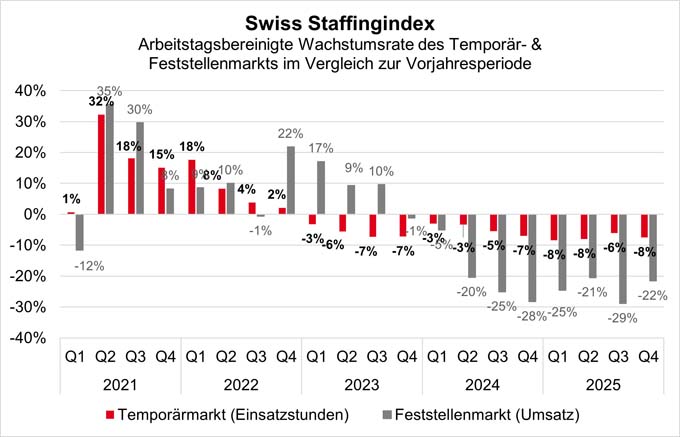
Swiss personnel service providers were hit by a significant economic slowdown in 2025. The year was economically challenging for the industry: The number of hours worked by temporary staff fell by 7.1% compared to the previous year, according to the Swiss Staffingindex. This is the first time that the temporary staffing business has fallen for three years in a row. The permanent placement business fell even more sharply. After an already weak 2024, turnover in 2025 fell by 23.3% compared to the previous year.
The downturn in the global economy, the economic crisis in Germany and the high level of economic uncertainty - also caused by US tariff policy - are the reasons for this development. The US tariff policy led to a high level of uncertainty in the export industry for months. Added to this was the continuing economic weakness in Germany, one of Switzerland's most important sales markets. Due to the weak order situation, many companies were very cautious in their personnel planning, particularly in industry.
Personnel service providers as a mirror of the labor market
The temporary sector is ahead of other sectors in terms of developments on the labor market. As Seco's unemployment statistics show, unemployment has risen the most in sectors such as research and development (+146%), information technology (+96%) and the pharmaceutical industry (+91%) since December 2021.
Christian Biedermann, Managing Director at Coopers Group, states: «The demand for IT specialists for cloud solutions, cyber security and artificial intelligence remains high.» But generalists are having a hard time: «The IT labor shortage is over. Uncertainty and cost pressure are keeping companies away from permanent positions in particular.» The temporary market is more differentiated. Biedermann explains: «Companies are less reluctant to take on new projects and ongoing assignments are being continued. The combination of IT skills and industry expertise in highly regulated sectors is particularly in demand.»
The situation is similar in the pharmaceutical sector. Ramon Bodenmiller, Managing Director of Bodenmiller Recruitment, says: «In the pharmaceutical sector, specialists in the clinical area, in regulation or in quality management are still in high demand.» There is less demand for overarching functions such as marketing, finance and sales.
Growth in construction and household-related services
According to Seco, unemployment has continued to fall in several sectors since December 2021, particularly in household-related services (-17%) and construction (-12%). This trend is also reflected in the temporary sector. «The construction sector performed well last year,» says Balz M. Villiger, Country Manager of Gi Group Switzerland. «Carpenters, electricians and foremen are particularly in demand. These professions cannot be replaced by AI.»
The trend also shows the strength of Swiss apprenticeships: apprenticeships and the dual education system are proving to be a mainstay in the current labor market situation. Villiger is optimistic about the coming months: «The combination of the abolition of the imputed rental value, the recent interest rate cuts and the ongoing housing shortage will further increase demand in the construction sector.» At the same time, he warns of a key challenge: «A lack of skilled workers could become a limiting factor for many construction companies.»
By providing care for senior citizens at home, the temporary employment sector is also active in the area of household-related services. Béatrice Mast, CEO of Dovida Switzerland, observes: «Due to demographic trends, there is a high demand for care among senior citizens. Accordingly, our company has been able to grow against the market trend.» In order to meet the increasing demand, Dovida Switzerland is promoting low-threshold training opportunities for new employees. Mast explains: «Thanks to training and further education, we can also quickly integrate older jobseekers - also from the non-employed sector - into our company.»
Cautious optimism for 2026
According to KOF and Seco forecasts, the economic situation in Switzerland remains challenging. The CEOs of swissstaffing member companies expect the economy to bottom out in 2026. According to an ad hoc survey by gfs-zürich, 79% expect business to move sideways or increase over the next six months. Only 12 percent expect a decline in 2026.
Dr. Marius Osterfeld, Head of Economics and Policy at swissstaffing, recalls: «The negative market signals currently predominate. At the same time, artificial intelligence, population growth and demographics offer new market opportunities. This growth potential is underestimated.»
Source: Swissstaffing