AI in HR: from hype to liability risk
Artificial intelligence has reached everyday HR life in Europe - and is forcing companies to rethink. The EU AI Act threatens binding rules for high-risk AI from August 2026. A new study by SD Worx shows how far companies have already come with the use of AI in HR.


The time of carefree experimentation with artificial intelligence (AI) is over. The technology has long since arrived in everyday HR life in Europe - and is turning from technological hype into a tangible liability risk for many companies. This is confirmed by the latest «HR & Payroll Pulse» survey by European HR and payroll service provider SD Worx, which surveyed more than 5,900 HR managers and 16,500 employees in 16 countries.
Investments rise sharply
The drive towards AI-supported modernization is clearly reflected in budgets: Almost half (48 percent) of German HR managers are now investing specifically in AI solutions - a significant increase on the previous year, when the figure was 38 percent. In the Europe-wide analysis, medium-sized companies with 250 to 2,499 employees are particularly dynamic: 57% of them are already investing money. Four out of ten organizations are already seeing clear, measurable results from these investments.
Man and machine as a tandem
Contrary to widespread fears, European companies are not looking to replace the human factor. What is needed is intelligent collaboration: HR professionals rely on a hybrid model in which AI does the groundwork and humans retain control. This shared responsibility is particularly evident in payroll accounting, where 40 percent of employers already rely on the symbiosis of humans and machines. In personnel resource planning, 39% would like AI support, while 38% rely on smart algorithms for data analysis in the area of reporting and analytics. However, clear boundaries remain: Emotional areas such as the well-being of employees and mental health are areas in which 51% of employers want to remain purely in human hands in the future.
Changing processes - qualification is the key
In order to make room for the new AI-influenced working world, 45% of companies are actively adapting their work processes and workflows. The fact that this change is also affecting the workforce is measurable: 47% of respondents state that AI is already reducing the need for certain traditional roles or tasks. This makes targeted training all the more important: 44% of employers are consistently investing in further training to strengthen the AI skills of their teams.
EU AI Act sets guard rails
As technology advances, so does regulatory responsibility. From August 2, 2026, the EU AI Act will tighten the rules for the use of high-risk AI in Europe - particularly in the areas of transparency, risk management and governance. Although there is currently an application to postpone the deadline for the regulation of high-risk AI to December 2, 2027, this has not yet been formally decided. Companies should not rely on possible postponements, but should document their use of AI in HR in good time and set it up in accordance with the regulations.
«Today, 47 percent of employers already report that their company has guidelines for the ethical and responsible use of AI in human resources. This is a good first step. However, it is now important to establish a robust governance framework with clear rules, clearly defined responsibilities and reliable accountability,» explains Tilman Rotberg, Managing Director of SD Worx Germany. «Companies derive the greatest benefit from AI when they use the technology in a targeted manner and with measurable results. By automating routine tasks, employees gain more time for activities with higher added value. This is why companies should not only invest in tools, but also in training and change support so that employees and managers can use AI with confidence. Clear communication about how roles are changing as a result of AI remains essential.»
Europe's AI maturity: clear north-south divide
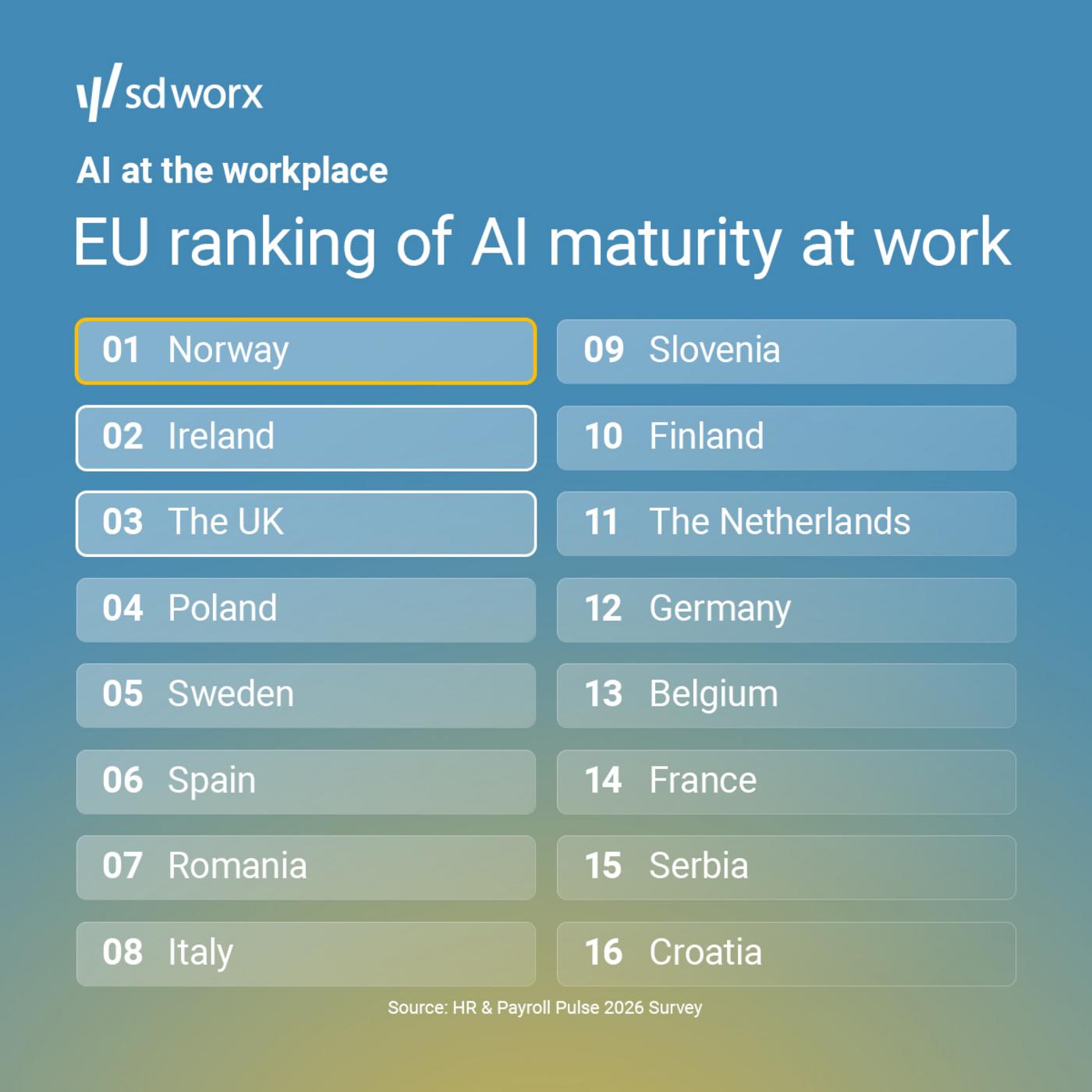
In terms of AI maturity - measured by factors such as investment, training and process adaptation - Europe shows a clear north-south divide. Norway tops the European list as the absolute leader, closely followed by Ireland and the UK. Poland and Sweden occupy fourth and fifth place. Germany is in the European midfield, while Croatia and Serbia are currently still lagging behind in terms of AI maturity.
More information about SD Worx and the study results: www.sdworx.com