Does BlueMind bridge the «why» gap in marketing and HR?
Tracking tools record every click, but they don’t explain a single motive. Markus Britschgi aims to fill exactly this gap with his psychographic model «BlueMind»—for targeted marketing and seamless internal collaboration.





Today, we know almost everything about consumers: age, ZIP code, click paths, touchpoints, and shopping carts. We know exactly who buys what, when, and through which channel. And yet, the crucial question remains unanswered with astonishing frequency:
Why, actually?
This is precisely where Markus Britschgi, founder of the Lucerne-based institute blue eyes marketing, comes in with his «BlueMind Lab». His diagnosis: Marketing has an excess of quantitative data but suffers from a glaring lack of psychological depth. With data-driven «BluePersonas,» he aims to bridge the qualitative gap—because today, the question of «why» determines relevance or loss of traction.
Why does one customer choose the premium product, while another stubbornly focuses on the price?? Why does the same message resonate immediately with one half of the target audience, while the other just shakes their head??
Demographic data and tracking provide an increasingly precise picture of people, but they do little to explain what truly drives them. This is where psychographics comes into play: it looks beyond measurable behavior to values, motives, attitudes, and unconscious needs.
Age is not a target audience
Target groups are still mostly defined based on characteristics that are easy to record in tables: age, gender, income, and place of residence. This provides guidance, but it also harbors a dangerous pitfall: the fallacy that people with similar background information also think and make decisions in similar ways.
Two 35-year-old men with identical incomes can find themselves in completely different worlds when buying a car. Some people are looking for high-tech features, prestige, and acceleration. The other: longevity, safety, and maximum resource efficiency. Demographically, they're twins—psychographically, they're worlds apart.
The same misunderstanding characterizes the discourse surrounding age cohorts such as «Gen Z» or «Best Ager». Generations are age groups, not homogeneous communities of values. Those who rely solely on statistical averages overlook the crucial differences within the target group.
From Click to Image: Relevance Is Created in the Mind of the Viewer
Analytics show exactly which touchpoints are effective and where users drop off. But a single click doesn't reveal a motive.
A high price puts some people off—for others, it’s an indispensable sign of quality. A perennial topic such as sustainability illustrates this phenomenon perfectly:
-
For people who are guided by values It is social responsibility in action.
-
Rational Pragmatists ask, in a matter-of-fact way, about measurable resource efficiency.
-
Those who value tradition respond to origin, regional character, and longevity.
-
Innovation-Driven searching for cutting-edge technology.
The product remains the same. But the reason why it becomes relevant changes fundamentally. Psychographics doesn't necessarily call for dozens of new products—it requires a precise understanding of which aspect of an offering actually resonates with which target audience. Relevance never originates with the sender, but always with the recipient.
BluePersonas: When Target Audiences Become Measurable
Personas have become an established part of marketing. They give a face to raw data: «Sandra, 42, part-time, two children, likes to shop online». That reads well, but it still doesn't explain why someone would buy it.. Many personas are nothing more than made-up anecdotes with no quantitative basis.
The Lucerne Institute fills precisely this gap blue eyes marketing with his BlueMind Lab. The ones developed there BluePersonas combine qualitative in-depth profiles with rigorous quantitative market research.
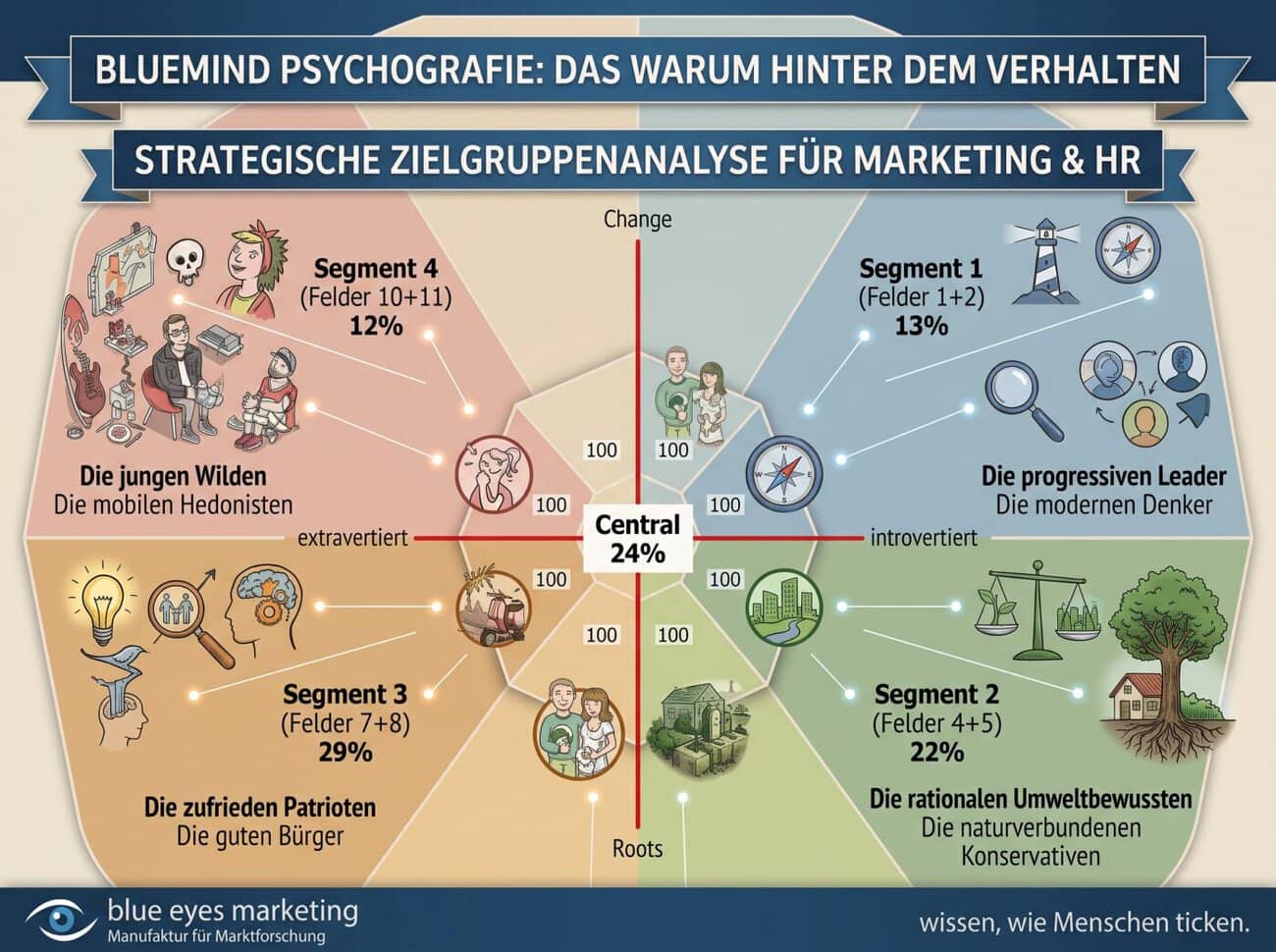
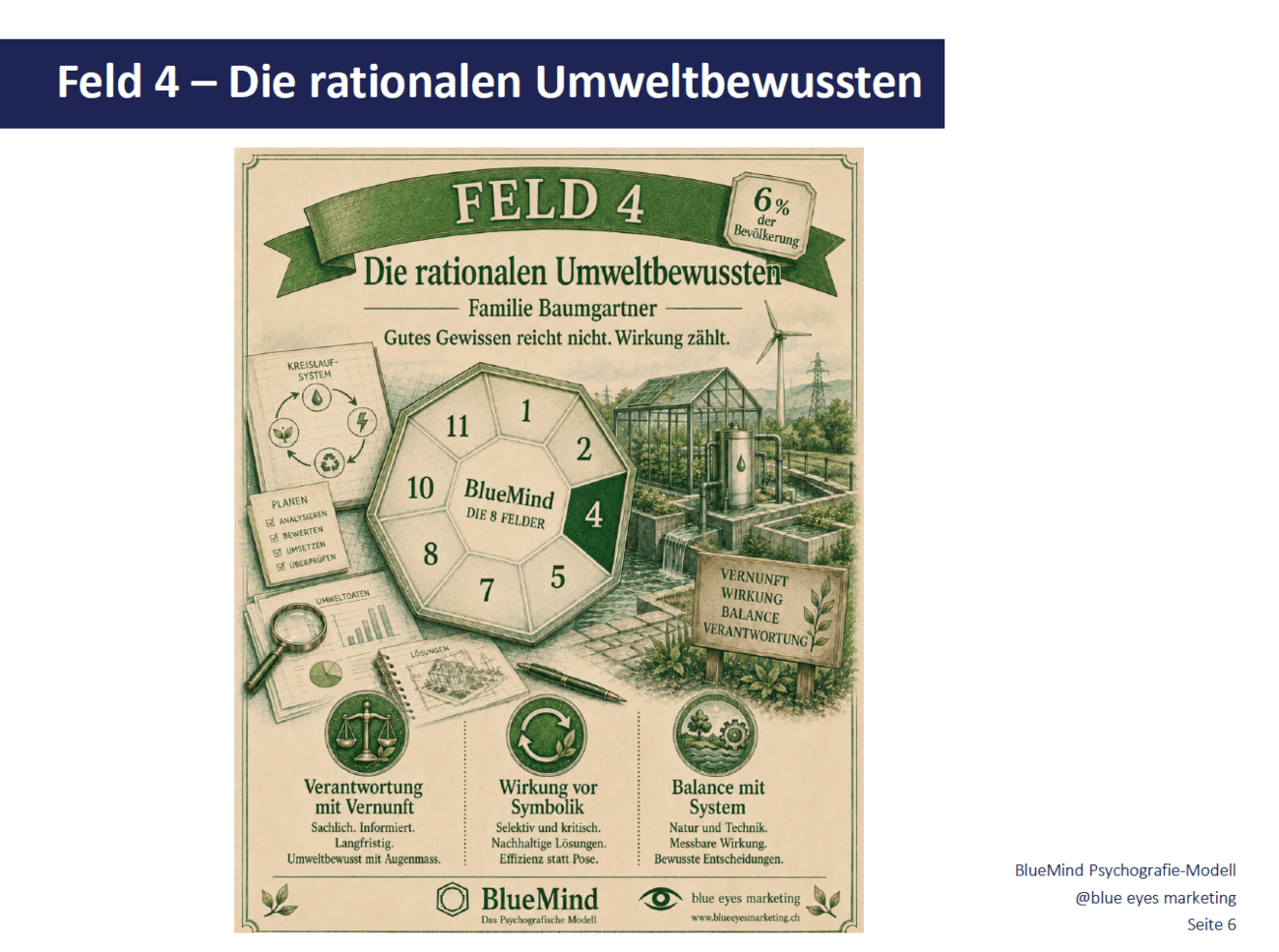
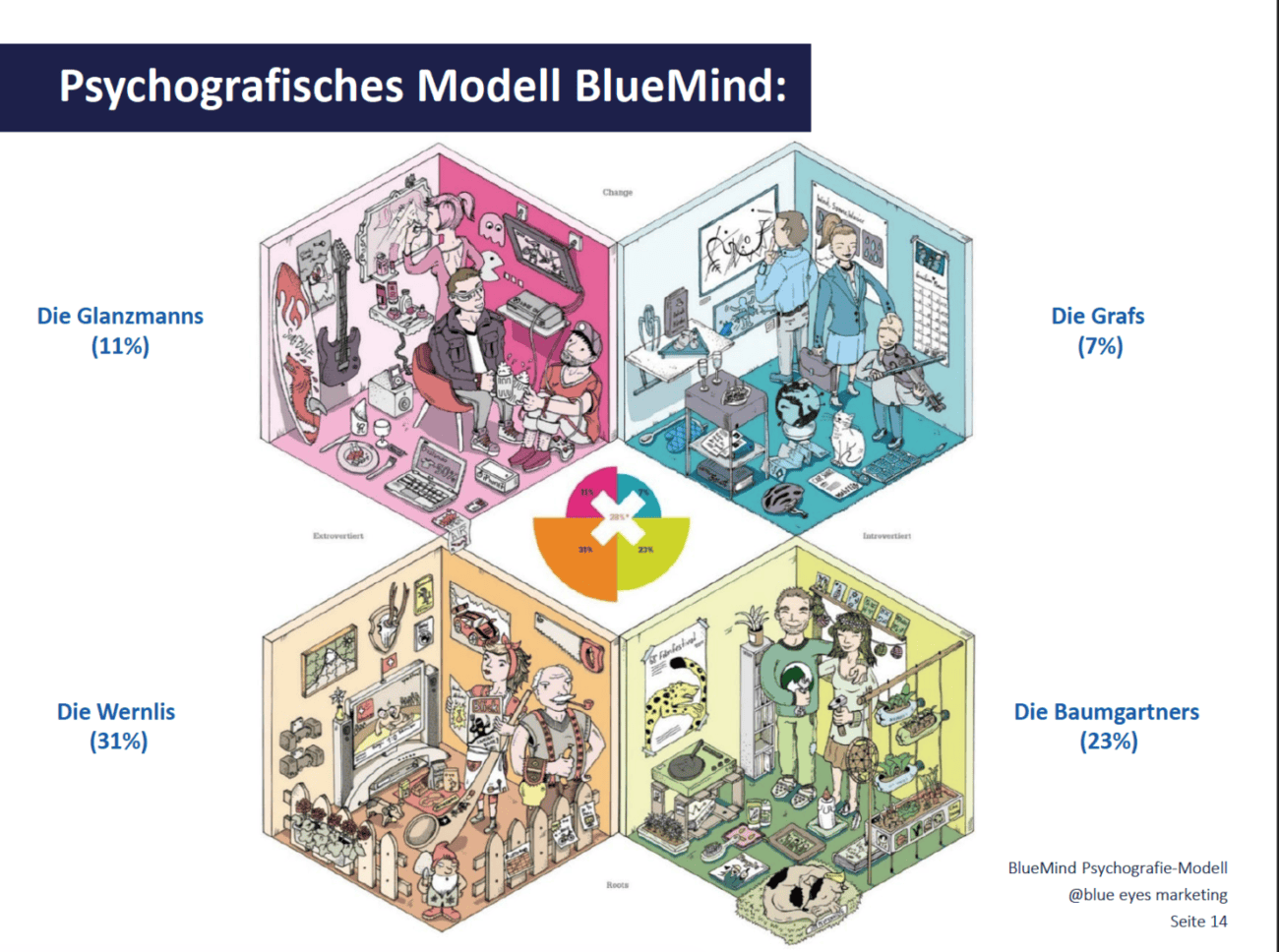
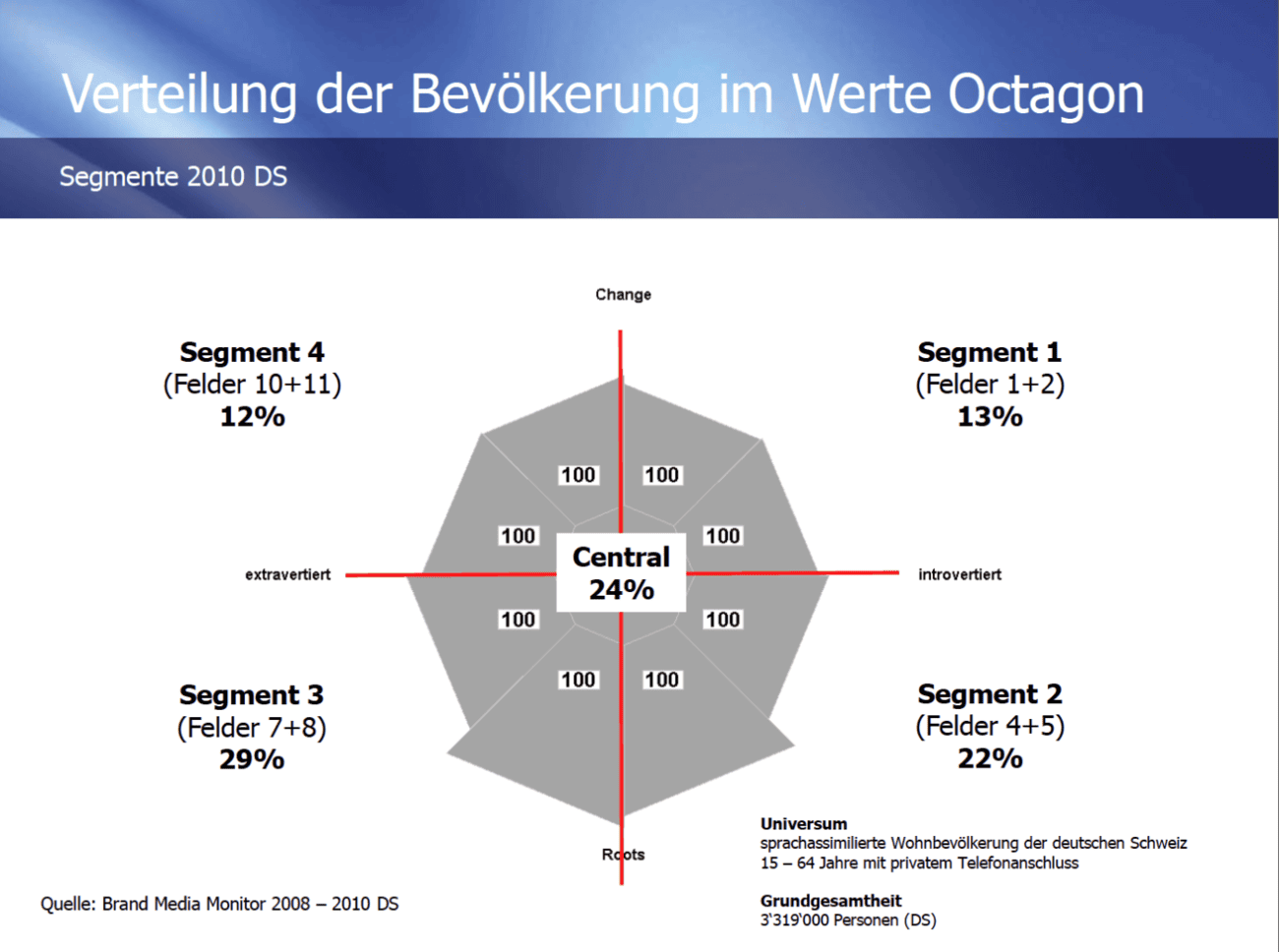
The underlying BlueMind Model spans two central axes: Change versus Roots as well as Extroverted versus Introverted. From this, eight psychographic fields are derived, which can be grouped into four broad value families:
-
The Glanzmanns (approx. 11 %): Mobile, hedonistic, adventure-seeking, and tech-savvy—open to change, but not very brand-loyal.
-
The Grafs (approx. 7 %): Intellectually alert, thoughtful, quality-conscious, and substance-oriented.
-
The Wernlis (approx. 31 %): Rooted in the community, safety-oriented, reliable, and economical.
-
The Baumgartners (approx. 23 %): Close to nature, conservative, focused on tried-and-true methods and longevity.
(Supplemented by the balanced midfield «Die Müllers» with approximately 24–28 %).
When such psychographic characteristics are linked to actual purchasing, brand, and media usage behavior in surveys, a hypothetical persona becomes a statistically reliable, targetable audience..
Working Closely with HR
The BlueMind Labs approach certainly doesn't end at the customer interface. Brand promises are fulfilled by people: Employees in customer service, sales, or product development shape the brand experience every day.
A look at internal values is correspondingly enlightening: When teams in direct contact with customers act quickly, pragmatically, and in a solution-oriented manner, while back-office departments focus on process reliability and risk minimization, both are pursuing the same goal—but friction is inevitable.. What some see as speed, others perceive as pressure; what some see as diligence, others see as stagnation.
The key point of intersection between marketing and HR is therefore this: How well do the brand, the workforce, and the customer base truly align with one another in terms of values??
Not a new category, but depth of field
Psychographics is not a panacea and must not be allowed to degenerate into yet another rigid template. People are complex, change over time, and react differently depending on the situation. It does not replace demographic data or web analytics—its strategic value lies in the combination.
Today, marketing has an abundance of data points. Nevertheless, campaigns fall flat because they lack a response. The next stage in modern target audience analysis isn't about counting even more clicks, but about enriching existing data with psychological depth.
Those who understand what customers do can optimize processes. Anyone who, thanks to BlueMind and psychographic research, understands, why When they do it, they win people over.