Export industry defies global uncertainty
Despite the conflict in the Middle East, the customs dispute and geopolitical tensions, companies in Germany and Switzerland are surprisingly optimistic about their export prospects. While German exporters are mainly struggling with risks and the pressure to adapt, Swiss SME export sentiment is on the upswing again following the reduction in US tariffs. However, confidence is on shaky ground.





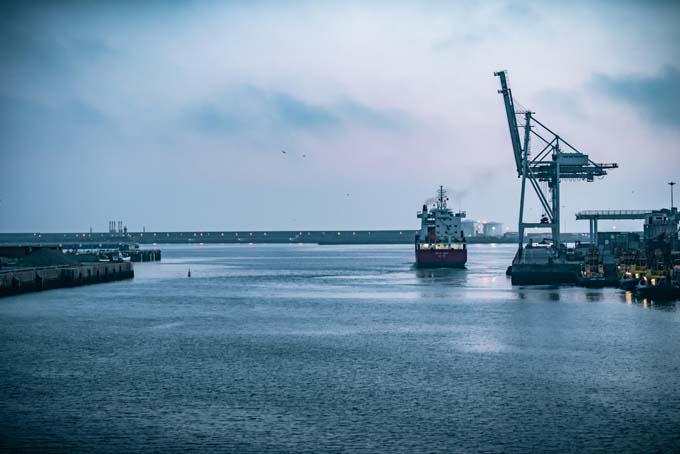
The ceasefire in the conflict between the USA and Iran declared on the night of April 7-8 brought relief to the economic world. This was directly reflected in rising stock market prices and a fall on the oil price front. Nevertheless, it remains to be seen how sustainable this easing of tensions will be for the export industry.
Optimism despite uncertainty
Geopolitical tensions, such as in the Middle East, and not least US President Donald Trump's tariff policy, which has been in place since 2025, have put pressure on export markets. Against this backdrop, it is actually surprising that export-oriented companies are nevertheless quite optimistic about their prospects. At any rate, this is the conclusion drawn by two recent surveys by Allianz Trade and Switzerland Global Enterprise (S-GE). While the Trade Global Survey published on April 8 surveyed 6,000 companies in Brazil, China, France, Germany, India, Italy, Poland, Singapore, Spain, the United Arab Emirates, the UK, the USA and Vietnam, the S-GE survey reflects the export sentiment of Swiss companies. It was published in January 2026 and therefore does not yet take into account the outbreak of war in the Persian Gulf. Both surveys are therefore snapshots.
German exporters remain surprisingly robust
First, let's take a look at our northern neighbor, which remains the most important export market for Swiss companies: How do export-oriented companies there assess the outlook? According to Allianz Trade, German exporters are proving more resilient than many of their international competitors. 83% of the companies surveyed expect export sales to rise despite the escalation in the Middle East; 41% expect a moderate increase of 2 to 5% over the next twelve months.
At the same time, confidence is accompanied by skepticism: 49% expect the US trade war to continue to have a negative impact in 2026, and almost half expect payment practices abroad to deteriorate. The biggest risks include the aforementioned geopolitical uncertainties, but also supply chain problems, transportation and financing risks.
Adaptation instead of waiting
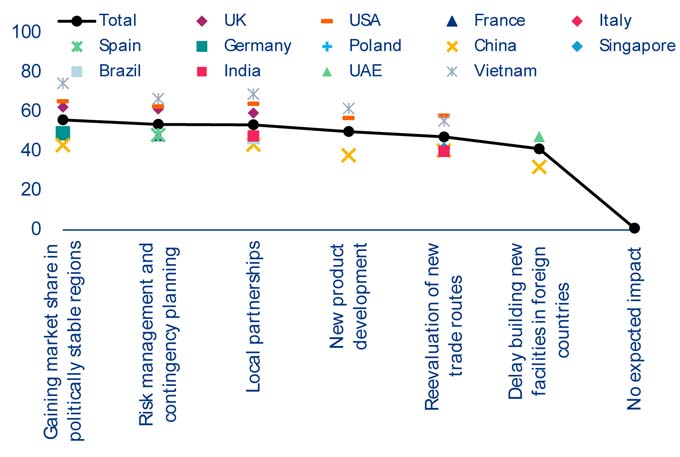
How can this optimism be explained? The answer is probably to be found in the increased resilience of German companies. Many of them have already reacted to the new environment: 80% have adjusted their trade and supply chain routes since Liberation Day, and 40% are rethinking or delaying production plans abroad. They cite friendshoring, i.e. trade relations with «friendly» countries, new products, local partnerships and stronger risk management as the most important strategies.
Companies are also focusing on greater security in their supply chains: 60% are building up stocks, 55% are developing new suppliers and 52% are expanding into new markets. In an international comparison, German exporters tend to act cautiously; the urge to redirect via third countries is more pronounced worldwide than in Germany, according to the study by Allianz Trade.
Switzerland: cautious optimism
Export sentiment in Switzerland is also better than expected. The situation is brightening somewhat for Swiss SMEs in particular - at least according to the assessment at the start of 2026. According to the S-GE survey, export sentiment is clearly above the growth threshold again at 63.5 points; 57.2% expect exports to rise in the first half of 2026, while only 15.9% expect a decline. For 2026 as a whole, 63% expect a positive development.
However, the report emphasizes that no trend reversal towards sustained growth can be derived from this. Four out of five companies surveyed expect only minor changes to their export volume, mostly in the region of plus or minus 10 percent. The mood thus remains characterized by a «zigzag movement» that has reflected the high volatility of the global economy since 2022.
Relief through US tariffs
A significant boost to sentiment comes from the US: Swiss companies have reacted with relief to the reduction in US tariffs from 39% to 15%. Although 40% still expect negative effects, this is less than in summer 2025, when 58% still saw burdens from the US tariffs.
Around three out of five companies have therefore already taken or are planning to take measures, such as reducing margins, adjusting prices or examining alternative markets. It is particularly striking that the option of a stronger local presence in the USA is gaining in importance: the proportion of companies that can envisage such a presence has almost doubled within six months.
Free trade as a driver of growth
Free trade agreements are playing an increasingly important role for Swiss SMEs. 69% already benefit from at least one agreement, and 61% expect to benefit from new or planned agreements in the future, particularly with India.
At the same time, the study shows that there are still gaps in knowledge and implementation. A lack of internal expertise, administrative hurdles and complex rules of origin make it difficult for many companies to take full advantage of existing agreements. This means that while free trade remains an important source of hope, it is not yet a sure-fire success.
Common pattern
Both countries share a similar basic pattern: companies see opportunities, but they are taking greater account of uncertainty, geopolitical shocks and higher friction losses in global trade. German exporters are reacting in particular with hedging and restructuring, while Swiss SMEs are relying on an easing of US tariffs and free trade agreements.
The view ahead is therefore not euphoric, but not resigned either. In Germany, resilience under pressure dominates, in Switzerland cautious optimism with a view to new trading areas. Flexibility and adaptability continue to be decisive factors for exporters. Diversification of sales markets and resilient supply chains remain the order of the day. Research and development is also becoming increasingly important: only through constant innovation will companies be able to achieve and maintain market leadership in their sectors. Something that SMEs in Switzerland and also in Germany have always been good at.
Sources: Alliance Trade and Switzerland Global Enterprise S-GE