Zurich SMEs are more pessimistic about the future
The sixth edition of the «KMU ZH Monitor» published by Zürcher Kantonalbank shows a clearly gloomy mood among Zurich SMEs. Fewer and fewer companies are expecting sales and margin growth - at the same time, weak demand and regulations are gaining in importance as challenges. The differences between sectors are considerable.


The «KMU ZH Monitor» will be published for the sixth time in 2026. The annual study by the ZHAW, commissioned by Zürcher Kantonalbank, examines the situation of SMEs in the canton of Zurich in a challenging economic and geopolitical environment. A total of 1287 companies took part in the survey, which was conducted between March and April 2026 - more than ever before.
Negative sentiment trend continues
The overall mood among SMEs in Zurich has deteriorated in 2026. Currently, 60% of companies rate their situation as positive - in 2025, this figure was still 64%. The outlook for the future is also more subdued: The proportion of SMEs expecting positive business development fell from 70% to 64% compared to the previous year.
«Sentiment has been trending downwards for several years,» says study director Dr. Patrick Chardonnens from the ZHAW. This can also be seen in the expectations for turnover and margins: looking at the difference between positive and negative expectations, 41% of SMEs still expected net turnover to increase in 2022. Today, the figure is 12%. SMEs have also become more pessimistic when it comes to margin expectations: in 2026, positive and negative assessments are in balance.
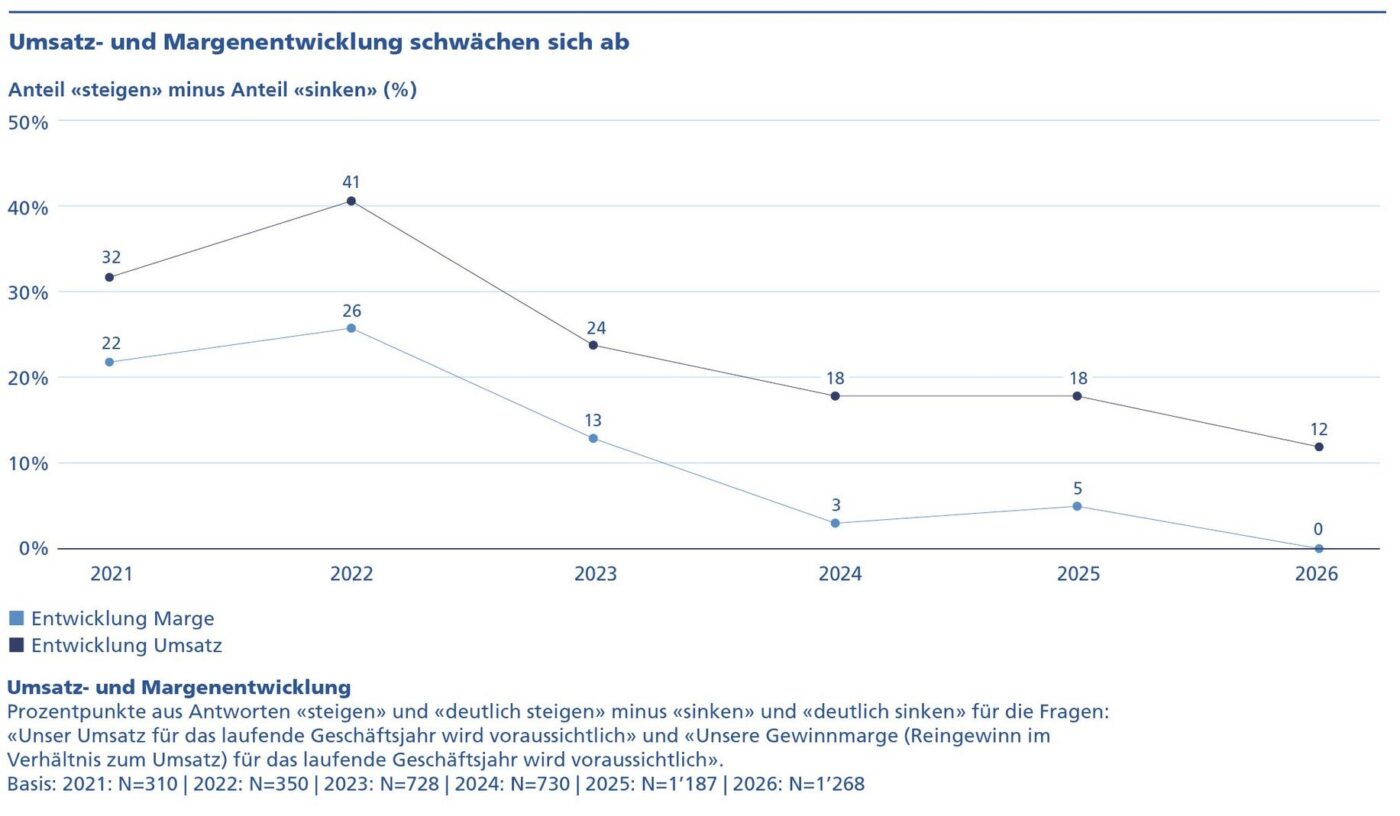
For SMEs, the cooling market sentiment means less growth - even for those that say they have sufficient market demand. The surplus of companies that are creating jobs compared to those that want to cut jobs has shrunk to around a third since 2022. Only 10% more SMEs are planning to increase their workforce rather than reduce it.
Challenges have shifted
One reason for the deterioration in the overall situation could be the significantly lower market demand. Since 2023, the proportion of SMEs that classify «insufficient market demand» as a major challenge has doubled. Around a third of companies are now struggling with weak demand. In this context, almost half of SMEs are focusing on a new topic: customer acquisition, which now ranks third among the top challenges.
In line with falling demand, challenging customer acquisition and declining staff recruitment, the ongoing issue of staff recruitment has become less important for SMEs - it ranks fourth this year. Between 2023 and 2026, the proportion of SMEs that see staff recruitment as a challenge fell from 63 to 42 percent.
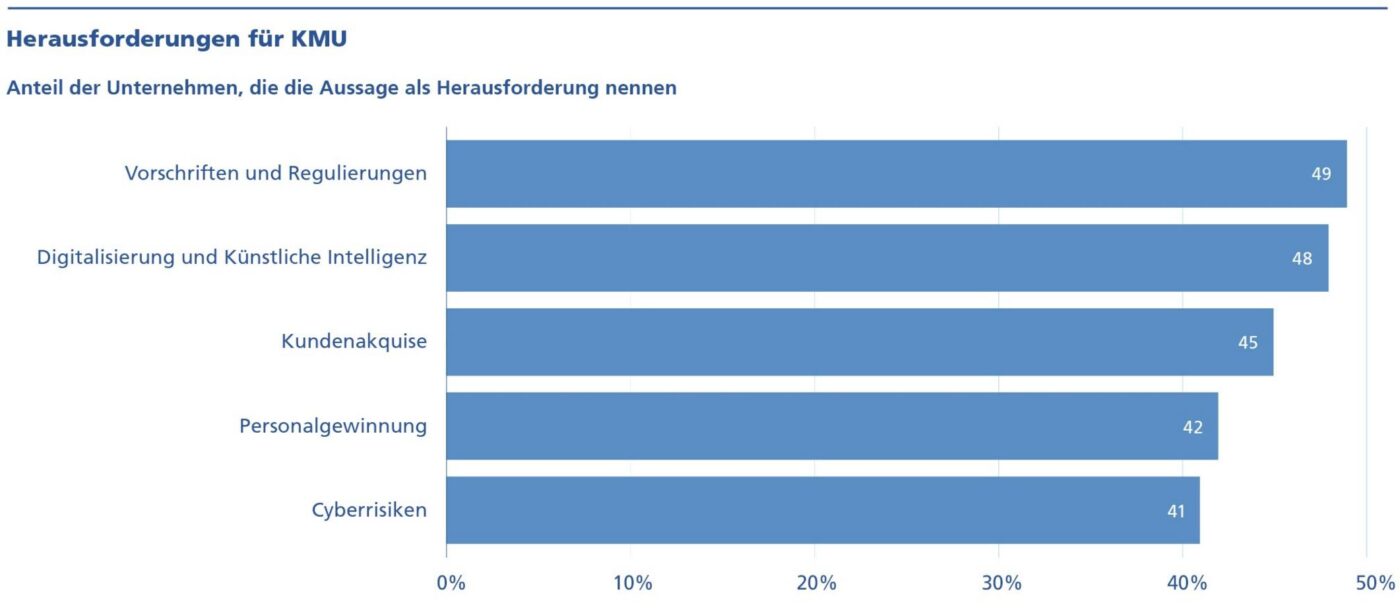
SMEs see «rules and regulations» as a top challenge. This topic has become slightly more important and is now a challenge for half of all SMEs. «Digitalization and AI» remains in second place, with smaller companies in particular increasingly perceiving this challenge.
Industry and trade burdened by low demand
A detailed look at the survey results shows clear differences between sectors. «We are also feeling the reluctance among our customers - especially when it comes to investment decisions,» says Patrick Sulser, Head of Special Advisory and Financing at Zürcher Kantonalbank. «At the same time, it is clear that the situation varies greatly depending on the sector. The broad participation of companies from various sectors in the KMU ZH Monitor provides a sound insight into the current situation of Zurich's SMEs.»
The mood in industry and trade is particularly gloomy. Here, less than half of companies rate their business situation as good (industry: 30%, trade: 47%). The majority of these SMEs expect margins to fall, and the proportion of SMEs with positive sales expectations is low compared to the rest of the sector. The proportion of SMEs that cite «insufficient market demand» as a challenge is slightly more than 11% above the overall average in both industry and trade. In addition, the strong Swiss franc is having an above-average impact on industry (+22.8%), while competitive pressure is the main challenge in trade (+15.5%).
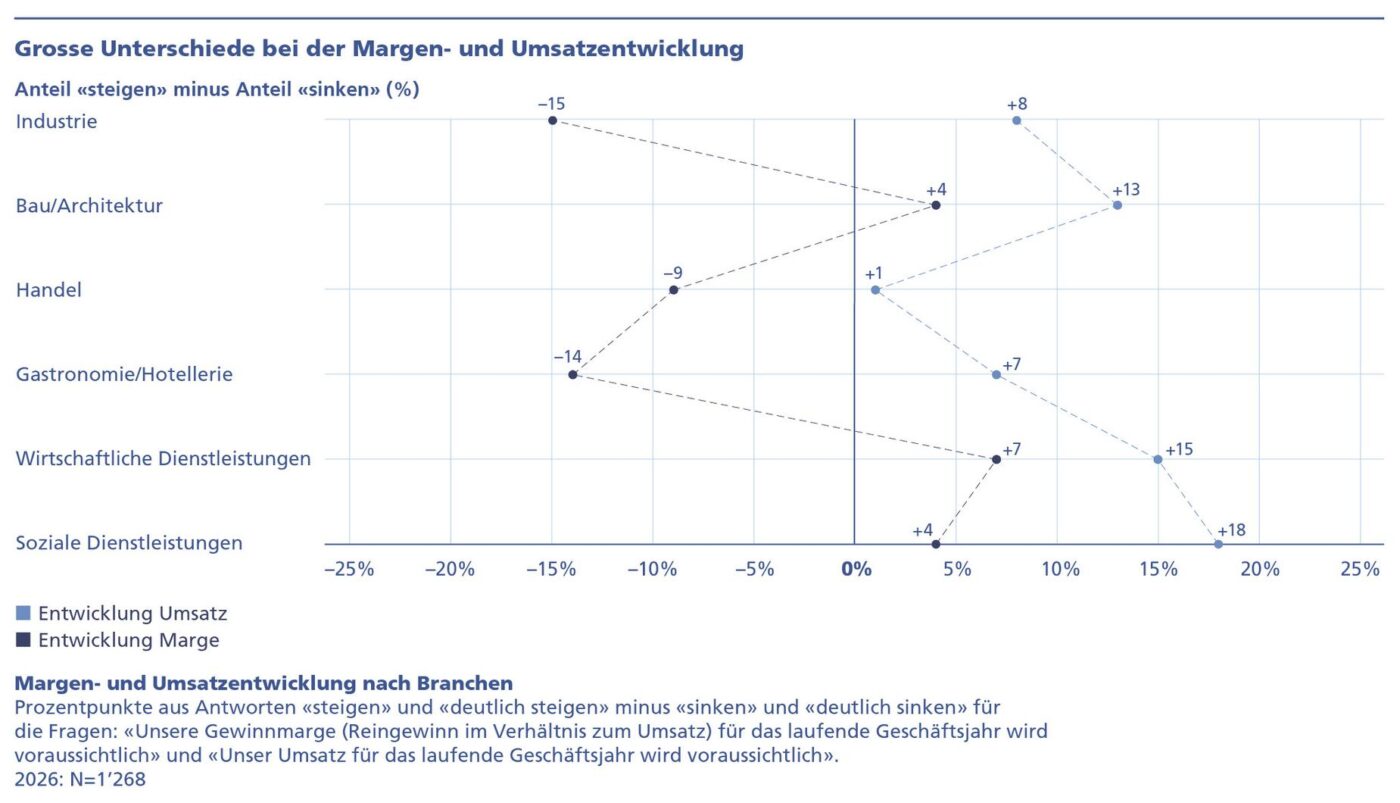
Construction and services provide bright spots
The deterioration in the overall assessment is not equally pronounced in all sectors. SMEs in the construction/architecture and economic and social services sectors continue to take a positive view of their economic situation. More than half of these companies continue to rate their business situation as good (construction/architecture: 70%, social services: 57%, economic services: 52%). The majority also expect turnover and margins to increase.
In this environment, recruitment remains a key issue for the construction/architecture sector. A total of 67.5% of companies in this sector see this as a challenge - 25 percentage points more than the sector average. For SMEs in the social services sector, on the other hand, «digitalization and AI» are among the biggest challenges. In the business services sector, the proportion of companies citing this topic as a challenge is 7.8 percentage points higher than the average.
Source: www.zkb.ch