Swiss companies are increasingly relying on AI for customer experience management
Customer experience has become much more important in Swiss companies. The Swiss CEX Study by Lucerne University of Applied Sciences and Arts recorded a new high of 59% in terms of maturity. Particularly noteworthy: AI projects, which hardly played a role two years ago, will be a reality in many companies by 2025.


Swiss companies rate their progress in customer experience management more positively than they have in years. This was revealed by the Swiss CEX Study conducted by Lucerne University of Applied Sciences and Arts in collaboration with Nexa Consulting. Compared to the previous year (53%), the maturity level has reached a new high of 59%. The acceleration of this development since 2023 is particularly remarkable: A consistent improvement is evident in both German-speaking and French-speaking Switzerland.
Measures take effect
The maturity level is based on an assessment of 14 individual criteria relating to customer experience management in the companies. It is a measure of how far companies have progressed overall and in various sub-areas.
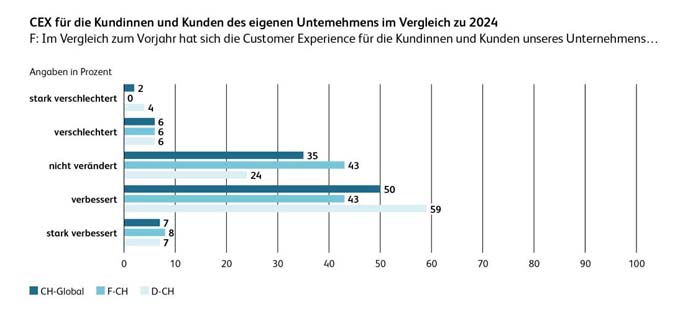
Almost 60 percent of the companies surveyed stated that the customer experience they offer has improved in the past year. Those responsible increasingly rate their measures as effective. The study therefore shows not only rising ambitions, but also increasing professionalization in the area of customer experience.
AI is becoming increasingly important
A key finding of this year's study is the rapid development in the area of customer experience and artificial intelligence. While AI projects hardly played a role two years ago, they will be a reality in many companies by 2025. Although the scope and degree of maturity of the implementations vary considerably, AI has clearly established itself in the context of the customer experience.
Chatbots are the most widespread and have already been implemented in around 40% of companies - compared to 20% in 2024. Voicebots are also making progress, but the majority are still in the discussion phase. Other solutions such as vocal biometric identification are «not an issue» for the vast majority of respondents.
«Progress in the field of AI has been remarkable over the past two years. It will be interesting to see what developments we can record in the anniversary study at the end of 2026,» says study author Michael Grund.
Stable investments - focus on employees and processes
Around 50% of companies are planning stable investments for 2026, while 35% are planning an increase. The most important goals continue to be increasing customer satisfaction and strengthening customer loyalty as well as strengthening the brand. Employee training is once again seen as a key area of investment, followed by AI initiatives and process optimization.
About the Swiss CEX Study
The 9th edition of the Swiss CEX Study has been published. Thanks to the collaboration of three institutes of the Lucerne University of Applied Sciences and Arts (Institute of Business and Regional Economics, Institute of Communication and Marketing and the Institute of Financial Services Zug) and the partner Nexa Consulting, the Swiss CEX Study combines practical consulting expertise with a scientific basis.
The assessment is based on 14 individual statements covering three key areas: Vision & Leadership (including strategy, anchoring in management, resources), Interaction & Intelligence (customer interaction, data and knowledge management, product development) and Excellence & Performance (processes, technology, measurement systems, profitability).
Further information and the complete study can be found at www.hslu.ch.