Study: Data exchange between healthcare institutions welcomed by patients
In Switzerland, discussions about the electronic patient dossier continue, while the Federal Office of Public Health (FOPH) continues to identify deficits in the digitization of processes: Almost all illnesses still have to be reported in analog form, as was reported in various media. The FOPH's reasoning: by reporting by telephone or fax [...]





74 percent of patients welcome data sharing
This is contrasted by the rapidly advancing developments in telemedicine. An initial consultation via an online medical platform can make many doctor's visits superfluous and means a reduction in the burden on the healthcare system. But what should happen to the data collected during a consultation with an online doctor? In Germany, Axway, a provider of API management solutions, surveyed 1,000 patients to find out how they view the possibilities of telemedicine. The opinions revealed a tension between a convenient service experience, data security and control over one's own patient data.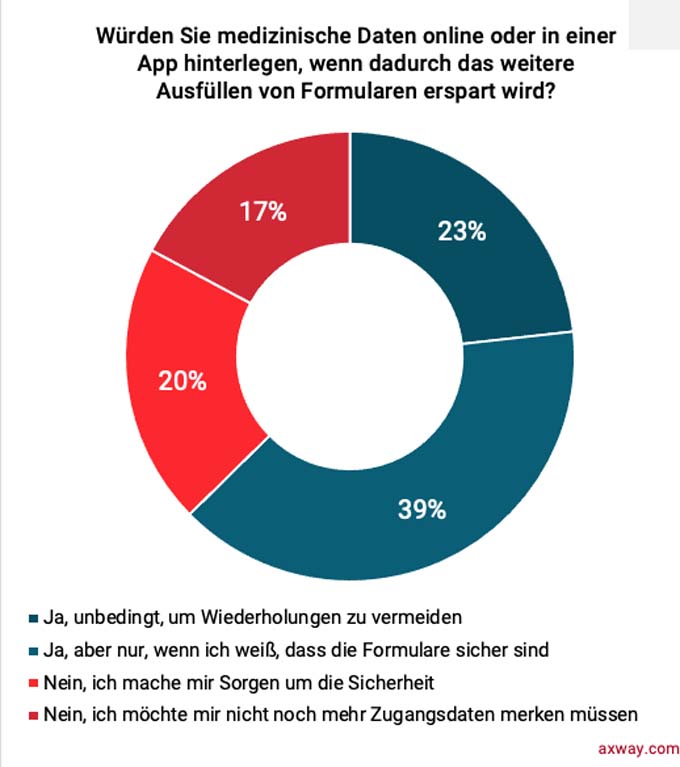
Hope for process optimization and increased convenience
Sixty-five percent want medical providers to always have access to the patient's current treatment status. For the following reasons:- 29 percent: It could reduce misunderstandings and human errors.
- 26 percent: It would be significantly more convenient.
- 23 percent: It could save repeated filling out of forms.
- 21 percent: It could improve treatment.
Data security and control is the biggest concern
For the majority of patients, the security of their data is the biggest concern in connection with telemedicine. 51 percent assume that health data is not safe from hackers, only 22 percent were of the opposite opinion. Twenty-six percent said they were unsure and could not make a definitive statement. On the other hand, when asked if patients would pay for an app that provides secure access to their immunization record and comparable medical data, two-thirds - 66 percent - answered "no." Uncertainty and lack of transparency also seem to be factors that concern patients: 72 percent of respondents would like to have more control over who can access their patient records.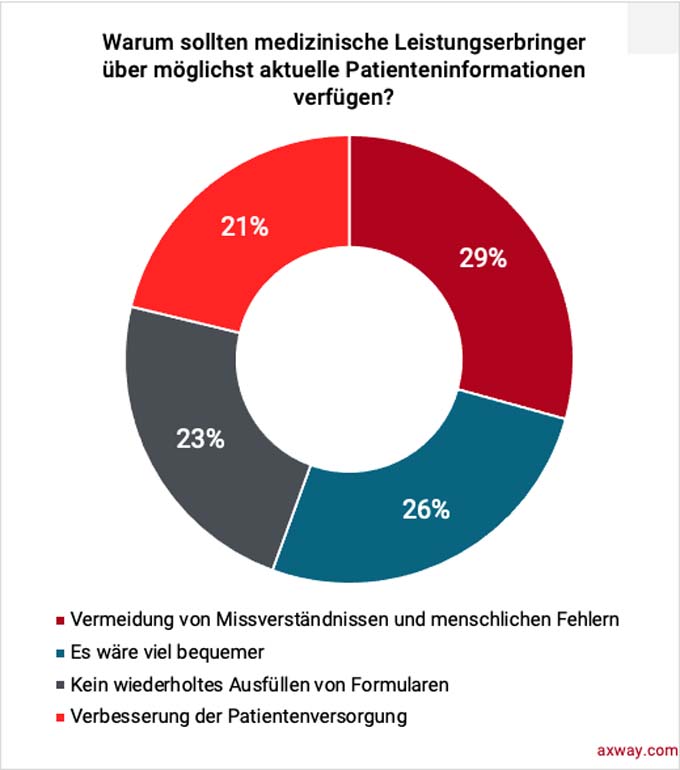
Data exchange yes, but only if it is secure
"Patients in Germany are caught between the familiar convenience of digital services, data security and control," Yves Lajouanie, SVP and General Manager EMEA at Axway, commented on the results. "The survey's sentiment also reflects an international trend in the telemedicine market: big tech and big retail players, such as Amazon, are currently trying to extend the convenient experience their customers have grown accustomed to from them to the healthcare and medical space by acquiring medical services, and further tying them to their platforms. Healthcare is at risk of losing data sovereignty to private providers. It is therefore important for healthcare organizations to design their digital ecosystems in such a way that they can easily transfer patient data into and receive it from other systems and applications according to generally accepted security standards. In this way, they can succeed in delivering value and a fulfilling digital service experience to their patients." To a significant extent, these assessments from Germany can also be applied to Switzerland. Here, too, data security and the ability to control the exchange of data are the factors that determine the success or failure of an electronic patient record. Source: AxwayThis article originally appeared on m-q.ch - https://www.m-q.ch/de/studie-datenaustausch-zwischen-gesundheitseinrichtungen-wird-von-patienten-begruesst/