Dualis shows: Production planning becomes adaptive
Variant diversity, material bottlenecks and volatile supply chains pose growing challenges for production planning. Dualis GmbH IT Solution explains why reliable data, historization and analytics are crucial - and how planning will systematically learn from actual execution in the future.


Production planning is changing fundamentally. For a long time, the focus was on allocating orders to resources and time slots as efficiently as possible. Today, an additional question is coming to the fore: how can planning learn from practice instead of just starting from the current status every time a new plan is drawn up?
«For Dualis, this is precisely the next level of maturity for modern production planning. Planning must not only calculate the current status, but must learn from the actual execution. A plan is only good if it can be adapted quickly and works under actual conditions,» says Dr. Kirsten Hoffmann, Product Manager at Dualis.
Data basis as a limiting factor
Production planning is subject to numerous restrictions - from materials and machines to shift models, qualifications and technological dependencies. In addition, there are conflicting objectives between throughput time, capacity utilization, costs and adherence to deadlines.
At this point, a central weakness of many planning systems becomes apparent: the database. Realistic production planning only works as well as the data on which it is based. This includes master data such as articles, parts lists, work plans, setup matrices, capacities and target times as well as movement and feedback data from production.
Small errors in the master data can have a major impact. An inaccurate target time, an incompletely maintained work plan or an incorrectly modeled setup status can have considerable consequences. A plan may seem plausible, but in practice it often proves to be too optimistic, too unstable or impossible to implement.
Historicization as a decisive lever
If production planning is to become adaptive, it is not enough to calculate the current status. The ability to systematically compare planning and actual execution over time is crucial. Companies must be able to understand what a plan looked like at a certain point in time, when and why it was changed and how production actually went. Only this temporal context makes deviations explainable - and usable.
«Production planning is always a hypothesis about how production will develop under the current assumptions. That's why it's not enough to have good data once. Planning must be continuously compared with reality and adapted,» says Dr. Kirsten Hoffmann.
A versioned storage of plan statuses and their changes makes patterns and systematic deviations visible. In combination with actual feedback, it is possible to find out where production deviates from the plan, which processes take longer, how often rescheduling takes place and where bottlenecks occur.
Ganttplan Analytics closes the gap between planning and reality
With Ganttplan Analytics, Dualis pursues a deliberately pragmatic approach. The tool systematically combines planning with actual execution and analyses and visualizes the relationship between planning and actual implementation.
This creates a reliable data basis on which planning processes, deviations and trends can be evaluated. The added value lies in the perspective: planning is no longer just viewed as a current target state, but as a process whose quality can be evaluated over time. Companies can see how stable the planning was, how often plans were changed and where assumptions deviate from reality.
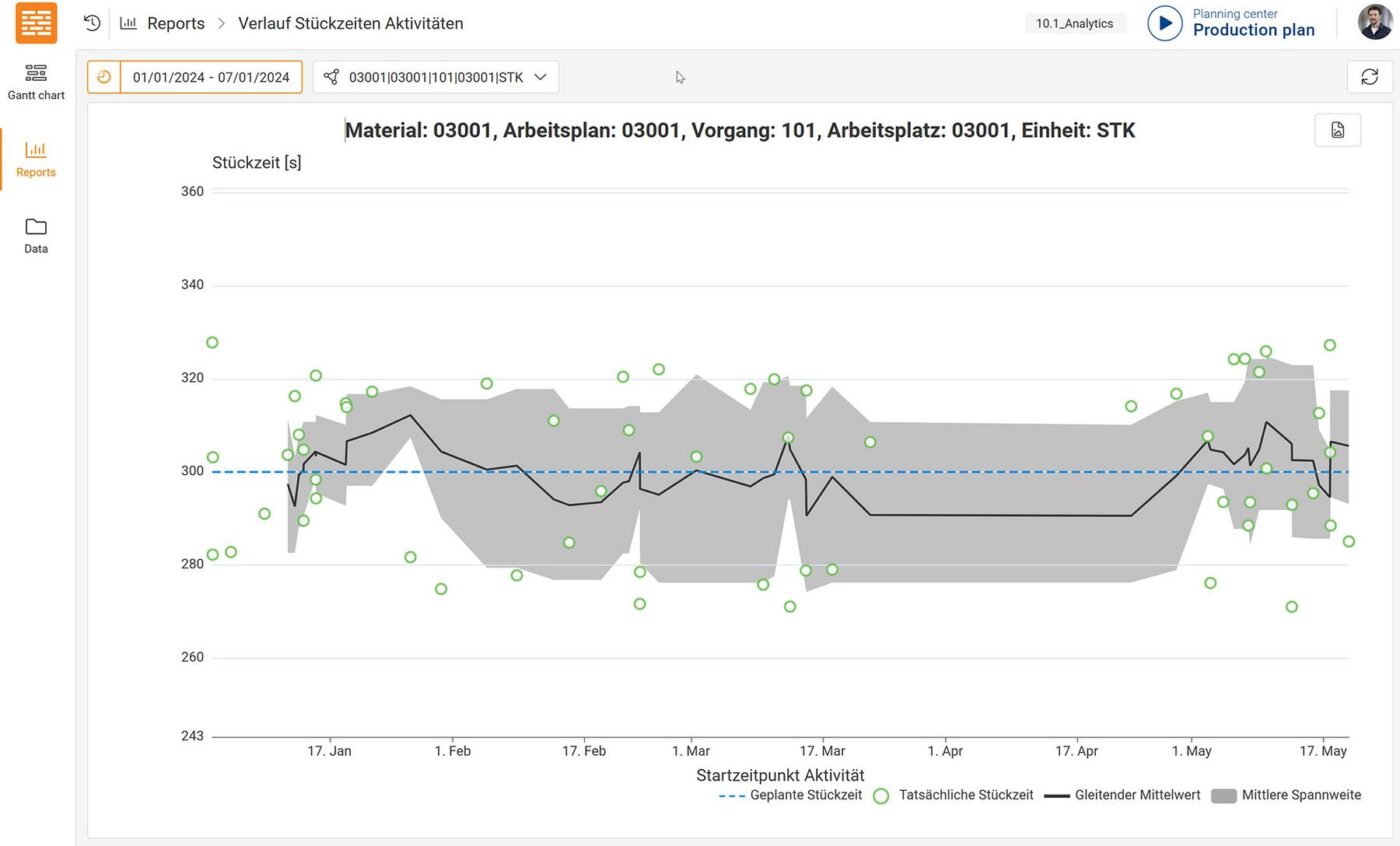
Key figures, reports and dashboards create transparency regarding throughput times, inventories, adherence to delivery dates and bottlenecks. More realistic forecasts for process durations, delivery dates or risks can be developed on the basis of historical data.
«In future, industrial companies will need more resilient plans, more stable processes, more realistic deadlines and faster responsiveness. These capabilities arise from the consistent linking of planning and reality,» explains Dr. Kirsten Hoffmann.
The target image is not a radical break with existing approaches, but a learning workflow. People remain at the center: they evaluate, prioritize and decide. Only this continuous feedback loop makes production planning truly adaptive.
Source and further information: www.dualis-it.de