Smart Building Management: Data and Expertise as the Key to Efficient Buildings
At the ZHAW’s first practice-oriented symposium, «Smart Building Management: Operational Optimization,» more than 160 experts from the fields of research and industry discussed how artificial intelligence, data, and expertise are transforming building operations. The focus was on the areas of investment, operations, and data.


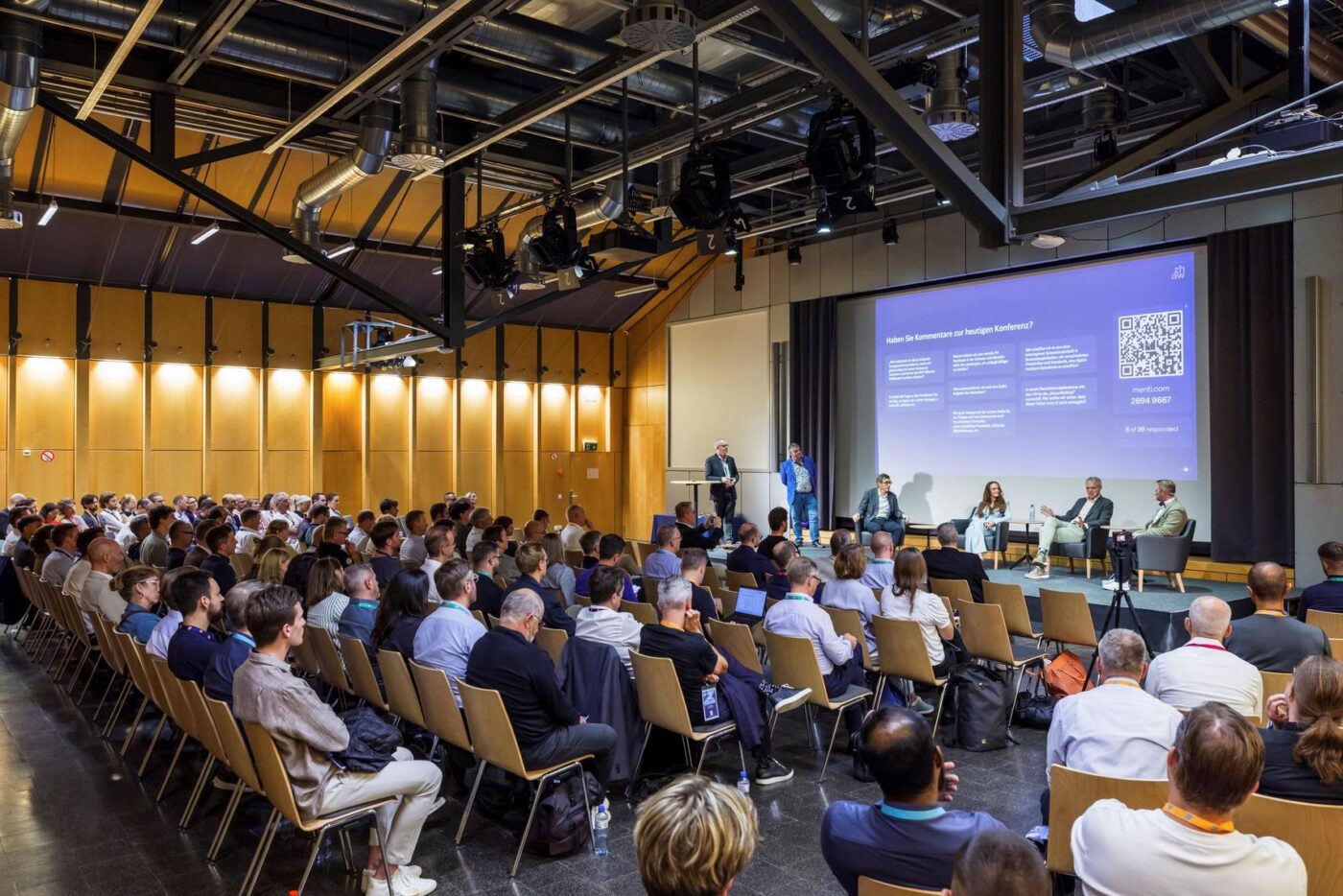
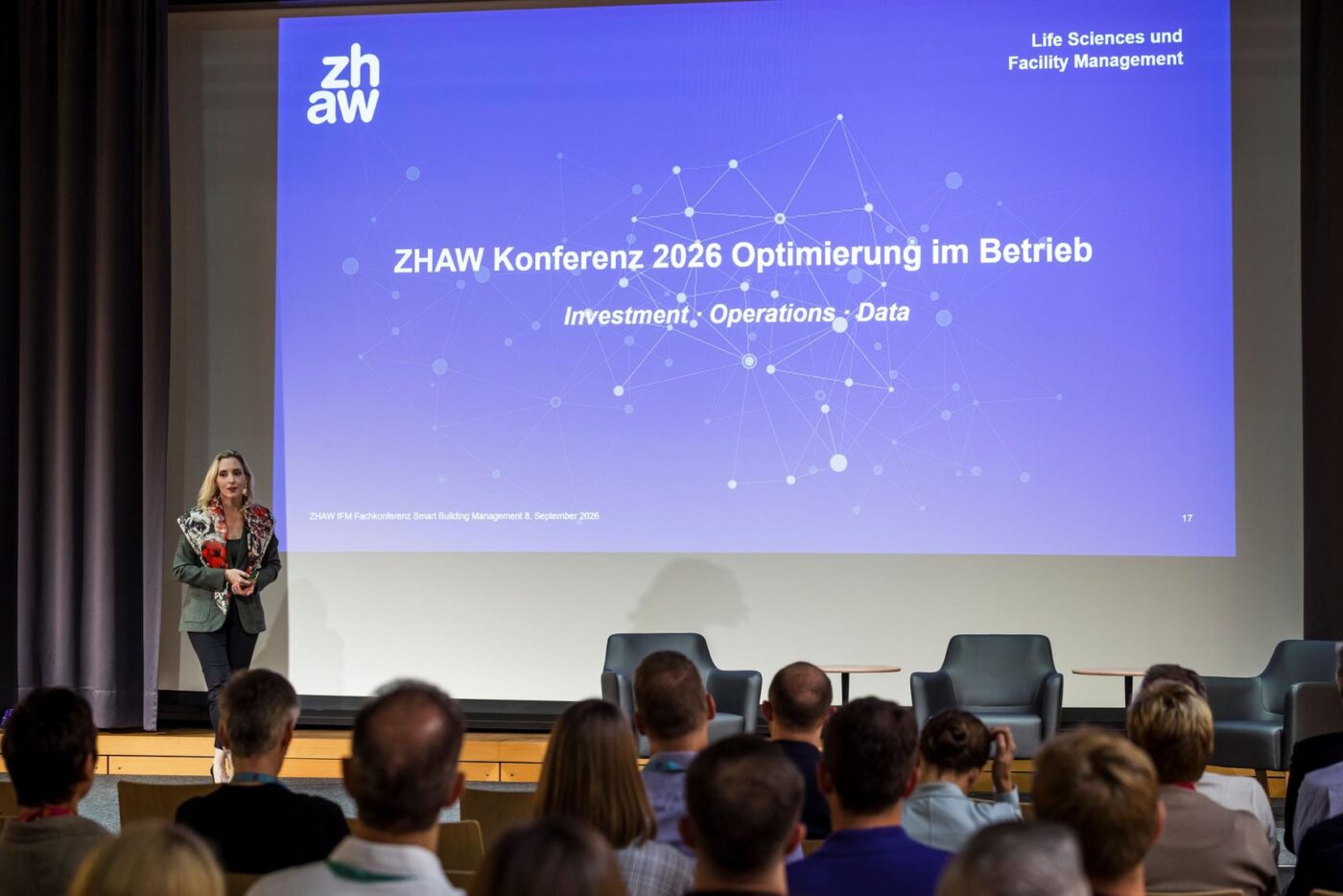
Smart Building Management aims to operate buildings in a way that is efficient, sustainable, comfortable, and conducive to good health. While technical capabilities are constantly expanding, the central challenge remains the same: buildings must meet the needs of their users while also being operated economically. The Smart Building Management Competence Group at the ZHAW Institute for Facility Management hosted the first practice-oriented symposium on this topic on September 8, 2026. Prof. Dr. Andrea González, head of the Competence Group, welcomed over 160 participants to Technopark Zurich.
AI Challenges Organizations
The first session, «Investment,» focused on the hypothesis that more technology does not automatically make buildings better. In her presentation, Marie Seiler, CEO of Pensimo, highlighted the areas in which artificial intelligence is used, such as to optimize the operation of heating systems. In most cases, the energy savings more than offset the high initial costs. In her view, it is essential to always keep in mind that the lifespan of technology is much shorter than that of buildings. Hannes Pichler, Director of ETH Real Estate, emphasized that every investment in technology must serve a specific purpose. He presented the design-build process, in which planning and construction—which are traditionally separate—are awarded together as a single contract. This leads to shorter implementation times and lower costs. In his presentation, Jan Eckert, Head of JLL Switzerland, raised the question of how artificial intelligence is changing the work environment. In his view, AI is completely transforming organizational structures in the real estate sector. However, the costs of AI should not be underestimated. He also pointed out the problem that AI poses a threat of a broad-based loss of expertise—and that fostering the next generation of professionals is a major challenge.
The panel discussion that followed made it clear that the introduction of AI is not primarily a technological challenge, but rather an organizational one. Companies must determine which tasks can be automated and where human oversight remains necessary. Data quality is a key prerequisite. There is a growing need for specialists who can evaluate data and derive recommendations for action from it.
Operations as a Key Driver of Efficiency
In the second session, «Operations,» the discussion centered on the hypothesis that, in the future, smart buildings will operate more efficiently under autonomous AI control than under human management. In his introductory presentation, ZHAW researcher Dr. Simon Ashworth highlighted projects being carried out in collaboration with industry partners. As an example, he cited the city of Thun, where the focus is no longer just on smart buildings but on a smart city. Tim Frey, Managing Director of EnergieSchweiz at the Swiss Federal Office of Energy, emphasized energy efficiency as one of the three pillars of Switzerland’s energy strategy. In many places, there is still significant potential for optimization, such as with incorrectly configured heat pumps or inefficient lighting systems. Through operational optimizations, savings of up to 30 percent can sometimes be achieved.
Martina Reinholz, President of SVIT FM Switzerland, emphasized that an autonomous building is only as smart as the way it is operated. The transition from the construction phase to the operational phase poses a particular challenge, as it is crucial to ensure that important information is not lost. To better leverage the potential, new roles are being discussed that combine technological, organizational, and operational aspects—for Martina Reinholz, these are Operational Intelligence Managers. Oliver Hofmann and Serafino Melloni, CEO and COO of Vebego, respectively, presented their vision of data-driven facility management. The focus here is on added value for customers. They cited ventilation systems as an example: Thanks to real-time data, ventilation runs only where it is actually needed, leading to lower energy consumption and reduced costs.
The panel discussion concluded that the only metrics that make sense are those based on measurable data and that lead to actionable measures. It is important to empower employees so that they can fulfill their responsibilities.
Data as the Foundation for Informed Decisions
The third session, «Data,» focused on how data can be used to manage building portfolios. In his presentation on «Strategies in the Age of AI,» Prof. Dr. Christian Coenen of the ZHAW posed three questions for reflection: What actually happens when knowledge becomes abundantly available and thereby loses value? So how is value created? What remains scarce also remains valuable—he includes coordination and the relationship with users in this category. And finally: What role do we ourselves play in this? Christian Coenen advocates for the «Architect of Intent»—a person who recognizes that a building serves its purpose and not just its key performance indicators. This requires curiosity, the ability to curate, and empathy.
In his presentation, Julian Studer, CEO of Loriot, highlighted projects in which data-driven applications open up new possibilities. For example, sensors can detect leaks or fires early on, monitor the condition of technical systems, or trigger maintenance work as needed. Such solutions offer great potential, particularly for existing buildings.
During the concluding panel discussion with Julian Studer, Annett Fack (Co-President of IFMA), Julie Vienne (COO of Viboo), and Jan Müller (CCO of LEIQ), it became clear that it is not the quantity of available data that matters, but rather its quality and how it is used. Open interfaces, a thorough understanding of the building portfolio, and clear lines of responsibility are considered key prerequisites for successful digitalization.
In her summary of the conference, Prof. Dr. Andrea González outlined three points: Optimization is not the end of a project, but rather an operational model. Impact is created when investment, operations, and data work together. And: AI supports decision-making, but responsibility and governance remain central.
Further information on the practice-oriented conference «Smart Building Management: Operational Optimization» and a preview of the 2027 conference can be found on the website of the ZHAW.