Every fourth new truck is electric
The Swiss market for new commercial vehicles grew by 6.7% in the first three months. Electrification in the Swiss commercial vehicle market is also making progress: in the first quarter of 2026, the proportion of all-electric commercial vehicles increased further. Every fourth newly registered truck runs on electricity.





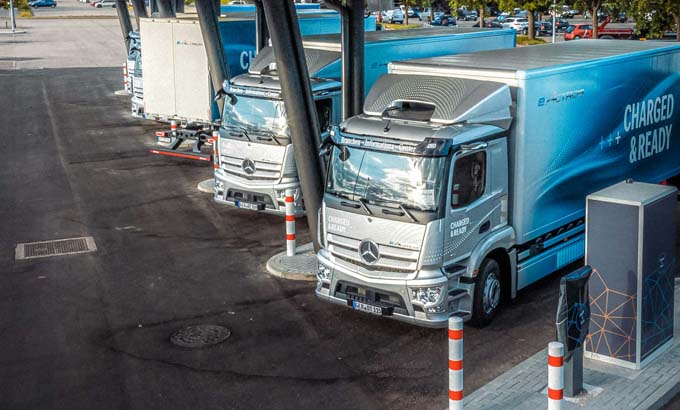
From January to March, 9,406 light and heavy goods and passenger transport vehicles were put on the road. This corresponds to an increase of 6.7% compared to 2025 (8,813). In the first quarter of 2026, 1,073 heavy commercial vehicles over 3.5 tons gross weight were registered. This corresponds to an increase of 15.6%. The proportion of all-electric vehicles (BEV) among heavy commercial vehicles over 3.5 tons gross weight has thus continued to grow. It stood at 26.8% in the first three months of 2026. This means that more than one in four newly registered vehicles in this segment is already electric. In the segment of heavy trucks over 16 tons, the electric share is around 25.1%, which corresponds to one in four new trucks. The previous subsidy system generated strong market demand for the latter category in particular, in contrast to light commercial vehicles, delivery vans and light semi-trailers up to 3.5 tons total weight, which are growing significantly more slowly. Growth here amounted to 4.3 percent compared to the same quarter of the previous year. In the light commercial vehicle segment, BEVs have a market share of 12.2% and plug-in hybrids 3.1%, a positive trend compared to the previous year.
Bourgeois vehicles still on the road with the handbrake on
The registration figures for heavy commercial vehicles up to a maximum of 4.25 tons, the so-called Bourgeois vehicles (see box), are stagnating; they account for just five percent of new registrations of commercial vehicles in the 3.5 to 16 ton weight class in the first quarter. This vehicle category is still being held back by regulatory hurdles and the industry is still waiting for more realistic market conditions.
«The electrification of commercial vehicles is gaining momentum - especially in the heavy-duty segment. This shows that the market is functioning in a stimulating regulatory environment,» says Thomas Rücker, Director of auto-schweiz . «At the same time, it is clear that the ramp-up of electromobility is taking place at different speeds depending on the area of application. A reliable policy that offers long-term planning and investment security has a decisive influence on market success.»
Together with the 52,982 new passenger cars, a total of 62,388 new motor vehicles were registered in Switzerland and the Principality of Liechtenstein in the first quarter of 2026. Compared to the previous year's figure of 61,503, this represents an increase of 6,442 new registrations or 1.4 percent.
What are Bourgeois vehicles?
These so-called Bourgeois vehicles owe their name to a political initiative by former National Councillor Jacques Bourgeois. In a motion, he called on the Federal Council to increase the permissible total weight of delivery vans with zero-emission drive systems from 3.5 to 4.25 tons, provided the increase in weight is purely due to the additional weight of the alternative drive system. However, the vehicles concerned must comply with the technical regulations for vehicles weighing between 3.5 and 12 tons. Legislators and politicians have recognized that further hurdles need to be removed in order to accelerate the switch to zero-emission vans. The consultation on further simplifications for „bourgeois vehicles“ and their drivers was recently concluded. The Federal Council is currently evaluating the consultation responses. auto-schweiz has also campaigned for further simplifications.