Debt collection ranking 2026: Half of global trade receivables at high risk
The 2026 debt collection ranking by Allianz Trade shows: The global complexity of debt collection is at a high level of 47.2 out of 100 points. Switzerland occupies an excellent 5th place out of 52 countries surveyed and scores highly for its very good payment practices. 1.1 trillion US dollars in international trade receivables are located in countries with a very high or serious risk.





Allianz Trade has published the fourth edition of its debt collection ranking. The study provides a clear assessment of how easy or difficult it is for companies to collect unpaid invoices in 52 economies. These 52 countries account for 90 percent of global GDP and trade. According to the world's leading provider of trade credit insurance, the global complexity of debt collection is at a high level of 47.2 out of 100 points.
Switzerland in a very good 5th place
Compared to the 2022 ranking, Switzerland has improved by one place and is in an excellent 5th place out of 52 countries surveyed with a score of 33 points. The payment behavior of Swiss companies is very good. Most payments are usually made in advance or within 30 days. Domestic courts are relatively efficient in processing disputes promptly, but out-of-court debt collection remains the most effective method.
«Although Switzerland has introduced mechanisms to promote debt restructuring and company rescues, liquidation currently remains the standard procedure,» explains Jan Möllmann, CEO Allianz Trade in Switzerland. «Unsecured creditors therefore have little chance of recovering claims from insolvent debtors. For small and medium-sized companies in particular, non-payment can quickly threaten their existence. Companies are always well advised to check credit ratings and insure against payment defaults.»
Global complexity remains a challenge
The index ranking has four levels of complexity: «low» with a score below 40, «high» between 40 and 50, «very high» from 50 to 60 and «severe» above 60. The global average is slightly lower than the 2022 edition's score of 49 out of 100, reflecting a lower spread of risk. A lower proportion of countries now fall into the categories of «severe» at 15% compared to 16% in 2022 and «very high» at 21% compared to 29%, while the proportion of «high» at 29% compared to 24% and «low» at 35% compared to 31% has increased.
However, given the continued high number of corporate insolvencies worldwide and increasing global fragmentation due to changing trade patterns, volatile protectionist tendencies, geopolitical tensions and growing digital risks, debt collection is becoming increasingly complex for companies, especially exporters.
Allianz Trade estimates that 48% of international trade claims are in countries with a very high complexity of 22% or severe complexity of 26%. Compared to 2022, this is a small increase of one percentage point, but a significant increase in absolute value to USD 1.1 trillion due to growing global trade.
Saudi Arabia, Mexico and the UAE bring up the rear
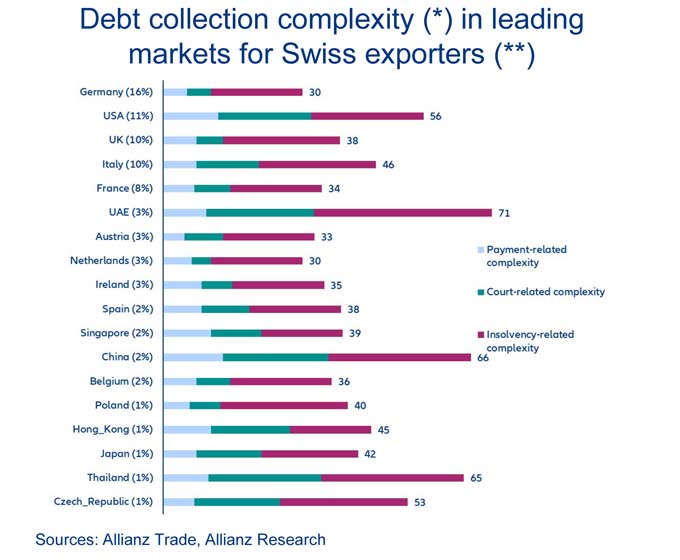
Taking into account local payment practices, court and insolvency procedures, Allianz Trade finds that international debt is easiest to collect in Germany, the Netherlands and Portugal, while it is most challenging in Saudi Arabia, Mexico and the United Arab Emirates. International debt collection is almost three times more complex in Saudi Arabia than in Germany.
Insolvency proceedings continue to account for the majority of debt collection complexity in all regions. In particular, local payment habits are the main reason for the complexity of debt collection in the Middle East, while judicial complexities are less common in Western Europe than in the Middle East, Africa and Latin America.
New retail centers require selectivity
In the midst of structural changes in the global trading system, new trading centers are emerging and becoming links in new trade routes. Despite their attractiveness, the collection of receivables remains a challenge for exporters in these markets, which exacerbates the existing country risks.
Emerging next-generation trade hubs, including the United Arab Emirates, Vietnam and Malaysia, have serious payment processing complexity with an average score of 62. Although these markets are becoming increasingly important in the current context, this requires selectivity and tight credit management when considering doing more business there.
The Allianz Trade Debt Collection Index is a measure of the degree of complexity of international debt collection procedures in each individual country on a scale from 0 as the least complex to 100 as the most complex. The score is based on the assessment of 340 Allianz Trade debt collection experts worldwide and over 40 objective indicators.
Source: Alliance Trade