Management mistakes lead to corporate crises more often than politics
The United Interim Economic Report 2026 shows: When companies get into difficulties, it is usually due to serious management mistakes - not political conditions. A survey of 550 interim managers reveals the most common causes and shows ways out of the crisis.



When companies get into difficulties, it is usually less due to unfavorable political conditions than to serious mistakes at management level. This is the conclusion of the 2026 Business Report by the management community United Interim. The study was compiled by 15 experienced interim management specialists and is based on a survey of 550 interim managers.
Lack of adaptation and late reaction as the main reasons
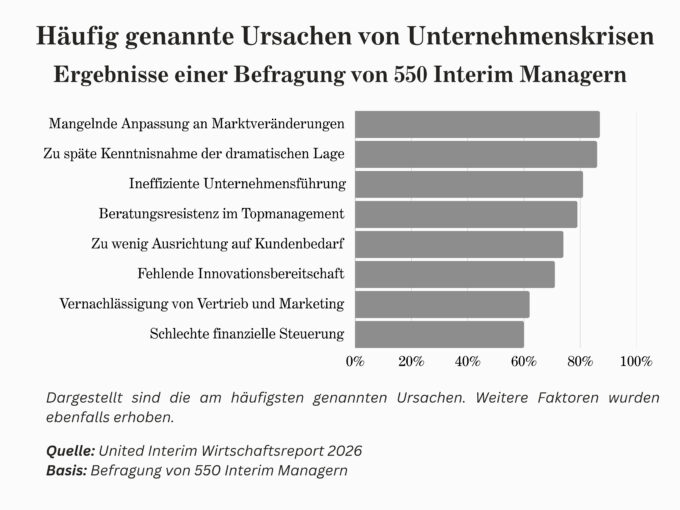
According to the report, the most common reasons for the decline are a lack of adaptation to market changes (87 percent), too late recognition of the dramatic situation (86 percent), inefficient company management (81 percent), resistance to advice from top management (79 percent), too little focus on actual customer needs (74 percent), a lack of willingness to innovate (71 percent), neglect of sales and marketing (62 percent) and poor financial management (60 percent).
«Sometimes the management mistakes are really hair-raising,» marvels Jan Beutnagel. «In many cases, I wish I had been called in to help a year or at least six months earlier,» adds his colleague Klaus-Peter Stöppler. «We are so busy putting out fires that we don't have time to eliminate the causes of fires,» says Dr. Andreas Vieweg, describing the prevailing company mentality that leads to permanent inefficiency in companies.
Ulrich Schmidt adds: «So as not to be misunderstood: Many companies are very well managed and rely on interim managers for specific transformation projects. But there are also many other cases where you ask yourself how things got this far before you call in external help.»
Data waste, cluster risks and a lack of future technologies
The survey revealed further reasons: inadequate risk management (57 percent), poor HR policy and loss of key personnel (55 percent), lack of communication between management and other stakeholders (54 percent), taking excessive cluster risks (54 percent), exclusive focus on costs (52 percent), failure to adapt to new regulations (51 percent), insufficient focus on the core business (51 percent) and lack of cost control (47 percent).
Dr Andreas Vieweg reports: «Many companies neglect their master data for many years: a lack of maintenance and structure costs efficiency in processes, prevents evaluability and inhibits standardization. The data waste requires more controllers - the course to a crisis is basically pre-programmed.»
Christian Jung points to another example: «Many automotive suppliers have been hit so hard by the automotive crisis because they have only focused on this sector - a classic cluster risk. The risk has been visible at least since the massive political intervention in the issue of electric versus combustion engines, but has all too often been suppressed.»
Christian Florschütz adds: «The neglect of customers is just as common. Companies do all sorts of things, from cost-cutting measures to management overhauls and restructuring, but rarely do they address the core issue of how to focus more on customer needs.»
Eckhart Hilgenstock has observed: «Many companies are so deep in crisis mode that they cannot find the strength to leverage the potential of new technologies such as artificial intelligence.»
Personnel policy as a key factor
Paul Stricker has identified a misguided HR policy as a frequent cause of company downfall: «Incorrect appointments, a lack of management development and a failure to adapt to new working environments lead to top performers leaving a company and only the administrators remaining.»
His colleague Ulf Camehn knows from experience: «As a rule, the first management level needs to be replaced, as well as at least fifty percent of the second management level, which is often THE »paralyzing layer' for change." In practice, a targeted realignment of the HR strategy is needed to get a company in difficulties back on track.
Ulvi Aydin sees light at the end of the tunnel: «The number of insolvencies in Germany in 2025 has risen significantly less than in the previous year.» He refers to the latest figures from Creditreform, according to which around 285,000 employees were affected by their employer's insolvency last year - 6,000 fewer than in 2024.
Jane Enny van Lambalgen counters: «In addition to the immediate damage caused by unemployment with the corresponding burden on social systems and bad debts, which ripple through the economy like waves and drag other companies into the maelstrom, know-how, innovative strength and industrial skills are lost in the long term.»
Asia as a strategic sales market
Roland Streibich names the causes of the economic slump: «The EU's unspeakable anti-economic course, reinforced by German politicians over the years, has ultimately led to the current situation. This historical blame clearly lies with the politicians. But it is up to companies to focus on their core competence in this situation - to take action - and not to rely on politics.»
«Blaming politics is no substitute for a corporate strategy,» explains Dr. Harald Schönfeld. Friedhelm Best recommends «looking to Asia». He analyzes: «In view of Europe's weakness and global uncertainties, companies should focus more on Asia as a stable, strategically important sales market for sustainable growth and innovation.»
«In view of the serious weaknesses of Germany as a business location, relocation is actually the best way forward from a business perspective in many cases,» says Dr. Sven Mues. This is particularly true for industrial companies that have to contend with excessively high energy costs and excessive German bureaucracy. «Instead of expanding a plant in Germany, relocating production abroad is often quicker, more cost-effective and more future-proof,» says Dr. Sven Mues, who is familiar with specific projects of this kind.
Trust and change management as success factors
The 550 interim managers surveyed reported what is most important when they take the helm in a crisis: establishing trust in the management and its decision-making power (89 percent), change management appropriate to the situation (88 percent) and crisis experience (84 percent).
«Turnaround management is above all strong leadership coupled with experience, swift action and clear communication with all stakeholders,» Klaus-Peter Stöppler knows from numerous projects. «Leadership skills with a team player mentality» is what more than two thirds (68 percent) of the interim managers contacted call it.
Other important factors are analytical skills (70 percent), strategic planning (69 percent), high resilience and negotiation and communication skills (64 percent). Reliable business and liquidity planning (58%) and a focus on eliminating reasons for insolvency (49%) are also important.
Why turnaround attempts fail
Turnarounds are not always successful. Creditreform counted around 24,000 company insolvencies in 2025 - a ten-year high. ’Many companies don't even think about bringing in an interim manager to avert the worst, or take this step so late that nothing can be saved,« wonders Dr. Harald Schönfeld, founder and managing director of the personnel consultancy Butterflymanager, which specializes in the placement of interim managers.
In fact, «acting too late» is the most common reason for the failure of turnaround projects, according to 86 percent of the temporary managers surveyed. In second place comes resistance to advice and a lack of consequences (80 percent).
The other causes of failure: lack of trust in those responsible for the turnaround (61 percent), poor stakeholder management (58 percent), exclusive focus on cost reduction and lack of confidence in the rescue concept (57 percent), loss of key personnel (41 percent), too many individual measures (34 percent) and incomplete performance programs (25 percent).
Insights from the survivors
What do companies learn that succeed in crossing the valley of tears and sailing back to success? The answers from interim managers: Maintain transparent communication (84 percent), act closer to the market (83 percent), focus more on the customer (79 percent), streamline processes and be willing to change quickly (75 percent), focus on cash flow instead of fixating on sales (61 percent), improve company culture (58 percent), exercise financial discipline (57 percent), streamline the portfolio and focus on the core business (55 percent), report more accurately (52 percent), increase the rate of digitalization (49 percent) and place greater emphasis on business development (48 percent).
«Restructuring is often only possible with a change of management in order to implement these findings,» Ulf Camehn knows from practical experience. «Many companies only learn to focus on their customers and their needs again during restructuring,» explain Christian Florschütz and Eckhart Hilgenstock in unison.
It is important to Jane Enny van Lambalgen to emphasize «that despite all the sometimes serious management weaknesses, the deterioration in the political framework conditions over many years has contributed significantly to the current imbalance of the entire business location». Her colleague Jan Beutnagel puts it in a nutshell: «Good managers also get their companies through bad times. These times are the result of anti-business policies - exacerbated by a lack of self-criticism and responsibility in parts of the economy.»
United Interim is the leading digital platform and the only ecosystem for interim management in Germany, Austria and Switzerland. As an open online community and curated pool, United Interim reaches well over 12,000 interim managers in the DACH region. Over 550 selected interim managers took part in the survey for the 2026 Business Report.