Skills shortage in the public sector: fewer tenders, different developments
An analysis of job advertisements in 2025 shows: The job market in the meaningful sector is becoming more selective. While the situation in administration has eased slightly, the shortage of skilled workers in the healthcare sector has worsened. The number of entry-level positions remained stable despite the AI debate.





The year 2025 presented meaningful organizations in German-speaking Switzerland with a familiar area of tension: austerity measures and budget cuts met with a continued high demand for personnel. Particularly in public administration, education and healthcare, organizations were forced to adapt their recruitment strategies. An evaluation of Publicjobs over the entire job year 2025 shows that The labor market in the meaningful sector has not become smaller, but more selective.
Decline in tenders with clear differences
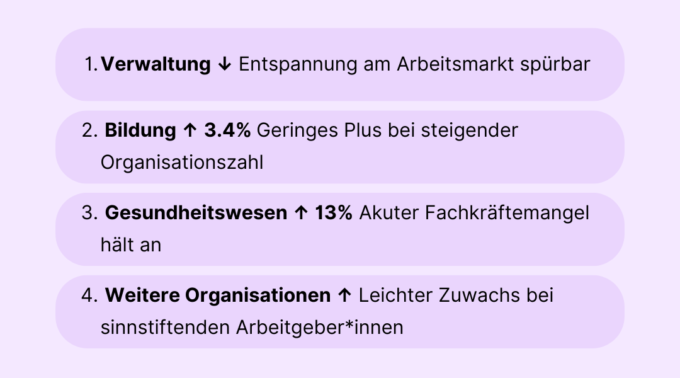
A total of 20,811 job advertisements were published in 2025. Compared to 22,273 advertisements in 2024, this corresponds to a decrease of 6.5 percent. The decrease was particularly significant in the public administration segment.
At the same time, there were opposing developments in other areas: In the education sector, the volume of tenders rose by 3.4 percent compared to the previous year, and in healthcare by as much as 13 percent. A slight increase can also be observed in other meaningful segments such as energy supply, social organizations, churches and foundations.
Administration: More stable structures despite fewer advertisements
A differentiated development can be seen in the public administration sector. Although the number of published job advertisements fell, the number of organizations that advertised at least one position remained constant.
This indicates that organizations were able to fill vacancies with fewer advertisements. The shortage of skilled workers appears to have eased slightly, at least in the public administration sector. The data suggests that open positions could be filled more efficiently. The decline in job advertisements should therefore be seen less as a withdrawal from the labor market and more as an indication of more stable personnel structures or adapted recruitment processes. Another aspect that could play a role here is the desire for secure jobs in a stable environment, while the overall economy has been characterized by uncertainty and geopolitical tensions.
Education: Broader, but less intensive
In the education sector, the number of organizations that advertised at least one position increased by 19 percent compared to 2024. At the same time, the total volume of job advertisements only increased by 3.4%.
This shows that although more educational organizations were recruiting, there were significantly fewer advertisements per organization. Fluctuation therefore also decreased in the education sector. Recruitment was more widespread, but less intensive. Here, too, the situation can be interpreted to mean that the shortage of skilled workers in the education sector is declining slightly or has peaked.
Healthcare: The shortage of skilled workers remains acute
The situation is different in the healthcare sector. Here, the number of publishing organizations remained almost unchanged, while the volume of tenders increased by 13% compared to 2024.
This combination points to a continuing acute shortage of skilled workers. Existing organizations have had to advertise more frequently to cover their staffing needs. The pressure on the healthcare labor market thus tended to increase rather than decrease in 2025.
Career starters: stability despite the AI debate
Contrary to the frequent debate about automation and the possible loss of entry-level positions, the evaluation of Publicjobs shows a stable picture: the proportion of jobs for young professionals remained unchanged in 2025 compared to 2024.
Especially in meaningful segments such as administration, education and healthcare, the focus remains on people. Artificial intelligence changes processes, supports administrative tasks and increases efficiency - but it does not replace professional responsibility, social understanding and proximity to citizens, patients or learners.
This stability is an important signal - not only for employers, but especially for talented young people who want to pursue a career with a social impact.
More selective instead of smaller
The job year 2025 does not show a general retreat from the labor market in the meaningful sector. While the shortage of skilled workers in administration has eased slightly, it remains a key challenge in the healthcare sector. Education and other segments are focusing more on stabilization and targeted recruitment.
Fewer tenders do not mean less demand - but a more conscious, more selective use of human resources.