

Inclusion: A Matter Close to My Heart
For Roger Stalder, OpenText’s Regional Vice President for ALPS, diversity and inclusion are more than just empty words. That’s why OpenText served as an official partner and co-sponsor of the 2026 National Summer Games hosted by Special Olympics Switzerland. We spoke with him about the impact of such initiatives.





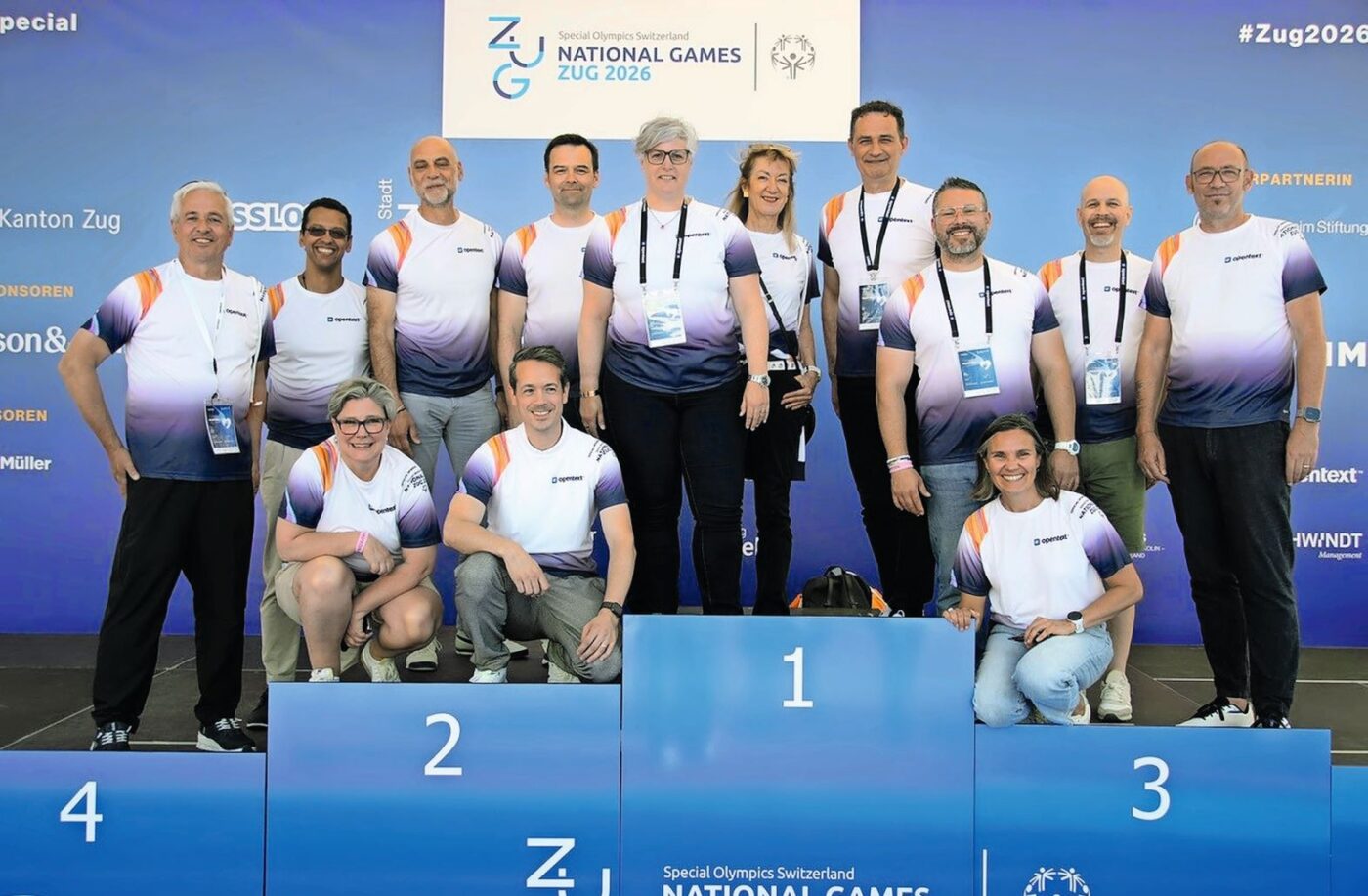
OpenText, a company specializing in information management, served as an official partner and co-sponsor of the National Summer Games Zug, which took place in Zug from May 28 to 31, 2026. The National Summer Games were organized by Special Olympics Switzerland and stand for diversity, equality, and active inclusion. Athletes with intellectual disabilities competed for medals in 16 sports. For Roger Stalder, OpenText’s Regional Vice President for ALPS, supporting this event was a natural choice, as it aligns with both his personal values and those of the company. Under the motto «Data for Good – Making a Bigger Difference Together,» the company thus sent a strong message about inclusion, social responsibility, and the unifying power of sports.
Mr. Stalder, the National Summer Games for people with intellectual disabilities took place in Zug at the end of May. What prompted OpenText to get involved in this event? Was this a decision based on the company’s global strategy, or a spontaneous idea from local management?
Roger Stalder: It’s a combination of both. Generally speaking, OpenText does not engage in traditional sports sponsorship worldwide. However, the company is very actively involved in the areas of inclusion, equality, and sustainability, which are grouped under the «Corporate Citizenship» program. Personally, I’m strongly committed to promoting equality—for example, as a manager in women’s ice hockey since 2017. For OpenText Alps, I wanted to align this commitment with the theme of sustainability. Our headquarters in Toronto agreed, and so we supported the U18 Women’s Ice Hockey World Championship in Zug as early as January 2024. The positive response from our employees and customers has encouraged us to continue down this path. When we saw that the 2026 National Summer Games in Zug were looking for sponsors, it was a perfect fit with our «Data for Good» philosophy.
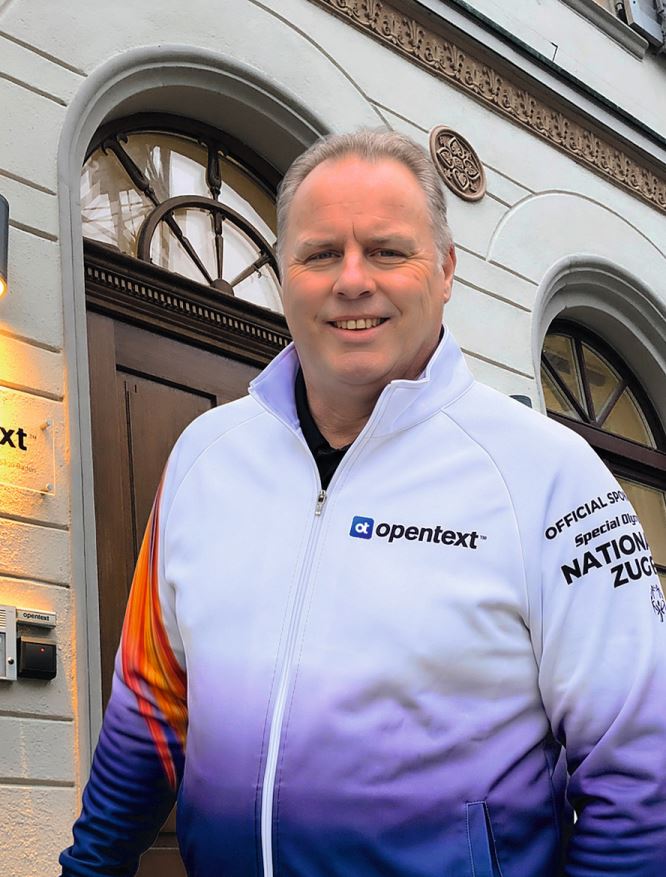
What exactly does your involvement in the National Summer Games look like? It was announced that you’ll be manning the grill yourself and that your employees will be on site as volunteers.
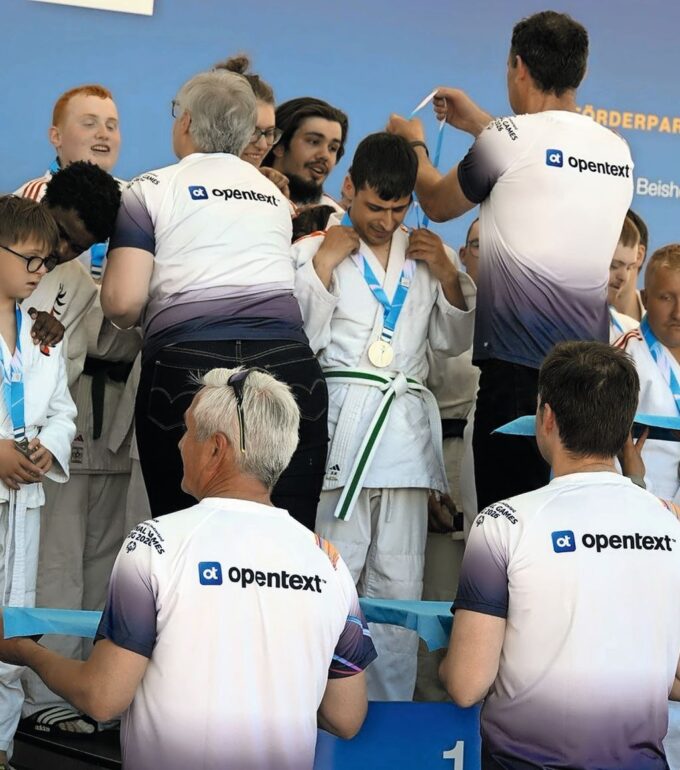
The organizing committee was very innovative. In addition to financial support as a co-sponsor, there was the «CEO Grill.» Here, the sponsors« top executives manned the grill themselves to show their support. I immediately signed up for the list. Our employees also signed up as volunteers. They were able to serve as part of the »Medal Crew” and assist the athletes during the medal ceremonies. They also presented the medals. Those were always very emotional and wonderful moments for the entire team.
People with disabilities often have special needs. Did your employees receive any special training or a briefing beforehand?
There wasn’t any formal training in the strict sense, but the most important thing is the mindset. Since we’ve been involved in the field of inclusion for quite some time—for example, through our support for the «HOPE» project in Baden, where we serve meals to people with social challenges—my team was already aware of these issues. In addition, the Special Olympics team is very experienced and provided us with a professional on-site orientation. Our team brought the right spirit—especially since many initiatives for social engagement don’t come from management, but rather from the employees themselves, in a bottom-up approach.
So diversity and inclusion play a major role at OpenText. How exactly is this put into practice at the Swiss office in Baden?
It starts with mindset and open communication. We hire based on the principle of «mindset over skill.» Still, we have to be honest: Our office in Baden is a beautiful historic building, but it’s not currently accessible. That’s an area where we want to make improvements. It’s often difficult to implement structural changes in listed buildings, but we’re working hard on it. As long as we see room for improvement, we’re on the right track. When it comes to our hiring processes, however, there are absolutely no barriers.
If you were to hire someone who uses a wheelchair, how would you go about it in practical terms?
We work in a two-story building. We could set up an accessible office space on the ground floor. Headquarters has indicated that construction work will be carried out as soon as a specific need arises. Furthermore, our IT business is very flexible. Today, work is often done on a laptop or smartphone, which allows for a high degree of location flexibility. We are prepared for such scenarios.
In the IT industry, technology—especially artificial intelligence—is a key topic. What opportunities does technology offer for people with disabilities?
This is a central aspect of our work. Our software received early recognition in Europe for its accessibility, which is particularly important in the public sector. With modern AI, we’re taking it one step further. We’re no longer just searching for data—we’re «talking» to the data. This builds entirely new bridges and breaks down barriers—in the true spirit of «Data for Good.».
What other projects are planned for the future in the area of diversity and inclusion?
We have a fixed budget for «Data for Good» for each country subsidiary. Every year, we decide as a team which local projects we want to support. One long-term goal for me is the 2029 Special Olympics in Chur. That will be a global event, and I plan for us to get involved there as well—and of course, I hope that many other companies will follow our lead.
What do you hope to achieve externally with these initiatives? Is employer branding also a factor?
I’m hoping for a ripple effect. I want other companies to see that, in addition to the big, often fully booked sporting events, there are other valuable sponsorship opportunities out there. As for the OpenText brand, we often operate behind the scenes as a data platform, so we tend to be hidden from end users. Initiatives like this make our brand more visible. Of course, it also helps with employer branding. Today, professionals are looking for companies that stand up for the «right» causes. For us, inclusion is definitely one of them.
To wrap up, do you have any advice for other organizations that would also like to get involved?
There’s no magic formula, but you should start with the right mindset. You shouldn’t just ask what you’ll get back financially, but what social value you’re creating. If you keep your eyes open, you’ll often find excellent projects right in your own community where even small contributions can make a big difference.
More information: OpenText Switzerland


