AXA Study: Swiss SMEs Defy Uncertainty—But the U.S. Is Losing Its Luster
Despite rising costs, persistent labor shortages, and global disruptions, 86 percent of Swiss SMEs are confident about the future. However, AXA’s latest SME labor market study also shows that confidence in the U.S. as a hub for business and innovation is waning—and absences due to mental health issues are on the rise.






Trade policy turmoil, rapid advancements in AI, a tight labor market, and growing dependence on foreign partners—the challenges facing Swiss SMEs are manifold. And yet: An impressive 86 percent of the companies surveyed believe it is likely that their business will still be in operation ten years from now. This is shown by the AXA SME Labor Market Study 2026, which was conducted by the research institute Sotomo on behalf of AXA. For this edition, a total of 336 SMEs from German- and French-speaking Switzerland were surveyed between March 11 and 18, 2026.
«Despite growing instability in the global economy, international security, and the digital transformation, SMEs feel fundamentally resilient. This resilience also suggests that companies have great confidence in the long-term stability of Switzerland as a business location, even as the immediate environment becomes more volatile,» says Reinhard Schmid, Head of Corporate Clients at AXA Switzerland.
Rising costs as the biggest source of stress
The economic situation remains tense: 43 percent of SMEs view the situation in their industry as uncertain. Rising costs are cited as the biggest source of stress by 65 percent of the companies surveyed—far ahead of increasing competitive pressure in Switzerland (29 %) and declining customer loyalty (26 %). For internationally networked companies, increasing competitive pressure from abroad (33 %), dependence on other countries (28 %), and exchange rate risks (27 %) further complicate matters.
At least three-quarters of SMEs have proactively taken measures over the past two years to address economic fluctuations. Companies with a particularly international focus have relied on strategic diversification of their product offerings (39 %), their sales markets (26 %), and their supply chains (24 %), or have expanded their inventory management (22 %). Domestically focused companies have taken such measures significantly less frequently.
The U.S. loses—Switzerland and China win
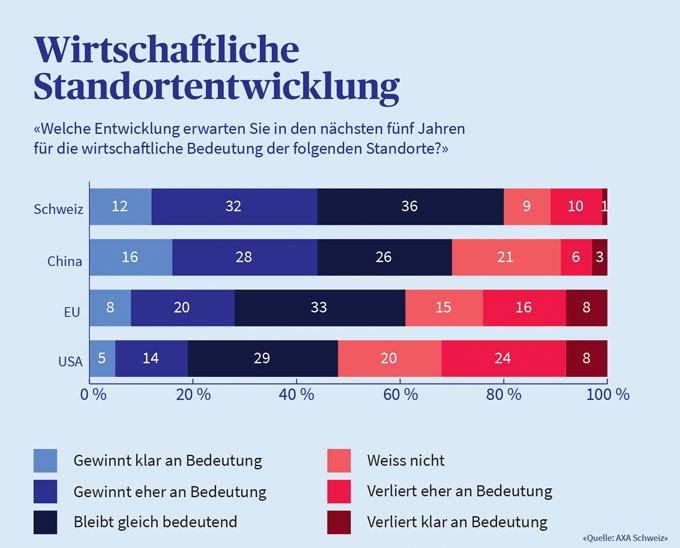
Particularly striking is the shift in perceptions of the global balance of power. Forty-four percent of SMEs expect Switzerland to gain importance as a business location over the next five years—and just as many predict the same for China. In contrast, only 19 percent expect the United States to gain influence, while nearly one-third expect it to lose significance.
The verdict is even clearer when it comes to innovative strength: 63 percent of SMEs rate Switzerland as highly innovative within their own industry, compared to 45 percent for China. The U.S., by contrast, lags far behind at just 31 percent. «One reason could be that local SMEs operate in niches where the U.S. is generally less of a driver of innovation. However, it’s also possible that confidence in the U.S.»s innovative strength has suffered amid the political turmoil of recent years,” explains Michael Hermann, CEO of Sotomo.
At the same time, a majority of SMEs (57 %) are concerned about their dependence on IT solutions from the U.S. However, breaking away is difficult: While 13 percent have already switched to European alternatives and another 15 percent are planning to switch, the largest group (29 %) has not yet taken any action despite their existing concerns.
Labor Shortages: Production Under Particular Pressure
41 percent of SMEs continue to cite labor shortages as their biggest challenge. At the same time, a gap is emerging between sectors: In the manufacturing sector, the percentage of companies facing recruitment problems has risen from 45 to 65 percent since 2022, while it has remained stable in the service sector. The reason: There is simply a lack of applicants in manufacturing—half of the companies receive too few or no applications at all. In the service sector, on the other hand, the main issue is a lack of suitable qualifications. «Apparently, the manufacturing industry is suffering not only from a shortage of skilled workers but also from a general labor shortage,» summarizes Reinhard Schmid.
This is particularly noteworthy given the rising unemployment rate: The rate climbed from a low of 1.9 percent in June 2023 to 3.1 percent by March 2026. However, despite the growing number of job seekers, one-third of small and medium-sized enterprises (SMEs) continue to find the recruitment process increasingly difficult, while four in ten companies perceive no change at all.
Apprenticeships Instead of College: SMEs Prioritize Hands-On Experience
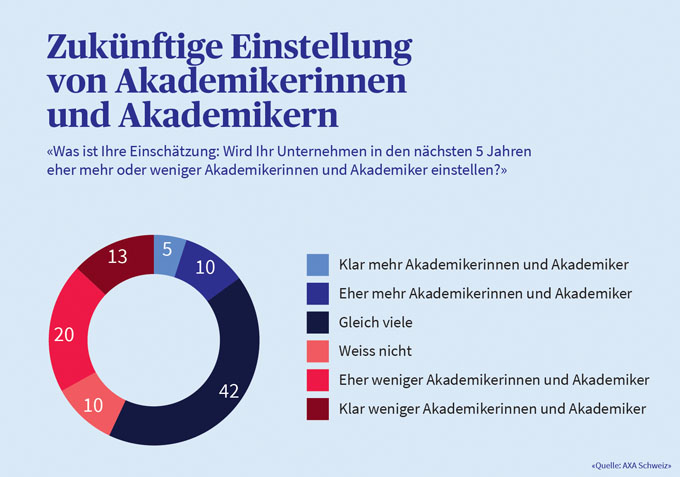
The study also examines whether supply and demand in the labor market are diverging. One-third of companies plan to hire fewer college graduates over the next five years, while only 15 percent plan to increase their hiring of college graduates. Sixty-three percent of SMEs would now be more likely to recommend a vocational apprenticeship to high school graduates than a college degree. For a good two-thirds of companies, a college degree is also not a prerequisite for a management position—in the manufacturing sector, as many as 79 percent share this view. «Against the backdrop of rising numbers of college graduates, this raises the question of whether a gap is opening up in Switzerland between the qualifications of job seekers and the demands of businesses,» says Michael Hermann.
AI as a tool for efficiency—not a disruptive force
Following the significant surge in adoption last year, AI usage among Swiss SMEs has stabilized: 74 percent are actively testing or using AI, while 26 percent continue to avoid it. The most common areas of application are translations (47 %), correspondence (42 %), and advertising copy (35 %). However, the strongest growth is seen in more advanced applications such as process optimization (35 %, 2024: 23 %) and data analysis (34 %, 2024: 22 %).
Nevertheless, only 12 percent of SMEs expect to be able to reduce their workforce in the future through AI. 41 percent view advances in AI as an opportunity, while only 15 percent see them as a threat. Just under two-thirds see no need to adapt their business model because of AI. From the perspective of the majority of Swiss SMEs, AI remains a tool for improving efficiency—not a disruptive force.
Mental Health-Related Absences Are Rising—Measures Are Stagnating
In the area of leadership and health, the study paints a mixed picture. The most important leadership principle in Swiss SMEs is freedom and personal responsibility (50 %), followed by shared visions and values (33 %) and an empathetic, supportive leadership style (24 %). At the same time, decision-making authority in four out of five companies remains with a single leader or a leadership team.
Meanwhile, the mental health of the workforce is becoming an urgent challenge. Four out of ten SMEs (42 %) report increased costs due to employee absenteeism over the past five years; among large SMEs, the figure is as high as 62 percent. Just over a third of companies are moderately or severely affected by absences attributable to employees’ mental health—an increase of ten percentage points compared to 2023. Companies that prioritize personal responsibility report such absences significantly less often (27 %) than companies without this guiding principle (43 %).
Despite an awareness of the importance of leadership for mental health—66 percent of SMEs view leaders as crucial to their employees’ well-being—concrete countermeasures have stalled. The percentage of SMEs that prioritize an open feedback culture has dropped from 35 to 28 percent since 2023. One in four companies takes no specific measures at all to address mental health-related absences. There is a significant gap between recognizing the issue’s importance and implementing solutions in the workplace.
Source: www.axa.ch