

Rethinking Toilet Systems—and Saving Water
Jojo Casanova is the founder of Kompotoi, a company that provides portable composting toilets. In this interview, he explains how the business idea originated in India, why an nonprofit organization evolved into a company, and why he considers urine and feces to be valuable raw materials rather than waste.






Perhaps you’ve noticed them before: small wooden restroom cabins, often found at playgrounds or events. Today, they’re a well-established alternative to portable chemical toilets. Their advantage: They operate without water or a sewer system. Waste is collected and later composted. Since urine is collected separately, less ammonia is produced, which reduces odors. To further control odors, a shovel of bedding (instead of flushing) is spread over the waste after each use. The composting toilets were developed by Jojo Casanova and his team. On the Greenovation Summit In his September 10, 2026, presentation, he explains how to rethink toilet systems.
Mr. Casanova, how did you come up with the idea for Kompotoi?
Jojo Casanova: I used to do a lot of volunteer work in development cooperation. During that time, I once had the opportunity to visit a partner organization in India that operated composting toilets. I was allowed to help maintain and empty them, and in doing so, I realized just how much high-quality soil can be produced from composting human waste. That gave me the idea to develop an alternative to the chemical toilets that are so widespread here. These don’t have a particularly good reputation, especially since the chemicals used are very harsh. My vision, therefore, was a solution that is both aesthetically pleasing and environmentally friendly.
It all started as an association before it became a company. In what circles did you find your fellow activists back then—in the development cooperation sector, or more in the environmental movement?
Most of them were roommates of my now-wife who had studied environmental engineering. When I approached them with the idea, they said: “Sure, we learned that in school; it works; it makes sense—and we also believe there’s a market for it.” I then got started with them. The nonprofit was our launchpad because we simply didn’t know how the whole thing was supposed to work—there was no precedent for doing exactly the same thing. We just said, “Let’s give it a try.”.
But that would have required investors, too—you can't just build a «restroom stall» like that in your hobby room; it takes materials and equipment.
But that’s exactly what we did: We volunteered our time, and when it came to materials, we tried to use recycled materials as much as possible to build the first little houses. That was basically part of the concept from the start. But we quickly realized that the workload is very high when you constantly have to source materials that are different every time—you’re much faster with a standardized solution. That entire development period basically coincided with the time we operated as a nonprofit: We functioned as a nonprofit from 2012 to 2016, and that was pretty much exactly when the finished product took shape. Of course, we’re still refining it today, but back then we reached the point where we could say: This works. We know how to transport and maintain it, and the customers are satisfied. That was also reflected in growing demand—and that’s how we eventually became a company.
How should I picture this innovation process—was it mostly trial and error, or were there also structured approaches?
I’d say we’ve probably made every mistake there is to make—but we’ve also learned from them. In the beginning, when we were just a club, we didn’t feel any pressure to have everything working perfectly right from the start. We gave ourselves the freedom to just experiment, to be inefficient at times, and to constantly reinvent ourselves. That definitely shaped the early days—in that sense, we weren’t stressed at all.
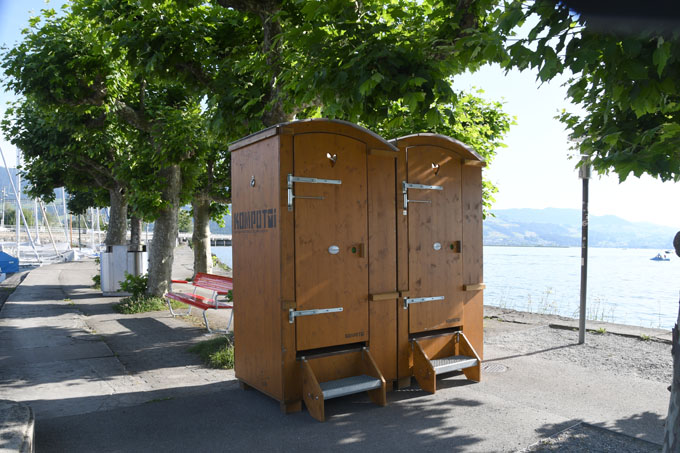
How does the Kompotoi concept work in practice? It’s mobile, requires logistics, and needs to be emptied and cleaned. Do you handle that on your own, with partners, or through a hybrid approach?
We run the business ourselves. Our core business is logistics—ensuring that all shipments are in the right place at the right time—and on top of that, we also offer maintenance services, which are recurring and can therefore be easily scheduled. In addition, we have sales and rentals as our second and third pillars, as well as timber construction and recycling. So we’re a very diverse business—I certainly didn’t choose the easiest path.
And where does the compost end up—at neighborhood composting sites or with professional landscaping companies?
We work with large composting companies. This is important because the composting process requires a specific mixture and a specific temperature to ensure sanitization. First, the material arrives at our respective warehouse, and from there we look for a suitable partner. Most often, these are businesses that need the compost themselves—for example, a tree nursery.
What kind of quantities are we talking about here?
Across Switzerland, we collect about 150 metric tons of solid waste—this figure is a bit imprecise—and an estimated 250,000 liters of urine. I find this particularly fascinating because, until now, urine has practically never been considered a raw material: We normally flush it away with six to nine liters of clean drinking water, diluting it so much that it can hardly be considered a recyclable material anymore. We’re probably the first company to extract this raw material individually on a large scale.
Urine does, after all, consist partly of urea, which is also highly valued as a fertilizer. Who are the buyers, and is it processed separately?
Urine fertilizer is actually more in demand among private consumers; for example, you can purchase it in our online store. However, in terms of price, we’re not quite competitive yet with conventionally produced nitrogen fertilizer. That said, it’s important to note that this imported nitrogen fertilizer is also problematic in the context of climate change because its production is very energy-intensive—about two percent of the world’s energy consumption goes toward fertilizer production. At the same time, it takes energy to extract nutrients from wastewater. That’s exactly where the fallacy lies: we could solve both problems if the urine didn’t end up in the water in the first place. Instead of polluting the water, we could produce fertilizer right away.
This consideration is likely to become even more relevant in light of heat waves and water shortages. Wouldn't a composting toilet—even a stationary one—be a welcome alternative for conserving water?
Absolutely, and that’s certainly feasible. However, it’s still rarely used on a large scale, partly because we want to continue using the existing infrastructure that has been built up over the last 150 years. That’s actually our biggest challenge: How do we build this innovation alongside infrastructure that already exists? Take Paris, for example: The city’s wastewater treatment plant faces a problem because it’s now located in the middle of a growing city and can’t expand any further, while the volume of wastewater it receives is steadily increasing. The City of Paris has therefore introduced a subsidy for every building that can treat its own wastewater—and this is exactly the kind of technology that’s being heavily promoted as a result.
That would also be a good solution for homeowners: generating their own energy with solar panels and using the toilet as a composting solution for the vegetable garden.
Exactly, and that’s an interesting point. While the circular economy is on the rise, nutrients are still rarely discussed—the conversation often remains very technical. Yet urine, along with solids, accounts for a large portion of the pollution in our wastewater. If you only have to treat shower and dishwater, that’s much easier than treating blackwater. So if you separate the toilet from the rest of the wastewater, the remaining water can be treated much more easily—for example, in a single-family home—and allowed to infiltrate locally, which would benefit the groundwater, or it could be fed back into the normal water cycle with less energy consumption.
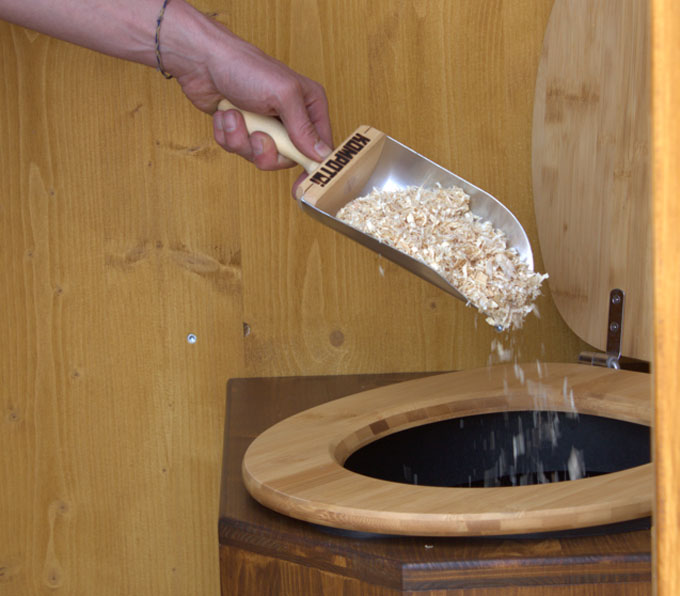
What we harvest is digested and ultimately returns to the cycle. That’s probably the most natural thing in the world—but we’re apparently still quite far from achieving it.
Yes. By the way, here’s something interesting: There was recently a radio segment on SRF in which a farmer explained that he had set up a dry toilet because he needs the water for other purposes. Farms like that are, of course, directly affected by water issues, and there, the cycle can be closed off relatively tightly.
Let's talk a little more about the market: Where is Kompotoi currently used the most—at large events, as a permanent fixture in tourist regions such as SAC huts, or in remote alpine pastures?
While these two areas do make up a portion of our work, they are not the largest. We are particularly active in municipalities with public spaces—basically, almost every playground needs a restroom, and that’s where we’re heavily involved. You’ve already mentioned tourism, but even there it’s not just about SAC huts—it covers a very broad field. In Aargau, for example, in a forest near Schneisingen, we have about 15 locations. One area where we still need to gain a foothold is construction sites: Construction workers also have a tough job and deserve a decent restroom, but there are already established providers there. A shift in mindset is certainly still needed.
Where is the company headed next—what are your strategic and growth goals?
We continue to grow and intend to keep growing. Over the past few years, we have built out our infrastructure so that we can support this growth. Looking at the overall market in Switzerland, there are around 30,000 portable toilets, of which we currently provide about 1,400—so there’s definitely still potential that we want to tap into, especially among our existing target groups. It would be very exciting for us to find a source of revenue that helps us get through the winter, as our main target groups are highly seasonal, which has a corresponding impact on our business. If we could make better use of our infrastructure during the winter, that would be a major goal for us.
Is the funding from ongoing operations sufficient, or are there investors backing the company, and are additional funding rounds planned?
There are investors behind the scenes, and given our continued growth, it's quite possible that we'll hold another round of funding. However, nothing concrete is happening at the moment.
What is your key message to the audience at the Green Innovation Summit?
My key message is: Innovation is possible, and we should simply put it into practice. We live in an era in which an incredible number of good ideas have been developed over the past thirty years—the solutions are actually all there. Now it’s just a matter of putting them into practice.
More information: www.kompotoi.ch
Registration for the Greenovation Summit 2026


