Which AI training program is the «right» one?
Artificial intelligence is sweeping through the workplace like an avalanche. To use AI properly—and, above all, to understand how it works—one needs the appropriate knowledge. Many Swiss universities of applied sciences and other educational institutions offer a wide range of continuing education programs in this field.






© Depositphotos.com
Artificial intelligence is another example of how new technologies require new knowledge. Swiss educational institutions have recognized this and are offering a growing number of specialized courses, seminars, and degree programs on the topic of AI. «In an era heavily shaped by artificial intelligence, companies must not only understand the technical aspects but also adapt their business models accordingly,» emphasized Ralph Hutter, program director of the CAS Digital Business Models & Strategy with AI at HWZ, on the occasion of its launch in August 2024.
A quick overview or in-depth knowledge?
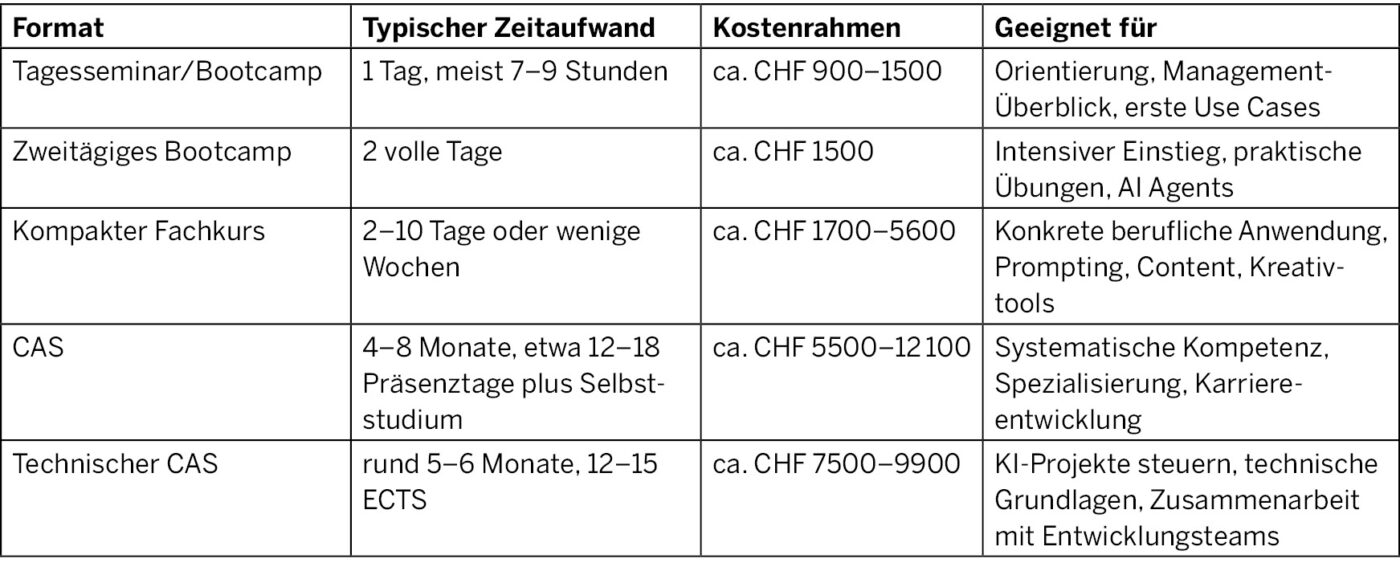
The range of continuing education programs on the topic of AI is considerable. It ranges from short «boot camps» lasting one to two days to courses lasting several months. The differences in price are correspondingly large. Those who are limited in time and have a tight budget but still want to gain a reasonably comprehensive initial overview of artificial intelligence can, for example, take the «Bootcamp AI for Management» course at the University of Applied Sciences and Arts Northwestern Switzerland (FHNW). This one-day course costs CHF 900. This and similar one- or two-day courses are suitable for executives or project managers preparing their first AI projects, or for creative professionals who want to test prompting, text, image, or video tools.
However, for those who want to delve deeper into productive machine learning systems or learn more about topics such as AI governance in companies, a boot camp simply isn’t enough. More comprehensive options include continuing education programs such as the CAS «AI Methods & Technology» at the University of Applied Sciences of Eastern Switzerland (OST), which consists of 14 days of in-person instruction over approximately five months, at a cost of CHF 9,900. Experience shows that, in addition to the in-person days, you’ll need to factor in sufficient time for preparation and follow-up work, as well as for completing coursework and project assignments. The ZHAW certificate course «Understanding and Applying AI,» for example, takes place weekly on Thursdays from 9 a.m. to 5 p.m. over about five months, costs CHF 6,700, and may incur additional tool costs of about 100 to 200 francs.
Cross-industry or industry-specific?
Artificial intelligence is now being used in some form in virtually every industry. It is driving companies to further develop their digital business models. The certificate course «Digital Business Models & Strategy with AI» at the Zurich University of Applied Sciences (HWZ), mentioned earlier, teaches the tools and strategies needed to do so. The CAS promises to equip participants with the ability to strategically deploy technologies such as generative AI, cloud platforms, digital marketplaces, and super-apps to drive innovation and create new value for their companies. Similar programs—also offered as CAS programs worth 10 to 15 ECTS credits—are available at universities of applied sciences such as ZHAW, BFH, OST, and HSO. All of these can be completed while working, though this requires careful time management. For example, the HSO estimates the time required for its CAS program «Applied AI in Business / AI in Marketing» at approximately 375 hours, which, over six months, corresponds to about one workday per week.
Continuing education needs vary depending on one’s professional field or career goals. For example, those who hold IT-related roles in companies but have limited programming or math skills may find the OST’s CAS in «AI Methods & Technology» to be a suitable option. This program combines AI tools, algorithms, machine learning, data analysis, and the evaluation of AI use cases. It is specifically designed for individuals who want to provide technically sound support for AI projects. A CAS is also valuable for those in management roles, especially when the continuing education program includes hands-on work on a specific company project. For example, the ZHAW’s certificate course «CAS Understanding and Applying AI: No-Code Solutions for Business Practice» allows participants to develop their own AI prototype and covers not only technology but also data quality, risks, ethics, and regulation. Those looking to build in-depth knowledge specifically on the latter topic may find the CAS «AI Law & Legal Tech,» also offered by ZHAW, to be the right fit. According to the provider, this program covers both practical tools such as ChatGPT, Microsoft Copilot, and Google Gemini, as well as AI legislation, data protection, copyright, liability, governance, and ethical decision-making. Other educational programs specifically geared toward the finance and insurance sectors additionally cover banking, insurance, fraud detection, credit checks, AML, and robo-advisory.
For practitioners who use AI tools—for example, in the fields of communication or content creation—a specialized course is usually more effective than a technical CAS if the goal is to achieve better results in text, image, or content workflows in the short term. For communications professionals who not only want to use AI but also want to strategically develop content processes and teams, however, a CAS in Digital Marketing, Content Marketing, Marketing Automation, or Corporate Writing makes more sense.
Evaluating the Benefits and ROI of Continuing Education
Continuing education and training in AI are essential. However, this should not lead to hasty decisions. Instead of saying, «We want to train employees in generative AI,» it’s more beneficial to start with a specific business problem and link it to clear objectives. A hypothetical example might look something like this: The creation of customer documents, management reports, and social media content currently takes up 320 work hours per month. The training program is intended to reduce this time by 20 percent within six months, without compromising quality or compliance. This means seeking out a suitable training program that supports a specific use case—for example, in communications, research, working with text variations, or editorial planning. In the area of management, such a training program could aim to improve use-case prioritization, define an AI strategy, or generally optimize processes.
Or let’s consider the following calculation—also using AI: A proposed training program costs CHF 40,000, including work time and implementation. It qualifies ten employees for three prioritized AI use cases in content production, research, and reporting. Based on a conservative estimate of a time savings of 30 minutes per person per workday, along with an additional quality benefit (e.g., better AI-generated results, lower risk of data protection and copyright violations, and better collaboration between departments) valued at CHF 15,000, this results in an annual gross benefit of approximately CHF 44,000. The break-even point is expected to be reached within the first year. In addition, the training reduces risks associated with uncontrolled AI use and builds internal expertise for further applications.
Conclusion: A training program is «effective» when it brings about measurable changes in specific work processes. Sometimes a short «AI boot camp» is enough to achieve this, but in other cases, a course of study lasting several months is also worthwhile.
Rule of thumb for practical application
- Available for only 1 day: Choose a boot camp.
- Available 1–2 days per quarter: several specialized courses instead of CAS.
- Available for half a day to a full day per week over 5–8 months: The CAS program is a realistic option.
- If you're planning a career change or formal specialization: Choose a CAS program with a recognized ECTS degree.
- It's unclear whether a longer continuing education program makes sense: attend a boot camp first, and then choose a suitable CAS.
Sources
Some of the research for this article was conducted with the help of AI. The following sources were used (selection):
- www.fhnw.ch
- www.fh-hwz.ch
- www.zhaw.ch
- www.bfh.ch
- www.ost.ch
- www.hso.ch
- www.bildungsakademie-am-rosental.de/faq/themen-faq/faq-ki/faq-wie-schnell-amortisieren-sich-investitionen-in-ki-schulungen/
- https://kibeauftragter.de/ki-roi-analyse/