AI in Swiss SMEs: A Tool for Efficiency, Not a Job Killer
Three out of four Swiss SMEs use artificial intelligence in their day-to-day operations—but there has been no major disruption. The new AXA labor market study, conducted by the research institute Sotomo, shows that two-thirds of the companies surveyed see no need for action regarding their business model, and only one in nine SMEs expects job cuts due to AI.


Artificial intelligence is no longer just a topic for the future in Swiss small and medium-sized enterprises—it’s already part of their everyday operations. As shown by the latest AXA Labor Market Study, conducted by the research institute Sotomo on behalf of AXA Switzerland, 35 percent of SMEs are actively using AI in their business processes, while another 39 percent are testing the technology. Only 26 percent have not adopted it so far. This means that adoption has leveled off at the previous year’s level: the big leap occurred between 2024 and 2025, when the share of SMEs testing or actively using AI climbed from 55 to 71 percent. The initial adoption phase is thus considered largely complete.
The use of AI is becoming more diverse and extending beyond text-based tasks
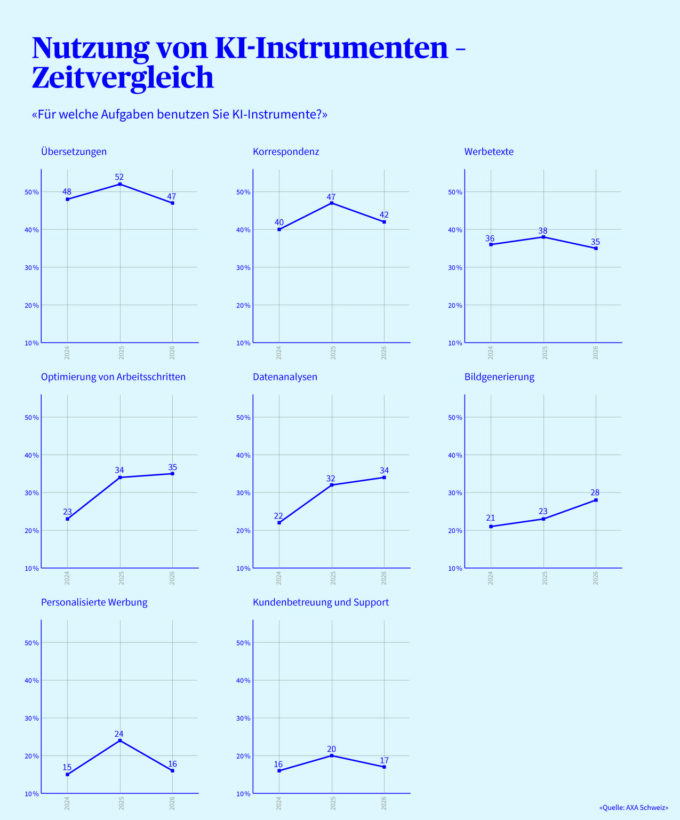
Language and communication tasks continue to dominate the areas of application for AI. Just under half of SMEs use the technology for translations (47 %), followed by correspondence (42 %) and advertising copy (35 %). However, the strongest growth since 2024 has been seen in more sophisticated applications: The percentage of SMEs using AI to optimize workflows rose from 23 to 35 percent. Data analysis (2024: 22 %, 2025: 34 %) and image generation (2024: 21 %, 2025: 28 %) also saw an increase. AI usage is thus becoming more diverse and is increasingly extending beyond purely text-based tasks.
What stands out is the stagnation in customer-related applications. Both personalized advertising (16 %) and customer service and support (17 %) have not grown beyond the 2024 level. The use of AI in external communications could potentially pose a reputational risk for companies, as customers may increasingly be able to recognize AI-generated content as such. «The »human-in-the-loop’ principle—that is, humans serving as the final authority—is proving effective here. Especially when it comes to direct customer contact, SMEs’ trust in the technology has apparently not yet grown sufficiently—concerns about hallucinations and uncontrolled AI behavior still seem to be significant,” says Kathrin Braunwarth, Head of DTI at AXA Switzerland, in her assessment of the results.
SMEs Do Not Expect Job Cuts Due to AI
Although the applications of AI are becoming more diverse, the companies surveyed do not expect any major upheavals in their workforce. Just under half of the SMEs with AI experience anticipate time savings without any impact on the number of jobs (47 %). Only 12 percent expect to be able to do without staff in the future—a figure that has remained remarkably stable over the three years of the survey. Even with growing experience in using the technology, companies do not expect AI to replace their employees.
«According to SMEs, the time savings achieved through AI do not lead to job losses, but rather seem to help ensure a more efficient use of existing capacity. The key question is how companies can pool the many small efficiency gains made by each individual and turn them into real added value. That will be one of the most challenging leadership tasks in the coming years,» says Kathrin Braunwarth.
Companies Remain Cautious
Swiss SMEs are largely optimistic about developments in the field of artificial intelligence. 41 percent view these advancements as an opportunity for their business, while only 15 percent perceive the technology as a threat. The majority take a neutral stance (44 %). Compared to previous years, this assessment has stabilized after having risen significantly from 2024 to 2025. SMEs thus continue to adopt a wait-and-see attitude: although the opportunities clearly outweigh the risks, the stance of many companies remains characterized more by caution than by euphoria.
It is interesting to note that there are hardly any differences in this regard between the service sector and the manufacturing industry. Roughly four in ten companies in both sectors view developments in AI more as an opportunity for their business. In the service sector, the perception of AI as a threat is slightly higher at 17 percent than in the manufacturing sector, where it stands at 10 percent. However, given the different ways in which the two sectors interact with AI, this difference is surprisingly small.
The differences become more pronounced when SMEs are categorized by size. Medium-sized (49 %) and large SMEs (41 %) tend to view AI as an opportunity more often than small businesses (33 %). «This could be related to the fact that larger companies often have more capacity to integrate new technologies than micro-enterprises. Those who are already using AI and experiencing concrete benefits may also view the technology more positively,» says Kathrin Braunwarth.
No Fundamental Change Expected from AI
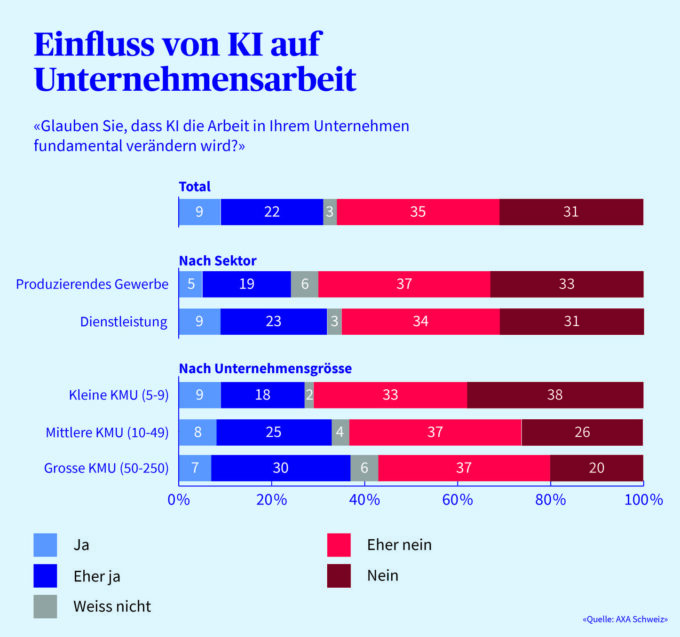
A measured attitude is also evident when it comes to the question of whether AI will fundamentally change work in companies. Only just under one-third of SMEs believe this will be the case, while two-thirds do not see the new technology as bringing about a fundamental change in the world of work. In the service sector, 32 percent of companies expect a fundamental change, compared to 24 percent in the manufacturing sector (%)—which is understandable given the tasks that AI can take on. Among large SMEs, the proportion of those expecting a profound transformation is slightly higher at 37 percent. AI is thus perceived as a useful tool that optimizes existing processes, rather than as a disruptive force that fundamentally reshapes everyday work.
The strategic assessment reflects this calm outlook. When asked whether SMEs need to adapt their business models in light of AI developments, 31 percent answered in the affirmative. A clear majority of just under two-thirds, however, sees no or little need for action. Here, too, service companies (32 percent) are slightly more likely to see a need for action than the manufacturing sector (27 percent). Large SMEs are more likely to feel compelled to take action than small ones: 42 percent of large SMEs see a need for action, compared with 23 percent of small SMEs. «This again shows that engagement with AI is more advanced in larger companies and is of greater concern to SMEs in the service sector,» says Kathrin Braunwarth of AXA. «For the majority of Swiss SMEs, however, it appears that AI continues to optimize existing processes without fundamentally challenging the business model.»
For the study, a total of 336 SMEs from German- and French-speaking Switzerland were surveyed from March 11 to 18, 2026.
Source: https://www.axa.ch