AI and Humans: HR Must Take the Wheel!
The 22nd Eastern Switzerland HR Conference focused on the topic «Between Algorithms and Everyday Life—How HR Creates Real Value with AI.» The conference highlighted one thing above all else: AI is advancing rapidly, which is why we must refocus our attention more strongly on people.


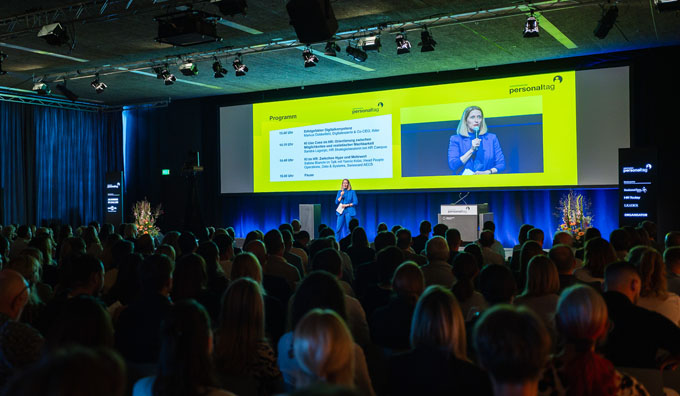
On September 17, 2026, approximately 260 participants gathered in St. Gallen for the 22nd Eastern Switzerland HR Day to address a topic that is sure to capture everyone’s attention: artificial intelligence. Many companies are grappling with the question of how AI is changing day-to-day work. At the same time, warnings are growing—especially from the very companies that set the whole thing in motion: Have we opened Pandora’s box with AI?
From Companion to Architect
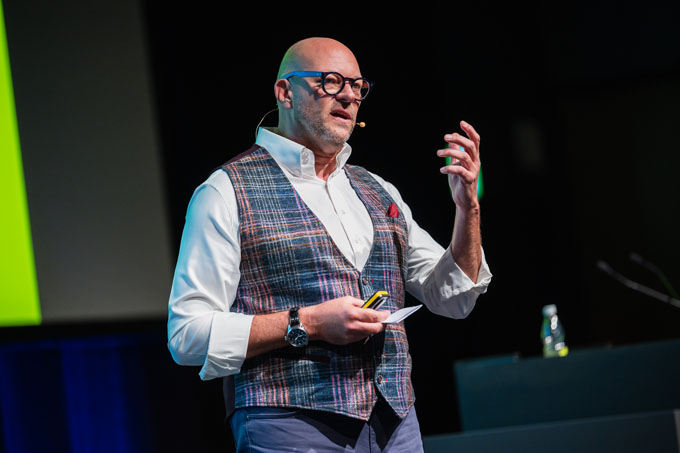
Be that as it may: A quick poll of the audience revealed that more than half of those present have already taken concrete steps toward AI. About 40 percent said they are still figuring out their approach. So the question is how to «put AI into practice,» as Peter Geiger of HR Ostschweiz noted in his opening remarks. The first speaker, Markus Dobbelfeld, digital expert and co-CEO at ifolor, also pointed out that many companies are still struggling with this «putting AI into practice.» «Many are using AI but aren’t measuring digital competence,» he explained. And it is precisely the enhancement of skills—not just digital ones—that is crucial for successfully navigating the transformation driven by digitalization and AI, demographic aging, a shortage of skilled workers, and economic pressures. In all of this, people and their (lacking) skills represent a bottleneck. It is therefore important to maintain people’s ability to learn and to cultivate it within companies. One-off training sessions are not enough; it is more effective to develop a learning organization. HR plays a key role in this process: it transitions from a facilitator to an architect and must therefore take the helm.
AI in HR Practice
Sandra Lugonjic, a strategy consultant at HR Campus, then addressed the practical implementation of these basic requirements in her presentation. Referring to recent studies, she began by noting that while the use of AI has become widespread in companies, the resulting productivity gains have not yet translated into tangible financial benefits. So far, a return on investment has only been achieved where processes have been fundamentally overhauled. Against this backdrop, Sandra Lugonjic presented the vision of «AI-Enabled HR»: AI serves as a platform, while HR takes on the role of empowerment rather than administration. As an example, she demonstrated a personnel change process—the transition from a full-time to an 80-percent position—in a digitized version (ticket system, automated approval processes, automated contract adjustments) and in a version utilizing an AI chatbot. She pointed out that many prerequisites must be met for an AI-supported process to succeed: a clean data foundation, defined workflows, and clear orchestration by HR experts. Data protection should also not be underestimated.
Yannic Krüsi, Head of People Operations, Data & Systems at Swisscard AECS and formerly with the now-merged Helvetia Baloise Insurance, also noted that AI cannot improve poor processes. There, thanks to People Analytics, the reasons for employee turnover could be investigated—no longer based on «gut feelings,» but on evidence. As a result, new competencies are emerging for HR experts: They must recognize that job profiles are changing; they are becoming sparring partners and must therefore maintain close ties with employees. «This cannot be outsourced to AI,» said Yannic Krüsi. His recommendation was that one should not «fall in love» with the technology, but rather with the problem. So here, too: HR must take the wheel, analyze the problems, and only then seek technological solutions based on that analysis.
People First!
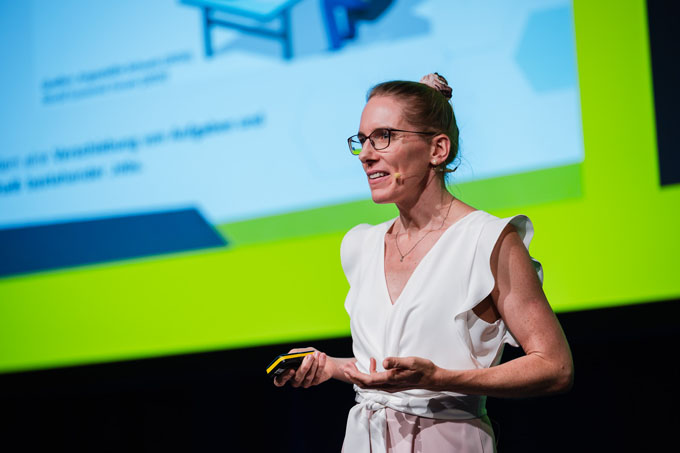
In her presentation, AI expert Berit Gerritzen confirmed many of the points made by the previous speakers. Many initiatives fail not because of the technology, but because people are not willing enough to embrace change. Her appeal was therefore: People first! If you want to implement AI, integration and trust must be in place. Only then can AI become productive, interoperable, and usable across the entire organization. However, she also warned against the consequences of overreliance on AI: This leads to «brain fry,» a form of mental exhaustion. Nevertheless, the transformation of the workplace driven by AI cannot be stopped. Berit Gerritzen also sees it as an important task of HRM to actively shape this change: analyzing tasks, redesigning jobs accordingly, aligning learning with concrete activities rather than abstract visions of the future, building skills, and, last but not least, ensuring the ability to use AI responsibly and productively. In this way, adaptable companies also gain a valuable tool for employer branding: when people are involved in the development process, the transformation strengthens their loyalty to the company, their trust, and the company’s appeal as an employer.
A person's strength lies in their steady efficiency
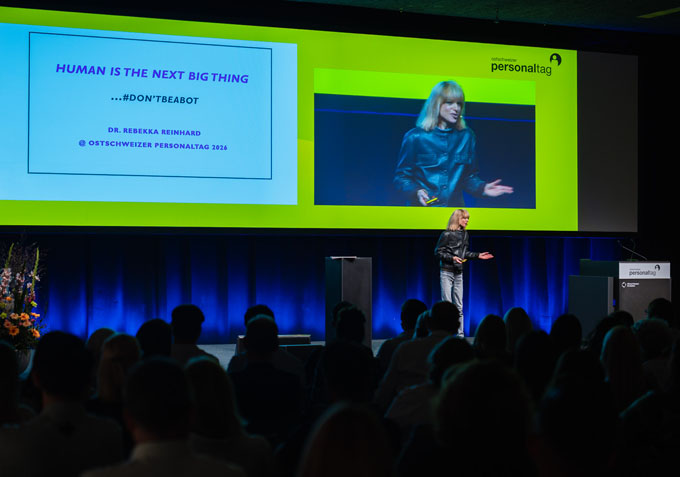
Dr. Rebekka Reinhard, author and editor-in-chief of «human Magazine,» provided the philosophical conclusion. Starting from the premise that change is nothing new—Heraclitus coined the phrase «Everything flows» as early as 500 B.C.—she offered the audience a wealth of food for thought. Her central message: «When we talk about AI, it’s not about machines, but about what it means to be human.» She does not view it as a negative that, compared to the rocket-like pace of technological development, humans are actually like snails. For she believes that human strength lies in our slow efficiency, which allows us to focus on what is essential. Values, responsibility, love, and humanity are what set us apart, but these can only be developed collectively, according to Rebekka Reinhard: «We is the new I,» she argues. As suggestions for action, she encouraged the audience to hold their own «reflection boot camp» from time to time, to think for themselves, to experience the «thrill of life,» while also consciously slowing down and focusing on the mind and heart. So here, too: It’s not technology, but people who are at the helm.
The 23rd Eastern Switzerland HR Day will take place on Thursday, September 23, 2027.