Shopping Season 2026: Brick-and-mortar Retail Remains the Favorite, Omnichannel Is Gaining Ground
A survey by Shopfully shows that in-store shopping will continue to be the top choice during the 2026 holiday season. At the same time, online research and in-store visits are becoming increasingly intertwined: flyers, special offers, and digital searches play a major role in determining which stores consumers ultimately visit.


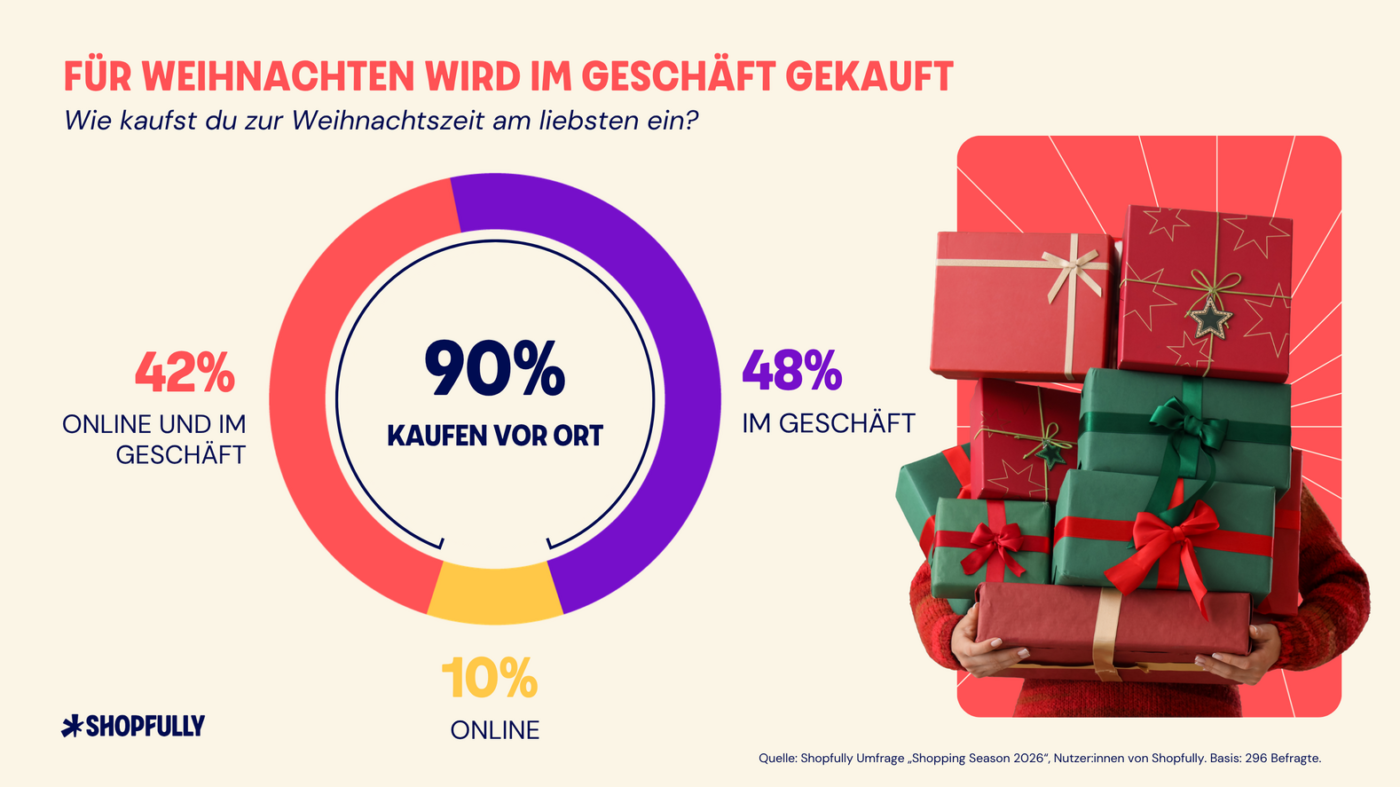
Brick-and-mortar retail remains the most important shopping channel during the 2026 shopping season. At least, that’s what the latest «Shopping Season» survey by Shopfully, conducted in Germany, shows. Just under half of those surveyed prefer to buy Christmas gifts in stores (48.3 percent). At the same time, many respondents combine online research with in-store shopping. Special offers, flyers, and search queries all influence which stores are ultimately visited.
Shopping is hybrid; purchasing decisions are made across multiple channels
In addition to a clear preference for in-store shopping, the survey reveals strong omnichannel behavior. 41.9 percent shop equally online and offline. During the holiday season, 9.8 percent of respondents shop exclusively online. For retailers and brands, this is an important signal: While the purchase is often finalized in-store, the decision-making process takes place across multiple channels. To drive customers to the store, retailers must place their offers where consumers search and compare.
For many, the store remains the most important source of inspiration. 39.7 percent find inspiration for deals and gift ideas while browsing in-store. Digital flyers and online catalogs are a key source of inspiration (28.7 percent). In addition, shoppers gather information via websites and platforms (20.7 percent) as well as through general web searches (21.8 percent). Printed brochures also remain relevant; about one-third of shoppers rely on them during the Christmas season (33.9 percent).
Whether on a whim or for Black Friday: Here's how the shopping season kicks off
When it comes to timing, the picture is mixed. 18.4 percent start shopping no later than October. For 20.1 percent, the season begins on Black Friday and is closely tied to the search for discounts and promotions. 22.2 percent shop on an as-needed basis, when they spot something they like online or in a store. Only 6.4 percent rarely start before mid-December.
For both occasions, about one-third of respondents did not specify a fixed budget (Black Friday: 31.0 percent; Christmas: 32.3 percent). However, there is a difference when it comes to specific budget expectations. For Black Friday, most respondents plan to spend less than 100 euros (20.8 percent), while for Christmas, the figure is between 100 and 200 euros (19.9 percent). Overall, 29.2 percent plan to spend at least 100 euros on Black Friday, and 49.1 percent plan to do so for Christmas. 19.1 percent do not plan to spend anything at all on Black Friday; for Christmas, that figure is just 3.1 percent.
Artificial intelligence has so far played a minor role in shopping. More than half of shoppers prefer to handle these tasks themselves (56.3 percent). When AI is used, it is primarily for comparing prices and finding deals (14.9 percent) as well as for gift ideas (12.1 percent).
What's Going into the Shopping Cart: Gift Cards, Fashion, and Entertainment Lead the Way
When it comes to planned product purchases, a wide variety of items tops the list: 29.3 percent mention clothing, shoes, or accessories. 28.7 percent plan to buy gift cards or vouchers. 27 percent mention cosmetics or perfume. These are followed by books, games, or other entertainment media (26.4 percent) as well as food and beverages (24.7 percent). Children’s products and toys also remain relevant (23 percent). For retailers, this presents the challenge of bundling appropriate product assortments and promotions in a way that both sparks inspiration and encourages customers to visit the store.
«The 2026 shopping season shows just how closely digital and brick-and-mortar retail are intertwined. While the purchase often takes place in-store, the decision is made beforehand based on research, promotions, and catalogs,» says Julian Klein, Country Manager for Germany at Shopfully. «If you want to get people into stores, you need to be visible early on with relevant promotions and communicate consistently throughout the customer journey.»
European market leader in the drive-to-store sector
The Shopfully «Shopping Season 2026» survey was conducted from September 14 to 28, 2026, among 296 users of the Shopfully app in Germany. Participants answered questions about their preferred shopping channel, their shopping style, their sources of information, their use of AI, their budget, and their planned product purchases for the holiday season.
Shopfully is the European market leader in drive-to-store and helps retailers and brands convert online search queries into actual purchases. The company, formerly known as Offerista in Germany, Austria, and the CEE countries, now operates in twenty-five countries with a team of more than four hundred fifty employees. Shopfully partners with more than five hundred retailers and brands. Through its global network of publishers and digital platforms, as well as its technological solutions—including its proprietary AI-based hyperlocal marketing platform—the company reaches over 200 million households worldwide.
Source and further information: https://www.shopfully.com