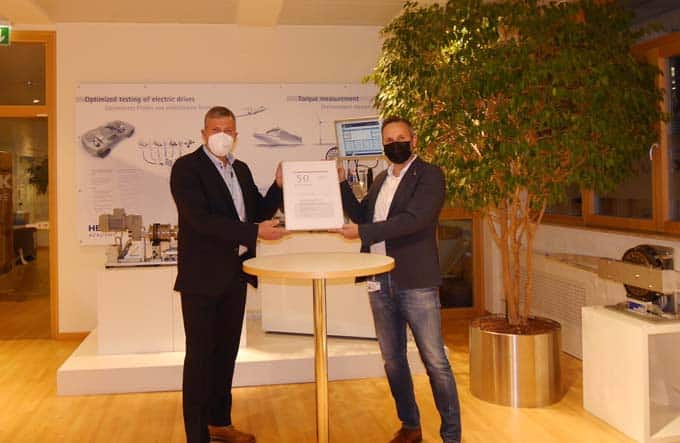
Test and measurement expert Hottinger Brüel & Kjaer (HBK) has been honored for its 50 years of membership in one of the most important German quality organizations, the German Society for Quality (DGQ). The award, or the corresponding certificate, was presented on September 14, 2021, at HBK's Darmstadt site and recognizes the company's long-standing commitment to high-quality [...]
Editorial - March 15, 2022
Hottinger Brüel & Kjaer has been a member of DGQ for 50 years and received an award for this. (Image: HBK) Testing and measurement technology expert Hottinger Brüel & Kjaer (HBK) has been recognized for its 50-year membership in one of Germany's most important quality organizations, the German Society for Quality (DGQ). The award, or rather the corresponding certificate, was presented on September 14, 2021 at HBK's location in Darmstadt and recognizes the company's long-standing commitment to high-quality solutions in the interests of its customers. HBK's German headquarters was the first company of its kind to receive ISO 9001 certification in 1986. The registration number of HBK's certification also reflects this: DQS-000001 for ISO 9001 (quality management), ISO 14001 (environmental management), ISO 50001 (energy management). Thanks to these standards, HBK's customers can be sure of receiving products and services of the highest quality. This is particularly important for customers in the military sector or for sensitive projects, for example in the aerospace industry. The DGQ (German Society for Quality) is a central, national quality organization in Germany. It acts primarily as the first point of contact as well as a moderator and mediator in quality issues. The umbrella organization is a registered association and can draw on a unique network of experts. HBK - Hottinger, Brüel & Kjaer - offers a complete portfolio of solutions across the entire product life cycle of test and measurement technology, bringing together the physical world of sensors, tests and measurements with the digital world of simulation, modeling software and analysis. By creating a scalable and open system for data acquisition hardware, software and simulation, product developers can shorten time-to-market, drive innovation and lead the way in a competitive global market. More information: https://www.hbkworld.com/en/about/quality-management
Russia's reputation falls by 19 percent worldwide - Switzerland slips three places
The study shows: All countries surveyed hold Russia responsible for the war in Ukraine - except China and India. Solidarity with Ukraine is high and has a positive impact on the global perception of the country. The current study is a supplement to the "Brand Finance Global Soft Power Index 2022" report, which is published annually [...]
Editorial - March 15, 2022
The study shows: All countries surveyed blame Russia for the war in Ukraine - with the exception of China and India. Solidarity with Ukraine is strong and has a positive impact on the global perception of the country. The current study is a supplement to the "Brand Finance Global Soft Power Index 2022" report, which records the perception of country brands every year. The USA takes first place in the ranking, followed by the UK in second place and Germany in third place. When asked who bears the main responsibility for the war in Ukraine, a clear majority of respondents in the study blamed Russia. This was also the case in Germany: 67% of Germans surveyed blamed Russia for the war in Ukraine. As a result, Russia has lost 19 percent of its reputation worldwide. Other countries, such as China (52%) and India (46%), however, blame the USA. Interesting: almost a quarter, 22% to be precise, of Americans blame their own country for the Russia-Ukraine conflict
Division in the USA
"This new study shows how strongly different news sources influence how people around the world classify current events. While on a global level the perception of Russia has undoubtedly worsened, the specific impact varies from country to country. What is most surprising, however, is the division of the American public regarding the war in Ukraine," explains David Haigh, CEO of Brand Finance. Last year's winner Germany slips to third place in the Global Soft Power Index 2022 - overtaken by the USA (first place) and the UK (second place). And yet: the overall ranking for Germany remains very stable and at a high level. Switzerland slips three places Switzerland and Austria also lost places in the "Brand Finance Global Soft Power Index 2022" report. Switzerland is in the top ten - but has slipped from fifth place (2021) to eighth place (2022), with a total score of 56.6 points. Austria dropped four places compared to the previous year - to 27th place. The Global Soft Power Index is a fully survey-based annual research study on the perception of country brands. The Global Soft Power Index records the opinions of over 100,000 respondents worldwide on 120 national brands. Brand Finance is a leading independent global brand valuation and analysis consultancy headquartered in London. Soft power is defined as the ability of a nation to influence the preferences and behavior of various actors in the international arena (states, companies, communities, the public, etc.) through attraction or persuasion rather than coercion. The report on the Download and more information
Cloud technology and Swiss manufacturers: about efficiency and much more
Manufacturers have spent the last few years looking at their data and adopting IoT sensors, architectures and applications to better understand their processes and optimize them for efficiency. But the focus on efficiency has left some manufacturing companies unable to see the forest for the trees when it comes to [...]
Editorial - March 15, 2022
The 2020s could be the decade for the final breakthrough of cloud technology in the manufacturing industry. (Image: Pixabay.com) Manufacturers have spent the last few years looking at their data and adopting IoT sensors, architectures and applications to better understand their processes and optimize them for efficiency. But the focus on efficiency has left some manufacturing companies unable to see the forest for the trees when it comes to digital transformation. A study by McKinsey found that 70 % of digital transformation initiatives fail to achieve their goals. However, pioneers in the industry are already looking beyond efficiency. The 2020s will be the decade when more mature, accurate approaches to digital transformation in the manufacturing sector evolve. Manufacturers will become more effective and strategically leverage cloud technology to drive better business outcomes.
Data nourish new models
In the past, a sale was seen as the end of the sales process. A customer decides to make a purchase, receives the product, and when they are satisfied with it, the manufacturer's involvement is over. However, manufacturers are increasingly seeing ongoing maintenance and other services as a profitable part of the sales process. We are now seeing new approaches move beyond a single transactional interaction with customers and use data to bring sales and services together. The result is a move to a pay-for-use model and then a pay-for-outcome model based on the delivery of a service - for example, connectivity as a service. Based on customer usage, manufacturers can offer personalized services. IoT thus enables the prediction and automation of maintenance and therefore effective and sustainable value creation. These models should be underpinned by cloud platforms that enable manufacturers to connect their operations, manage data and introduce machine learning, AI and analytics solutions. A suite of cloud applications also enables them to continuously innovate and develop new features. Manufacturers can also gain a unified view of their customers with cloud technology/solutions, which is essential for ongoing service-based relationships.
Circular economy is the future
I also believe that the circular economy will play a central role in the new models that are being introduced. At present, the global economy is circular only to 8.6 %while 100 billion tons of materials are produced every year. This linear approach to products means that we will produce 65 billion tons of greenhouse gases in 2030. Manufacturers will play a key role in completing the circular economy, reducing both waste and emissions. For manufacturers, the circular economy can be anything from aftermarket services throughout the lifecycle of a machine to clothing lines that use recycled fibers and resale platforms to reduce waste in the fashion industry. Once the entire lifecycle of a product becomes a manufacturer's responsibility, they need the analytical tools to determine when and how to service or reuse it.
Thanks to cloud technology: manufacturers can flourish
Switzerland, its emerging technology and its political and economic stability offer global companies a safe place to develop their digital manufacturing and supply chain processes. The FM Global Resilience Index 2020, which provides insights for companies that need to make equipment decisions, expand supply chains or enter new markets, has ranked Switzerland as one of the most resilient economies in the world. However, manufacturers are under pressure to take action, and cutting costs and increasing efficiency is a priority. This is also why they are turning to cloud technology to improve the efficiency of their operations. In 2021, McKinsey found that 64 % of industrial companies actively using the cloudalthough 50 % see cloud technology as more complex than originally expected. Rather than trying to "boil the ocean" by taking on a daunting challenge all at once, it would be most effective for manufacturers to use the cloud to quickly test new solutions and services and then expand them as needed. Siemens, for example, is working with Oracle on a high-performance processing solution that will help utilities better manage large-scale data processing requirements. This will use Oracle Cloud Infrastructure (OCI) to retrieve and process readings from smart meters at 30-minute intervals in homes and small, non-domestic sites to facilitate the transition to the smart grid. So far, volume and performance tests have been successfully conducted with 1.5 million meters. However, the Siemens application and OCI can be scaled far beyond this as the industry moves to an event-driven architecture. Swiss steel wheel manufacturer, Alcar Ruote, is another example, as it needed to rely on technology to continue producing with Swiss quality while remaining competitive in the global market. The company chose Oracle Supply Chain Management and Manufacturing and Oracle Fusion Cloud ERP applications to manage its planning, procurement, manufacturing and distribution while improving visibility in these areas.
Training for the digital transformation
However, we must not forget that alongside the introduction of new technologies, the digital capabilities of businesses depend on the right skills. Manufacturers need to ensure that their staff are trained in how to use the new solutions most effectively and support them with retraining where necessary. To ensure that the full benefits of cloud technology are realized, this should be done across the organization. Digital solutions are also at the heart of this employee training process. The Digital Capability Center Venice, a joint venture between McKinsey and Confindustria that uses Oracle Fusion Cloud Applications, was recently established to provide manufacturers with hands-on experience of operational transformation. Through realistic simulations, trainees can explore rapid prototyping and test modular solutions to gain hands-on experience. In this way, employees learn how digital capabilities can increase productivity and collaboration and improve safety on the factory floor and in the back office.
Cloud technology: efficiency and more
Manufacturers have the opportunity not only to gradually improve the efficiency of their operations, but also to change their operating models. In this way, they can achieve long-term positive outcomes for their customers while bringing much-needed circularity and resource productivity to their approach. To achieve this goal, they need to acquire the necessary tools to quickly test, iterate and scale new solutions. They also need to support their employees on this digital transformation journey with the latest training solutions. If they get it right, the result will be an improvement in effectiveness and efficiency. Author:Billy Kneubühl is Country Manager Oracle Switzerland
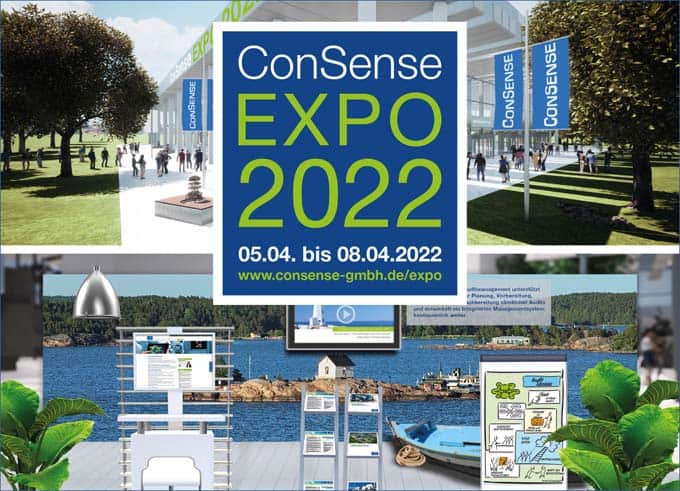
The virtual trade fair ConSense EXPO of the software provider ConSense GmbH presents software solutions and services around management systems including all novelties. The program offers varied live conferences, the presentation of the 4th ConSense ScientificAward and many opportunities for networking. Registration for the visit is now open at www.consense-gmbh.de/expo. Here you will also find the complete conference program as well as the registration [...].
Editorial - 14 March 2022
The ConSense EXPO virtual trade fair provides information about innovations in quality management and integrated management systems. (Image: ConSense GmbH) The virtual trade fair ConSense EXPO of the software provider ConSense GmbH presents software solutions and services around management systems including all novelties. The program offers varied live conferences, the presentation of the 4th ConSense ScientificAward and many opportunities for networking. Registration for the visit is now open at www.consense-gmbh.de/expopossible. Here you can also find the complete conference program as well as the registration for the conferences.
Virtual trade fair with comprehensive product information
At the ConSense EXPO digital trade show, experts from ConSense will be available for personal discussions at various topic booths, e.g. about QM software and to solutions for IMS - regardless of whether it consists of a QM system, data protection, occupational health and safety, environmental protection management or other management areas. The trade show also offers helpful information material on GxP-compliant QM solutions as well as measures, training and risk management. It will also present in detail the end-device-independent, web-based management system solution ConSense PORTALwhich provides user-friendly access to the entire digital documentation from any location and at any time. The ConSense Hosting Services take care of provisioning, backup, maintenance, monitoring and the installation of updates on request.
Live conferences, keynote, networking and more.
The highlights of the ConSense EXPO include a diverse conference and event program that is in no way inferior to a presence trade fair. The Live Conferences deal with current topics from the QM world. They are presented by experts for management systems from well-known companies and by ConSense GmbH. For example, the accredited DAkkS calibration laboratory Eumetron GmbH will describe how it can use the Integrated Management System to quickly and transparently demonstrate compliance with standard specifications. For safe ship operation with mandatory documentation in digital form and intelligent form management, see the example of BBC Chartering GmbH & Co. KG. Another conference will demonstrate how the QM methods of the Automotive Core Tools from the automotive industry can also ensure systematically good quality in other industries. Following the various technical presentations, the speakers will be available for discussion. Networking and exchange of experiences will take place in the digital Coffee Lounge. Visitors can also deepen their knowledge in on-demand webinars. Existing customers of ConSense GmbH will have access to extra slots for consulting sessions, additional live conferences and the keynote speech by Dr. Alexander Künzer from the management of ConSense GmbH via an exclusive area.
Presentation of the ConSense ScientificAward
For the first time, visitors can also be present live at the presentation of the 4th ConSense ScientificAward. With this interdisciplinary scientific award, ConSense GmbH honors final theses with innovative ideas for living management systems. The independent expert jury, consisting of Prof. Dr. Mendling (Humboldt University of Berlin and Chairman of the Society for Process Management), Prof. Dr.-Ing. Rosenbaum (Dresden University of Applied Sciences, Faculty of Mechanical Engineering) and Dr.-Ing. Sommerhoff (Head of Innovation and Transformation at the German Society for Quality), will evaluate the submitted theses. Following the announcement and the award ceremony, the award winner will present his or her award-winning work in a lecture.
"The metaverse can become a gigantic marketing channel"
m&k Werbewoche.ch : Tobias Müllhaupt, for many people the metaverse and everything that goes with it is still "uncharted territory". But you have already developed a business model for it. What, explained in simple terms, does your agency "Miss Wolf" do? Tobias Müllhaupt: With Miss Wolf, we produce all advertising media that can be displayed on a digital screen: whether social ads, [...]
Editorial - 13 March 2022
m&k Werbewoche.ch : Tobias Müllhaupt, forFor many people, the metaverse and everything that goes with it areört, nor "New territory". However, you have already created a GeschäThe company has developed its own business model. What, in simple terms explainärt, does your agency "Miss Wolf"?Tobias Müllhaupt: With Miss Wolf, we produce all advertising media that can be displayed on a digital screen: whether social ads, sophisticated HTML5 ads, DOOH or complex dynamic feeds. With the advent of Metaverse, it is natural that we have now expanded the above portfolio. We have recently started offering productions for Metaverse platforms, NFTs and also AR productions. Brands or agencies come to us who already have a mature idea of how and where they want to be present in the Metaverse. We then take over the production job. If you still ühas no idea at all what the metaverse is about. is: Can you give us a crash course? The basic idea of the metaverse is not complicated. Simply put, the metaverse encompasses any digital experience that is three-dimensional, immersive, permanent, and virtual - that is, that does not take place in the physical world. There are two terms of the metaverse in particular that need to be distinguished: Virtual reality refers to an entirely new 3D digital world that replaces reality; in augmented reality, digital content is added to the natural environment. Why should companies in Switzerland already beür interested in what happens in the metaverse? Nowadays, we are no longer in a linear, but in an exponential development of technologies. This means that it can happen unimaginably quickly that new technologies become accepted by the masses and the development of the metaverse is thus massively accelerated. As a company in Switzerland, I would therefore already start thinking strategically about how I can use the current or future Metaverse technologies. Modern and scalable business models will emerge. I see "growth hackers" and digital marketing pioneers as responsible for pitching and driving the entry into the metaverse within a company. Another term that you can always häThe one that reads more often is that of "NFT". Digital images of bored looking monkeys are used by pop stars füThe auction was held for horrendous sums of money.ünstler Wolfgang Beltracchi launches a DaVinci collection on the Blockchain. Once again füFor laymen like me, what is an NFT? Non-fungible tokens are non-exchangeable, blockchain-based tokens that can be used to digitally map ownership. The beauty of this is that, thanks to the transparency of blockchain technology, anyone can check whether someone actually has the rights to a digital asset or not. For example, a digital image or piece of music can be copied and downloaded thousands of times. Nevertheless, there is only one token that represents the original, and the blockchain can be used to show whether someone is in possession of this token or not. This is regulated via so-called smart contracts. These are "digital contracts" that can also be viewed transparently. What I find exciting is that with NFT transactions, Creators are rewarded for each transaction. For example, a Creator can program royalties into their NFT. Each time the token changes hands, a portion of the resale value is returned to the original creator or to any person or organization. Here, too, the question arises: Which applicationöThere are many possibilities forür company? Already now there are interesting possibilities to get involved as a company: The "simpler" way is to launch your own NFT collection with art, trading cards ... or to buy virtual land. If you want to get started in a more complex way, you can create virtual brand experiences on platforms like Roblox and Decentraland. Here, the focus is on brand awareness and engagement for now. Great examples are Vans World and Alo Sanctuary. Alternatively, as a simple end user, you can get the Oculus Quest 2 and take your first steps into the metaverse. Let's talk üWhat are your Metaverse visions for the near future, what will möbe possible? The one extreme is: Everything collapses and the fundamental idea, the decentralized vision does not prevail. The other extreme is: The whole life takes place only in the metaverse and the "virtual me" has at some point more value than my "real me". As we know, the solution will settle somewhere in the middle of these two extremes. The key is to first overcome fundamental hurdles: The technology has to be there - you need VR goggles, for example, that won't make you dizzy if you wear them for a long time. The big tech companies are working on such solutions right now. Profitable business models for companies also need to develop. And how köBrands can leverage these developments to create new revenue streams.öme and generate leads? The Metaverse has the potential to be a fully functioning economy. Individuals and businesses will be able to create, own, invest, sell, and be compensated for various "works." The metaverse can become a gigantic marketing channel for businesses.* Tobias Müllhaupt (pictured below as Digital Avatar) is founder and CEO of the digital production agency Miss Wolf in Zurich. The 29-year-old previously worked as Head of Social Media for Globus, among other positions. The company produces säAll advertising media that can be displayed on a digital screen can be used in the same way.öand has recently started to offer productions for theür Metaverse-platforms, NFTs and AR productions.
Jung von Matt Brand Identity creates fresh market presence for Freshhaus
Freshhaus has been building individual single-family homes throughout Switzerland for many years. As a general contractor, Freshhaus assumes overall responsibility for the construction project and assists future homeowners with construction consulting, architecture, construction management and interior design. In the past, however, Freshhaus was repeatedly confronted with prejudices against prefabricated houses and had to repeatedly prove that a concept house is not a prefabricated [...]
Editorial - March 10, 2022
Freshhaus has been building individual single-family homes throughout Switzerland for many years. As a general contractor, Freshhaus assumes overall responsibility for the construction project and assists future homeowners with construction advice, architecture, construction management and interior design. In the past, however, Freshhaus has repeatedly been confronted with prejudices against prefabricated houses and has repeatedly had to prove that a concept house is not a prefabricated house. In order to dispel these prejudices once and for all, Freshhaus - together with Jung von Matt Brand Identity - further developed its own brand with the aim of highlighting the brand's differentiating services and appealing to customers in a more emotional way. In joint workshops, the agency and company developed a brand story that was intended to get to the heart of the unique selling points: Individual and high-quality concept houses that make the wishes of future homeowners come true through comprehensive support, flexibility and guaranteed costs.
Enabling individual life dreams
In order to express the brand history even more strongly in the brand design, the individual design elements were further developed. The logo and colors were modernized and refreshed. In addition, floor plan animations were developed to make it clear that Freshhaus does not simply place ready-made house templates on the plots. The various Freshhaus concept houses can be visited via a digital tour and experienced with the help of a 360-degree view.
The brand experience taken further
Further touchpoints were also developed on the basis of the new brand experience: From a print media concept to sales documents and a new website. The website was implemented in close cooperation with the digital experts from Jung von Matt Tech. Using a brand-first approach, a modern, digital brand experience was created based on Webflow. The website should impress with its simplicity, user-friendliness and striking corporate language.Responsible at Freshhaus: Ivana Milanovic, André Kressebuch, Kerry de Zilva. Responsible at Jung von Matt Brand Identity: Alessandra Bally, Julius Jäger (Strategy), Monica Bühlmann, Boris Stoll, Christina Widmann (Design). Responsible at Jung von Matt Tech: Andrin Gorgi (implementation, project management), Stefanie Pfeffer (project management), Manuela Tappe, Michelle Scholz (design).
Flow instead of frustration: Strengthen measures against IT disruptions in digital workplaces
The high importance of Digital Employee Experience (DEX) has arrived in the mechanical and plant engineering and industrial production sectors. This is shown by a survey conducted by Nexthink among 300 IT experts from six industries in Germany, Austria and Switzerland. The study was conducted in May 2021 by the independent market research company Sapio Research. Among the majority (industrial production [...]
Editorial - March 10, 2022
"Why isn't it working!" Frequent IT disruptions lower the quality of work in digital workplaces - especially in manufacturing companies. (Image: Depositphotos.com) The high importance of Digital Employee Experience (DEX) has arrived in the mechanical and plant engineering and industrial production sectors. This is shown by a survey conducted by Nexthink among 300 IT experts from six industries in Germany, Austria and Switzerland. The study was conducted in May 2021 by the independent market research company Sapio Research. For the majority (industrial production 81%, mechanical and plant engineering 70%), the topic of DEX plays an important role and is to be driven forward with a team or employees specifically responsible for it (industrial production 76%, mechanical and plant engineering 66%). The main focus is on measures against IT disruptions.
Systematically and with a high level of automation, resolve IT faults more quickly
Comprehensive measures for disruption-free digital working environments are planned primarily by manufacturing companies. 87% (average 81%, mechanical and plant engineering 75%) will use systematic processes and tools with a high degree of automation to accelerate troubleshooting in digital workplaces. According to the Nexthink study, 85% of manufacturing companies use metrics and key performance indicators to measure the quality of digital workplaces (average 76%, mechanical and plant engineering 72%). A similar picture emerges for the plan to use a central management platform for the IT helpdesk that covers everything from ticketing and user communication to reporting, analysis and troubleshooting instructions.
Predict and prevent IT disruptions with predictive analytics
What are the causes of IT disruptions? To answer this question, 85% of the manufacturing companies surveyed (average 75%, mechanical and plant engineering 68%) plan to use an integrated system that correlates data from the IT backend with the service desk's management platform.
Predictive analytics technologies such as big data, artificial intelligence and machine learning are also very popular in industrial production (81%) in order to predict or prevent potential disruptions (average 76%, mechanical and plant engineering 75%).
Majority lives with compromises in the digital workplace
The measures are a logical consequence of the fact that companies have so far tended to wait passively for IT disruptions instead of avoiding them proactively and with a high level of automation from the outset. A critical aspect here is that the majority of the companies surveyed live with many compromises in the digital workplace (industrial production 70%, mechanical and plant engineering 62%). In addition, many faults occur repeatedly (industrial production 46%, mechanical and plant engineering 55%) and usually take a long time to rectify (industrial production 57%, mechanical and plant engineering 58%).
In the event of IT disruptions, the situation of users is unnecessarily complicated
The situation is also made unnecessarily difficult for users. They are often left in the dark as to how long a disruption will last (Industrial Production 70%, Mechanical and Plant Engineering 66%) and the IT self-service portal often proves not to be very helpful (Industrial Production 48%, Mechanical and Plant Engineering 62%). In addition, users are inadequately informed about major or planned impairments to the digital workplace (Industrial Production 85%, Mechanical and Plant Engineering 77%). Frustrating from the user's perspective is that although employee feedback is obtained, this usually does not lead to improvements (Industrial production 54%, Mechanical and plant engineering 70%).
Often abandonment of new applications due to possible additional problems
The existing shortcomings in the IT experience of employees are particularly evident with regard to the introduction of new applications. A full 91 percent of respondents from manufacturing companies believe that more or better assistance should be made available for new applications (Machinery and Plant Engineering 81%). To make matters worse, end users avoid calling the ticket hotline when they have problems with new applications (industrial manufacturing 57%, mechanical and plant engineering 72%). The result: as few new applications as possible are introduced to avoid problems, as confirmed by 59 percent of respondents from industrial production and a full 75 percent from mechanical and plant engineering.
DEX and the user perspective gain importance
The results of the Nexthink study show that the dynamic development of digitization is also bringing the topic of digital employee experience to the fore among companies. 81 percent from industrial production and 83 percent from mechanical and plant engineering say that this topic will have high priority in their company. And the manufacturing companies (80%) in particular want to take greater account of the user's perspective - an aspect that is significantly less in focus in the mechanical and plant engineering sector at 55 percent.
How to create value in a digital world - Value is no longer synonymous with value creation or shareholder value. Value also includes new customer perceptions of value, creating value thanks to new technologies, thanks to "beautiful" products with high value and, of course, new digital platform business models. At first glance, platforms and super apps from leading technology companies seem like [...]
Editorial - March 10, 2022
Ralph Hutter, course director of the new CAS Digital Product Lead HWZ and CAS Platforms & Ecosystems HWZ. This course is about digital ecosystems, among other things. (Image: HWZ) How to create value in a digital world - Value is no longer synonymous with value creation or shareholder value. Value also includes new customer perceptions of value, creating value thanks to new technologies, thanks to "beautiful" products with high value and, of course, new digital platform business models. At first glance, platforms and super apps from leading technology companies such as Google, Apple, Meta, Amazon, WeChat and Co. appear to be a threat because they are penetrating various industries. In fact, various banks, insurance companies, retailers, media houses and numerous start-ups have already discovered the great potential of platform business models in Switzerland as well. Typical offerings are mortgage marketplaces, mobility offers, comparison and e-commerce platforms - the race for market leadership has begun. And with it, the race for the right talent.
What makes digital ecosystems so successful?
The focus is not on technology, but on the consistent integration of the participants in an ecosystem. The focus is on customers, suppliers and even the company's own competitors. The primary goal is to jointly create real innovation and added value for all participants across companies and industries - in the form of a Digital Ecosystem. "New technologies such as Cloud, APIs, Big Data and Analytics are just enablers that help to implement new data-centric business models in a fast, scalable and standardized way. Central to successful implementation are the consistent reconfiguration of the business model and the design of the ecosystem. Only a few companies have the necessary enterprise capabilities and expertise in this area. This is reflected, among other things, in the large number of job offers and new job profiles in the field of ecosystems," says Ralph Hutter, head of the new CAS Digital Product Lead HWZ and CAS Platforms & Ecosystems HWZ programs.
Product development transforms radically
Product development is changing fundamentally: at its core is an increased focus on customers and design. The speed of innovation and technical complexity have increased substantially in recent years. New software development methods and management approaches such as agile, lean startup, etc. are being widely used to take account of this change. The role of the product manager is also changing radically due to the increasing importance of data and the use of new technologies. These include new interfaces such as AR, VR, IoT, voice, blockchain and gaming engines. The next generation of the internet, Web 3.0, is already on the horizon. Digital extensions via smart devices such as watches, glasses and new immersive user experiences with VR headsets in and around metaverse worlds enable new types of services, innovative business models and new touchpoints with the target clientele. The digital product lead is the new role designation for the leading product manager that is becoming established in start-ups and international companies. Digital Product Management is the key competence for transferring existing products and services to the next generation of the Internet, Web 3.0, and the emerging metaverse, or for launching completely new digital offerings based on new technologies.
How to create value in a digital world?
Innovative digital products with the latest technology create real added value for customers and lay the foundation for digital ecosystems in which new digital business models can be developed. This is real "digital value creation". The Institute for Digital Business at the HWZ Zurich University of Applied Sciences offers further education in this area. The newly launched CAS Platforms & Ecosystems HWZ and CAS Digital Product Lead HWZ, which are led by Ralph Hutter, strengthen the understanding of this cultural change and offer a methodical toolbox for dealing with the challenges of new platform business models and the development of digital products and services. If desired, the two CASs can be combined with a further elective module to create a Master's degree with a specialization in "Digital Value Creation" (Master of Advanced Studies in Digital Business, Major Digital Value Creation). This program prepares graduates in a practice-oriented manner for a career step in the new job profiles in the field of ecosystem and digital product management. Source and information: HWZ
Hotelplan merges beach holiday business into one division
The Hotelplan, Migros Ferien and German Vtours brands will come under the umbrella of the new Volume Tour Operating business unit, the Migros travel subsidiary announced in a communiqué on Wednesday. Also part of the new unit is the existing flight broker business in Switzerland and Germany. As a result, the former Hotelplan Suisse business unit will be split up and the business unit [...]
Editorial - March 9, 2022
Tim Bachmann becomes head of the new Volume Tour Operating division at Hotelplan. The brands Hotelplan, Migros Ferien and the German Vtours will come under the umbrella of the new Volume Tour Operating business unit, as the Migros travel subsidiary announced in a press release on Wednesday. The existing flight broker business in Switzerland and Germany is also part of the new unit. The former Hotelplan Suisse business unit will thus be split up and the Vtours business unit will be merged into the new division. The two specialist brands Travelhouse and Tourisme Pour Tous, marketing in Switzerland, distribution and the 88 travel agencies will remain with Hotelplan Suisse, as Group spokeswoman Bianca Gähweiler said on request.
No job cuts
By combining the classic beach holiday business, it will be possible to bundle purchasing in Switzerland and Germany. Gähweiler said that the larger volume would result in lower prices in some cases. Nothing else would change for customers. The employees would also keep their jobs. "The adjustment of the organizational structure will not result in any job cuts in either Switzerland or Germany," wrote the Hotelplan Group.
Bachmann new head of the division
The head of the new Volume Tour Operating division will be Tim Bachmann (pictured), the current head of Hotelplan Suisse, who will remain on the Executive Board. Nicole Pfammatter, previously Director Distribution & Marketing Hotelplan Suisse, will become the new Head of Hotelplan Suisse, while retaining responsibility for Distribution. Pfammatter thus joins the Group Executive Board. Vtours CEO and co-founder Achim Schneider will leave the company at the end of October 2022, according to a statement: "He already made the decision not to extend his contract in summer 2021 and it is not related to the new organizational structure." As part of the structural adjustment, the Executive Board of the Hotelplan Group will also be expanded. Walter Jung, previously HR Director Hotelplan Group, and Adrian Arnold, previously Director Group Strategy & Projects, will be newly appointed to the Executive Board. As Chief People Officer, Walter Jung will increasingly focus on strategic HR issues for the entire Group. As Chief Digital & Strategy Officer, Adrian Arnold will be responsible for the digitalization of customer interfaces and the area of sustainability. (SDA)
The advertising agency and Displaysolutions give the POS a new face
The newly developed claim "Staging Brands" puts the product in the spotlight, while expressive key visuals highlight the synergy between product and display and put the different areas of the company in the center. The animated CGI visuals are designed to convey the value of the brands and the implementations. "The new look is an interplay of form, animation and type, which [...]
Editorial - March 9, 2022
The newly developed claim "Staging Brands" puts the product in the spotlight, while expressive key visuals highlight the synergy between product and display and place the various areas of the company at the center. The animated CGI visuals are intended to convey the value of the brands and the implementations. "The new appearance is an interplay of form, animation and type, which flow together to create an unmistakable, meaningful and contemporary overall image. The focus is always on the customer experience," explains Emanuel Brunner, Creative Director of Displaysolutions. In addition to the visuals, it was equally important to communicate the company and industry trends to the outside world. The Website has therefore been given a new magazine section that will serve as a source of inspiration and information. This is where POS trends, interviews and other news from the industry will find their new home, which are also linked to LinkedIn and thus serve as multipliers. "Materiality and the future were central themes throughout the entire process. The result is a new world that makes tangible on the outside what is already being lived on the inside. A communication platform rarely seen in display production that not only sells a service, but can also offer real added value for the company and its customers," explains Andrea Zanzerl, Brand & Design Strategist at Die Werbekanzlei. Responsible at Displaysolutions: Django Rubinick, Emanuel Brunner, Adrian Binkert. Responsible forThe Advertising Firm: Andrea Zanzerl, Patrick Varga, Turan Oeznalci, Ladina Baumgartner.
Study shows: False promises cost companies customers
For the study, Qualtrics, provider of experience management systems, surveyed more than 500 consumers in Germany about their opinion of customer and brand experiences. Half of the respondents said they stopped buying from a manufacturer because the customer experience they experienced did not match the brand promise. The main reason cited by respondents was product quality [...].
Editorial - March 8, 2022
For the study, Qualtrics, a provider of experience management systems, surveyed more than 500 consumers in Germany about their opinion of customer and brand experiences. Half of those surveyed stated that they had stopped buying from a manufacturer because the customer experience they had experienced did not match the brand promise. The main reason cited by respondents was product quality (68 percent) - followed by poor customer service (62 percent) and a mismatch with the company's vision, values or stance on social issues (40 percent). "An excellent customer experience is crucial to the success of a brand," says Martin Meyer-Gossner, Experience Scientist at Qualtrics. "The brand is defined by everything the company does. It is embodied by the product and the customer journey and implemented by the employees. Take a delivery service, for example. If the delivery window is not met, it affects the experience with a brand." The importance of the customer experience for the brand is also made clear by the factors that will strengthen trust in the brand in 2022: customer service ranks just behind appropriate pricing, followed by concern for employees and not taking advantage of crises for one's own company. Going above and beyond the recommended safety standards rounded off the top five. For companies looking to stay relevant in an increasingly competitive market, the quality of products and services (74 percent) and customer service (59 percent) have more influence on consumers than marketing and advertising (43 percent) and social media presence (34 percent). "Understanding a company's purpose and communicating with its workforce is key to a good brand and customer experience. A company must have the right systems and processes in place to achieve this. The next step is to identify the moments in the customer journey that have the biggest impact on customer behavior. With these insights, companies can fulfill customers' wishes - exactly when it matters most. A brand's purpose, promise and values should be embedded in everything it does," adds Meyer-Gossner. Do not underestimate ratings Companies should not underestimate the importance of reviews. 95 percent of people have read a review before buying from a new vendor. If there was a bad review, 62 percent of people would probably not buy.
Health protection: Preventing burnout among employees
Because of the pandemic, many of us have had to move our jobs to the home office. While burnout has always been an issue to take note of and counteract, the pandemic has significantly blurred the lines between work and personal life. This has led to many of us working extra hours, either to [...]
Editorial - March 8, 2022
Working from home blurs the boundaries between leisure and private life. The risk of burnout increases. (Image: Pixabay.com) Because of the pandemic, many of us have had to move our jobs to the home office. While burnout has always been an issue to take note of and counteract, the pandemic has significantly blurred the lines between work and personal life. This has led to many of us working extra hours, either to make up for perceived shortcomings or delays at work, or even unknowingly.
When employee engagement wanes
According to a British study 70 % of employees report that they suffer from burnout symptoms. Lack of free time and high workload are the main contributing factors among those who feel such effects. This is a major concern for managers and companies, as employee engagement is directly related to business results. Hogan Assessments, a leading provider of personality assessments and leadership consulting, highlights three areas employers can scrutinize and address to ensure their employees are satisfied, engaged and well-supervised, thereby avoiding the burden of burnout.
Personality is the key when it comes to work and burnout
The research conducted by Hogan suggests that the pandemic has not changed people's personalities themselves, but only reinforced certain pre-existing traits. For example, if someone is extraverted and enjoys the more social aspects of an office environment, then his or her priorities have not changed. The isolation that comes with working from home could be detrimental to his or her work. On the other hand, a more introverted person might thrive in a home office atmosphere and find that more tasks can be accomplished without the added distractions that come with working in a shared space. To avoid burnout and avoid putting unnecessary stress on employees when they return to work, employers need to work with team leaders. Encouraging an open dialog between managers and team members will help build a more flexible hybrid system that maximizes productivity among engaged employees. Employees who choose to continue working from home may feel they have to put in more effort or work more hours as they are not constantly monitored - it is therefore important to keep a close eye on this and remind these employees through regular communications that their regular workload is more than sufficient. Setting up a system that allows and encourages open and honest conversations between employees and managers will make employees feel that they are seen and heard and that their needs are being considered.
To mitigate the effects of burnout, stress management is critical
Often, burnout can be triggered by an excess of stress. Covid-19 has led to employees feeling increased pressure to mask any difficulties they may have in coping with stresses from both work and the pandemic. In doing so, according to a Lime Group survey Only one in six employees feel that their psychological needs are sufficiently taken into account by their employer and in the workplace. A person's experience of burnout can often be measured by how well they deal with stress. To get a better idea of how individual employees deal with stress, a development survey developed for this purpose can be used. This is because people who internalize stress are more likely to feel the effects of burnout. Conducting tests can help companies make better decisions that enable employees to better manage their time and workload and avoid stress. They also contribute to smarter strategy and decision making within the company's management structures to prevent the effects of burnout. They also help those who are already suffering from it to recover better. An important tool in the fight against burnout is to remind employees of all the mental health and support systems available to them in their company. This encourages them to contact the HR department if they want or need to make use of them.
The company's values are directly linked to the commitment of its employees
Burnout is less likely to occur if people are hired whose personal values are most in line with those of the company. However, a company must also lead by example at all times. If management does not exemplify the values it wants to see in its employees, it runs the risk of being the driving force behind unhealthy work practices. The key to combating burnout is to prioritize work-life balance. Acknowledging employees' overtime and reassuring them that this is not a standard that is always expected of them is key. Allowing employees to sign off at the end of their working day may not seem like a revolutionary concept, but it is important as this fact has been forgotten or pushed aside by many employees during the pandemic. "The employer response to burnout must no longer be retroactive. Employers need to start addressing burnout proactively, even before it occurs. Companies need to pay attention to employee engagement data to see who in their organization is most at risk of burnout," adds Dr. Ryne Sherman, Chief Science Officer at Hogan Assessments, "For those suffering from burnout, consider setting up weekly individual check-ins with team members so managers are aware of their workload and any overtime or additional actions that may need to be taken.
in the picture. Providing better structure in this way will help set expectations and reassure your team that they can get the support they need." Source: Hogan Assessments








 The study shows: All countries surveyed blame Russia for the war in Ukraine - with the exception of China and India. Solidarity with Ukraine is strong and has a positive impact on the global perception of the country. The current study is a supplement to the "Brand Finance Global Soft Power Index 2022" report, which records the perception of country brands every year. The USA takes first place in the ranking, followed by the UK in second place and Germany in third place. When asked who bears the main responsibility for the war in Ukraine, a clear majority of respondents in the study blamed Russia. This was also the case in Germany: 67% of Germans surveyed blamed Russia for the war in Ukraine. As a result, Russia has lost 19 percent of its reputation worldwide. Other countries, such as China (52%) and India (46%), however, blame the USA. Interesting: almost a quarter, 22% to be precise, of Americans blame their own country for the Russia-Ukraine conflict
 m&k Werbewoche.ch : Tobias Müllhaupt, forFor many people, the metaverse and everything that goes with it areört, nor "New territory". However, you have already created a GeschäThe company has developed its own business model. What, in simple terms explainärt, does your agency "Miss Wolf"? Tobias Müllhaupt: With Miss Wolf, we produce all advertising media that can be displayed on a digital screen: whether social ads, sophisticated HTML5 ads, DOOH or complex dynamic feeds. With the advent of Metaverse, it is natural that we have now expanded the above portfolio. We have recently started offering productions for Metaverse platforms, NFTs and also AR productions. Brands or agencies come to us who already have a mature idea of how and where they want to be present in the Metaverse. We then take over the production job. If you still ühas no idea at all what the metaverse is about. is: Can you give us a crash course? The basic idea of the metaverse is not complicated. Simply put, the metaverse encompasses any digital experience that is three-dimensional, immersive, permanent, and virtual - that is, that does not take place in the physical world. There are two terms of the metaverse in particular that need to be distinguished: Virtual reality refers to an entirely new 3D digital world that replaces reality; in augmented reality, digital content is added to the natural environment. Why should companies in Switzerland already beür interested in what happens in the metaverse? Nowadays, we are no longer in a linear, but in an exponential development of technologies. This means that it can happen unimaginably quickly that new technologies become accepted by the masses and the development of the metaverse is thus massively accelerated. As a company in Switzerland, I would therefore already start thinking strategically about how I can use the current or future Metaverse technologies. Modern and scalable business models will emerge. I see "growth hackers" and digital marketing pioneers as responsible for pitching and driving the entry into the metaverse within a company.
  Another term that you can always häThe one that reads more often is that of "NFT". Digital images of bored looking monkeys are used by pop stars füThe auction was held for horrendous sums of money.ünstler Wolfgang Beltracchi launches a DaVinci collection on the Blockchain. Once again füFor laymen like me, what is an NFT? Non-fungible tokens are non-exchangeable, blockchain-based tokens that can be used to digitally map ownership. The beauty of this is that, thanks to the transparency of blockchain technology, anyone can check whether someone actually has the rights to a digital asset or not. For example, a digital image or piece of music can be copied and downloaded thousands of times. Nevertheless, there is only one token that represents the original, and the blockchain can be used to show whether someone is in possession of this token or not. This is regulated via so-called smart contracts. These are "digital contracts" that can also be viewed transparently. What I find exciting is that with NFT transactions, Creators are rewarded for each transaction. For example, a Creator can program royalties into their NFT. Each time the token changes hands, a portion of the resale value is returned to the original creator or to any person or organization. Here, too, the question arises: Which applicationöThere are many possibilities forür company? Already now there are interesting possibilities to get involved as a company: The "simpler" way is to launch your own NFT collection with art, trading cards ... or to buy virtual land. If you want to get started in a more complex way, you can create virtual brand experiences on platforms like Roblox and Decentraland. Here, the focus is on brand awareness and engagement for now. Great examples are Vans World and Alo Sanctuary. Alternatively, as a simple end user, you can get the Oculus Quest 2 and take your first steps into the metaverse.
  Let's talk üWhat are your Metaverse visions for the near future, what will möbe possible? The one extreme is: Everything collapses and the fundamental idea, the decentralized vision does not prevail. The other extreme is: The whole life takes place only in the metaverse and the "virtual me" has at some point more value than my "real me". As we know, the solution will settle somewhere in the middle of these two extremes. The key is to first overcome fundamental hurdles: The technology has to be there - you need VR goggles, for example, that won't make you dizzy if you wear them for a long time. The big tech companies are working on such solutions right now. Profitable business models for companies also need to develop. And how köBrands can leverage these developments to create new revenue streams.öme and generate leads? The Metaverse has the potential to be a fully functioning economy. Individuals and businesses will be able to create, own, invest, sell, and be compensated for various "works." The metaverse can become a gigantic marketing channel for businesses.
 Freshhaus has been building individual single-family homes throughout Switzerland for many years. As a general contractor, Freshhaus assumes overall responsibility for the construction project and assists future homeowners with construction advice, architecture, construction management and interior design. In the past, however, Freshhaus has repeatedly been confronted with prejudices against prefabricated houses and has repeatedly had to prove that a concept house is not a prefabricated house. In order to dispel these prejudices once and for all, Freshhaus - together with Jung von Matt Brand Identity - further developed its own brand with the aim of highlighting the brand's differentiating services and appealing to customers in a more emotional way. In joint workshops, the agency and company developed a brand story that was intended to get to the heart of the unique selling points: Individual and high-quality concept houses that make the wishes of future homeowners come true through comprehensive support, flexibility and guaranteed costs.


 The newly developed claim "Staging Brands" puts the product in the spotlight, while expressive key visuals highlight the synergy between product and display and place the various areas of the company at the center. The animated CGI visuals are intended to convey the value of the brands and the implementations. "The new appearance is an interplay of form, animation and type, which flow together to create an unmistakable, meaningful and contemporary overall image. The focus is always on the customer experience," explains Emanuel Brunner, Creative Director of Displaysolutions.


 For the study, Qualtrics, a provider of experience management systems, surveyed more than 500 consumers in Germany about their opinion of customer and brand experiences. Half of those surveyed stated that they had stopped buying from a manufacturer because the customer experience they had experienced did not match the brand promise. The main reason cited by respondents was product quality (68 percent) - followed by poor customer service (62 percent) and a mismatch with the company's vision, values or stance on social issues (40 percent). "An excellent customer experience is crucial to the success of a brand," says Martin Meyer-Gossner, Experience Scientist at Qualtrics. "The brand is defined by everything the company does. It is embodied by the product and the customer journey and implemented by the employees. Take a delivery service, for example. If the delivery window is not met, it affects the experience with a brand." The importance of the customer experience for the brand is also made clear by the factors that will strengthen trust in the brand in 2022: customer service ranks just behind appropriate pricing, followed by concern for employees and not taking advantage of crises for one's own company. Going above and beyond the recommended safety standards rounded off the top five. For companies looking to stay relevant in an increasingly competitive market, the quality of products and services (74 percent) and customer service (59 percent) have more influence on consumers than marketing and advertising (43 percent) and social media presence (34 percent). "Understanding a company's purpose and communicating with its workforce is key to a good brand and customer experience. A company must have the right systems and processes in place to achieve this. The next step is to identify the moments in the customer journey that have the biggest impact on customer behavior. With these insights, companies can fulfill customers' wishes - exactly when it matters most. A brand's purpose, promise and values should be embedded in everything it does," adds Meyer-Gossner. Do not underestimate ratings Companies should not underestimate the importance of reviews. 95 percent of people have read a review before buying from a new vendor. If there was a bad review, 62 percent of people would probably not buy.