Corporate culture as a strategy in the age of AI
Top performance is not the achievement of individuals - it is the result of a well-orchestrated system. In a new e-book, Culture Amp shows how companies can make their culture measurable and thus achieve a demonstrable competitive advantage.





Culture Amp's science-based data research, based on more than 1.5 billion analyzed data points from 6,800 companies, proves this: Top performance is not the merit of individuals. Rather, it is the result of a well-orchestrated system within the company. Just as in Formula 1 racing, where victory does not depend on the driver alone, but on a well-coordinated team of tire strategists, engineers, pit crew and analysts, top performance in the corporate context is only achieved when all the parts work together.
47 percent advantage thanks to peak performance culture
Leaders and managers try to build high-performance cultures, but sometimes wonder how they will know when they have actually achieved this status. Peak performance often feels more like an aspirational goal than something that organizations can actually identify and sustain. The key question is therefore: can an organization's top performance be measured?
The answer is yes. Culture Amp's data shows that listed companies that are in the top performance area have a 47 percent advantage in terms of share price performance over companies that are not. In addition, these companies have an employee retention rate of 88 percent and attract 21 percent more top talent. And: 76 percent of companies in this state retain their peak performance status in the following year - proof that this is a sustainable, controllable variable.
Commitment and performance: psychologically linked, systematically separated
A key finding from Culture Amp's research is that engagement and performance are closely linked psychologically - but are systematically considered separately in practice. Companies with high employee engagement have been shown to have a higher proportion of high performers. In addition, the quality of leadership has a direct influence on employee performance: Managers who exceed expectations or set new standards have a significantly higher proportion of high-performing direct reports than those who fail to meet expectations.
«CPOs are tired of just improving engagement scores. What we urgently need is a message that marks a clear shift in the conversation towards true excellence and resonates immediately with the CEO and leadership team,» says Anna Binder, former CPO.
The Performance Culture Quadrant: orientation framework for the path to top performance
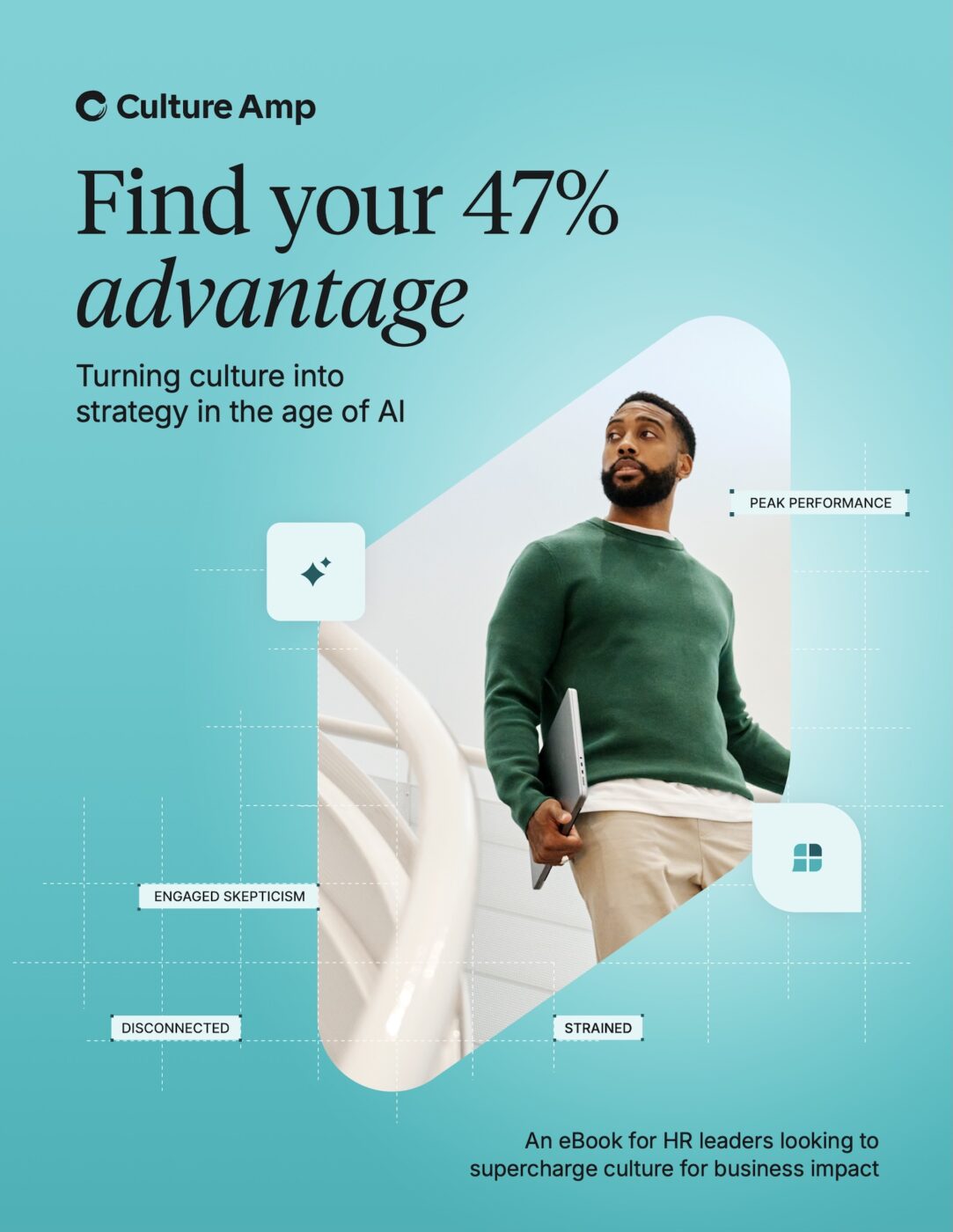
In its new e-book «Find your 47% advantage», Culture Amp presents the Performance Culture Quadrant (PCQ). The analysis model classifies companies into four cultural states based on engagement and performance data: Peak Performance, Engaged Skepticism, Strained and Disconnected. For the first time, the model provides a clear orientation framework for the path to peak performance.
The PCQ measures six factors that make cultural strengths and weaknesses visible: Excellence (a strategic North Star that creates long-term alignment), Vision (a motivating perspective that rallies everyone around a common goal), Ownership (personal responsibility and accountability), Learning (two-way communication and continuous learning), Voice (roles that align with what drives people) and Energy (clear allocation of roles and focused use of resources).
«The PCQ has shifted the conversation from »how do we improve engagement scores' to 'how do we achieve a peak performance culture'. This change has created greater focus and engagement among managers," says one user, describing the impact of the model.
Where do companies stand today - and how do they achieve top performance?
In the analysis of around 1,800 companies, 44 percent are in the Peak Performance state, 34 percent in the Engaged Skepticism state, 10 percent in the Strained state and 12 percent in the Disconnected state. Medium-sized companies are more frequently represented in the Peak Performance state than very large or very small ones. The distribution also varies greatly depending on the sector.
The e-book also shows what measures companies have taken to achieve top performance: Companies from the Engaged Skepticism state particularly improved cross-departmental collaboration and accountability. Companies in the Disconnected state strengthened trust in leadership, developed a motivating vision and promoted innovation. Companies in the Strained state invested in people-centered leadership and the connection to a social goal. What all successful transformations had in common was a consistent alignment of resources and the visualization of cultural changes.
Five ways in which HR managers contribute to top performance
The e-book concludes with five practical recommendations for HR managers: they should link engagement and performance measurement via a uniform intelligence layer, align the strategy away from individual performers and towards systemic solutions, aggregate performance data at team level, continuously interpret cultural signals and condense them into concrete recommendations for action, and work specifically on the cultural factors that drive or inhibit performance on the basis of the PCQ.
The e-book «Find your 47% advantage - Turning culture into strategy in the age of AI» is available for download at the following link: https://www.cultureamp.com/resources/reports/performance-culture-research
Further information on Culture Amp: www.cultureamp.com