

Swiss Staffingindex: Temporary staffing market turns positive after three years
The Swiss temporary staffing market is growing again for the first time after twelve quarters in the red. In the first quarter of 2026, deployment hours rose by 1.3% - despite geopolitical tensions. However, the permanent placement business remains under heavy pressure.





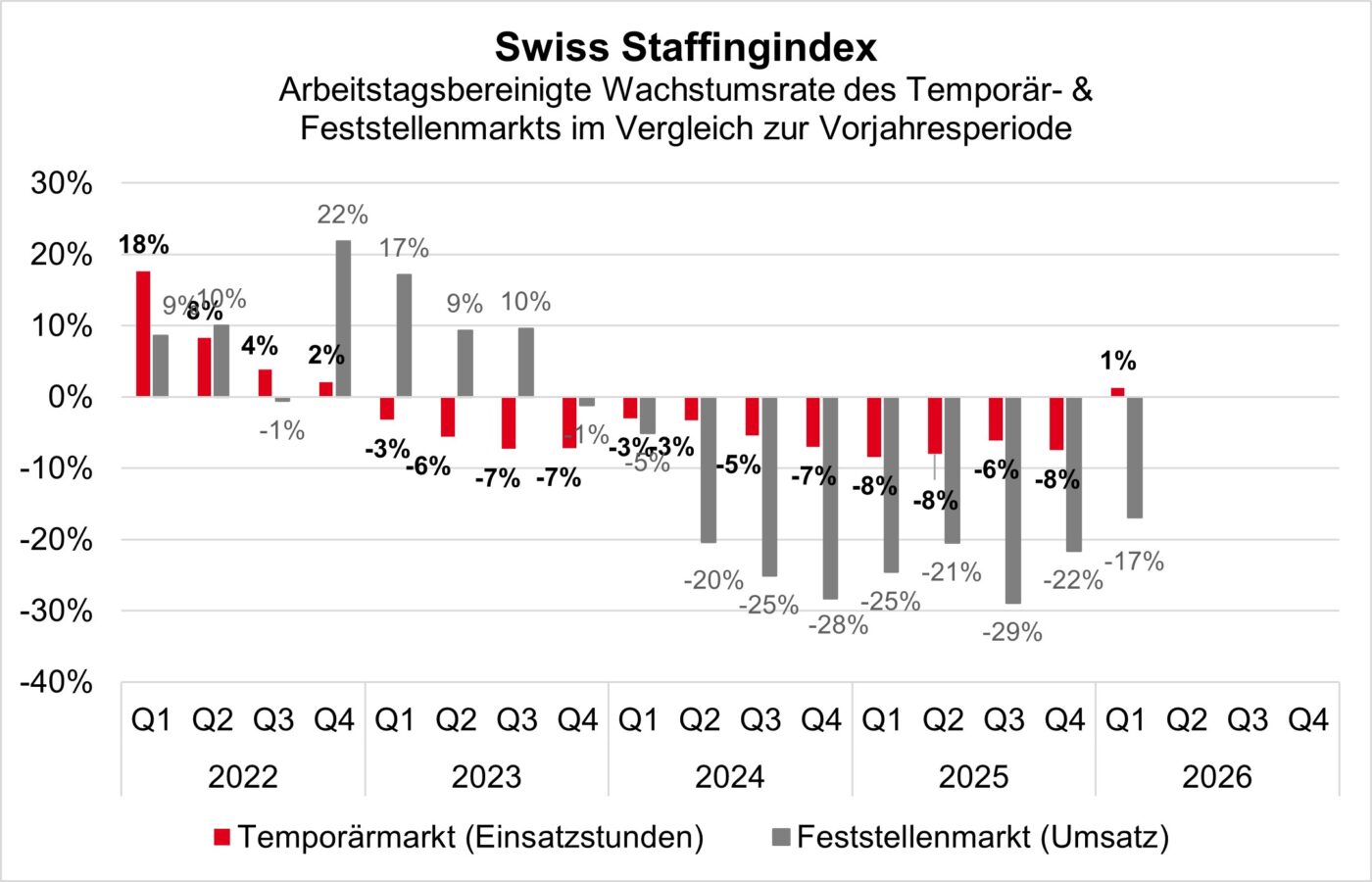
Swiss personnel service providers halted a multi-year downward trend in the first quarter of 2026: after twelve quarters with a negative sign, the number of hours worked by temporary staff rose by 1.3% compared to the previous year. The permanent placement business, on the other hand, continues to suffer from the economic slowdown and economic uncertainty - with a decline of 16.9%, the market segment is now falling for the eleventh quarter in a row. The Swiss Staffingindex is thus a clinical thermometer of the Swiss economy, reflecting the overall positive but fragile development of the labor market and economy.
Selective recovery with major regional differences
The first quarter was characterized by stabilization at a low level in the temporary market. There were marked regional differences: In Eastern Switzerland, more industrial companies had to register short-time work for their permanent staff, which caused the demand for temporary staff in the region to fall by 2.2% compared to the same quarter of the previous year. The Central Plateau, on the other hand, saw an increase of 5.5% - growth to which the watch industry made a significant contribution.
Marcel Keller, Country President Adecco Group Switzerland, comments: «The slight recovery in the first quarter is not a broad-based upturn, but a selective countermovement in individual industrial clusters - particularly in the Central Plateau. After several weak quarters, companies there are responding cautiously with temporary hiring, but remain very cautious overall.»
Iran conflict: still no impact on business in March
The effects of the Iran conflict were not yet noticeable in March 2026. Staffing hours grew by 1.1% compared to the previous year - weaker than in January, but stronger than in February. Dr. Marius Osterfeld, economist at Swissstaffing, explains: «By historical standards, energy price increases in March were moderate despite the noticeable impact at the pumps. The Iran conflict therefore had hardly any impact on the business of staffing companies.»
This is significant, as March has around 20% more working hours than January due to seasonal factors. Negative effects would have had a correspondingly greater impact on the quarterly result.
However, Osterfeld is not giving the all-clear for the coming months: «If the conflict on the Strait of Hormuz is not resolved, this will hit Swiss industry particularly hard - and therefore also the temporary staffing sector.» The industrial sector accounts for around a quarter of the turnover of personnel service providers, which means that the temporary staffing industry reacts strongly to its business development.
Geopolitical uncertainty strengthens individual segments
However, the Iran conflict could also strengthen individual market segments: According to Osterfeld, the uncertainty surrounding kerosene prices and flight cancellations is likely to prompt more undecided travelers to take vacations in Switzerland or invest in consumer goods instead of booking a vacation. This will boost demand in the catering, hotel, logistics and retail sectors. The overall effect would nevertheless remain negative, as some of the money saved would have to be spent on higher prices.
Despite the tense geopolitical situation, the CEOs of Swissstaffing member companies are optimistic: according to a survey conducted by the opinion and social research institute Gfs-Zurich, 38% of CEOs surveyed expect business to increase over the next six months - a figure comparable to the previous quarter's survey.
Source: Swissstaffing.


