

AXA Study: Staff Absences Are Becoming a Cost Factor for SMEs
Four out of ten Swiss SMEs are seeing rising costs due to employee absences. AXA’s latest SME labor market study shows that absences due to mental health issues are on the rise—and that leadership culture plays a crucial role in this trend.






The burden of staff absences has intensified among Swiss SMEs. According to AXA’s latest SME labor market study, conducted by the Sotomo research institute in March 2026, 42 percent of the companies surveyed reported increased costs due to absenteeism over the past five years. Among large SMEs with 50 to 250 employees, the figure is as high as 62 percent. At the same time, absences due to mental health issues are on the rise—and targeted countermeasures are stagnating.
Mental Health Takes Center Stage
Just over a third of the SMEs surveyed report being moderately or severely affected by absences attributable to their employees« mental health. Compared to 2023, this represents an increase of ten percentage points. »Staff absences are no longer just an HR issue. For many SMEs, they are becoming a business risk. Especially in times of labor shortages, even a few extended absences can delay projects, place additional strain on teams, and impair a company’s competitiveness—particularly for SMEs that have fewer personnel reserves to absorb such absences,” says Laetitia Amey, CEO of WeCare, AXA’s workplace health management service.
The causes of mental stress are varied. Forty-six percent of the SMEs surveyed cite personal stress as the most common factor. Just over a third (36 %) identified an excessive workload as the main trigger. Conflicts within the team or with supervisors, as well as a lack of appreciation, followed in subsequent places.
Personal Responsibility as a Psychological Buffer
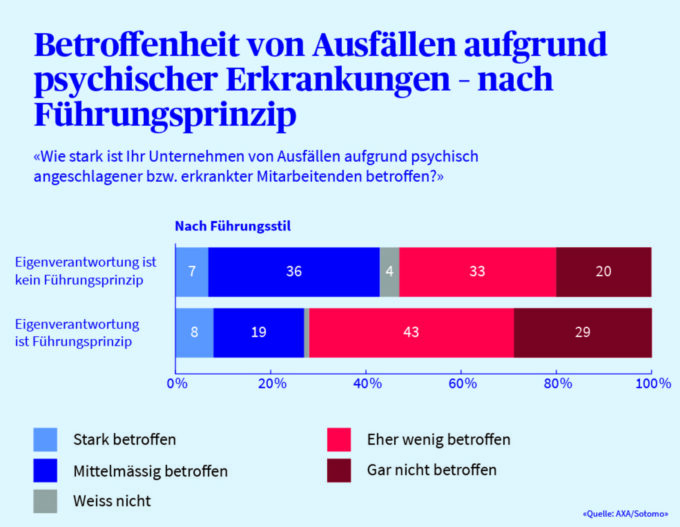
The study reveals a remarkable correlation between leadership culture and absenteeism: Companies that cite freedom and personal responsibility as key leadership principles report lower rates of mental health-related absenteeism. While 27 percent of employees at companies with this leadership philosophy are affected by such absences, the figure rises to 43 percent at companies without this guiding principle.
It is interesting to note that companies with a culture of autonomous leadership cite high workloads as the main cause of mental stress more frequently (41 %) than companies without this guiding principle (32 %). Conversely, the latter group more often reports a lack of appreciation as a key factor (27 % vs. 16 %). Personal responsibility thus tends to shift the stress profile away from social factors toward a higher subjective workload, which may be more easily managed due to the autonomy it provides.
«This is consistent with our practical experience. Leadership influences not only motivation and collaboration, but also how people cope with stress. When employees are able to take on responsibility, experience trust, and receive support, they often form more resilient teams. This makes good leadership a key factor for success—including from an economic perspective,» says Laetitia Amey.
Despite this clear finding, the majority of Swiss SMEs (50 %) rely on freedom and personal responsibility as their core management principles. At the same time, decision-making authority in four out of five companies continues to rest with a single manager or a management team. In practice, therefore, personal responsibility primarily means freedom to shape one’s daily work, not strategic participation in decision-making.
Awareness Exists, but Action Is Lacking
Two-thirds of the SMEs surveyed (66 %) believe that managers play a crucial role in their employees’ mental well-being. Only one-quarter of the companies would disagree. Nevertheless, there is a significant gap between recognizing this importance and taking concrete action.
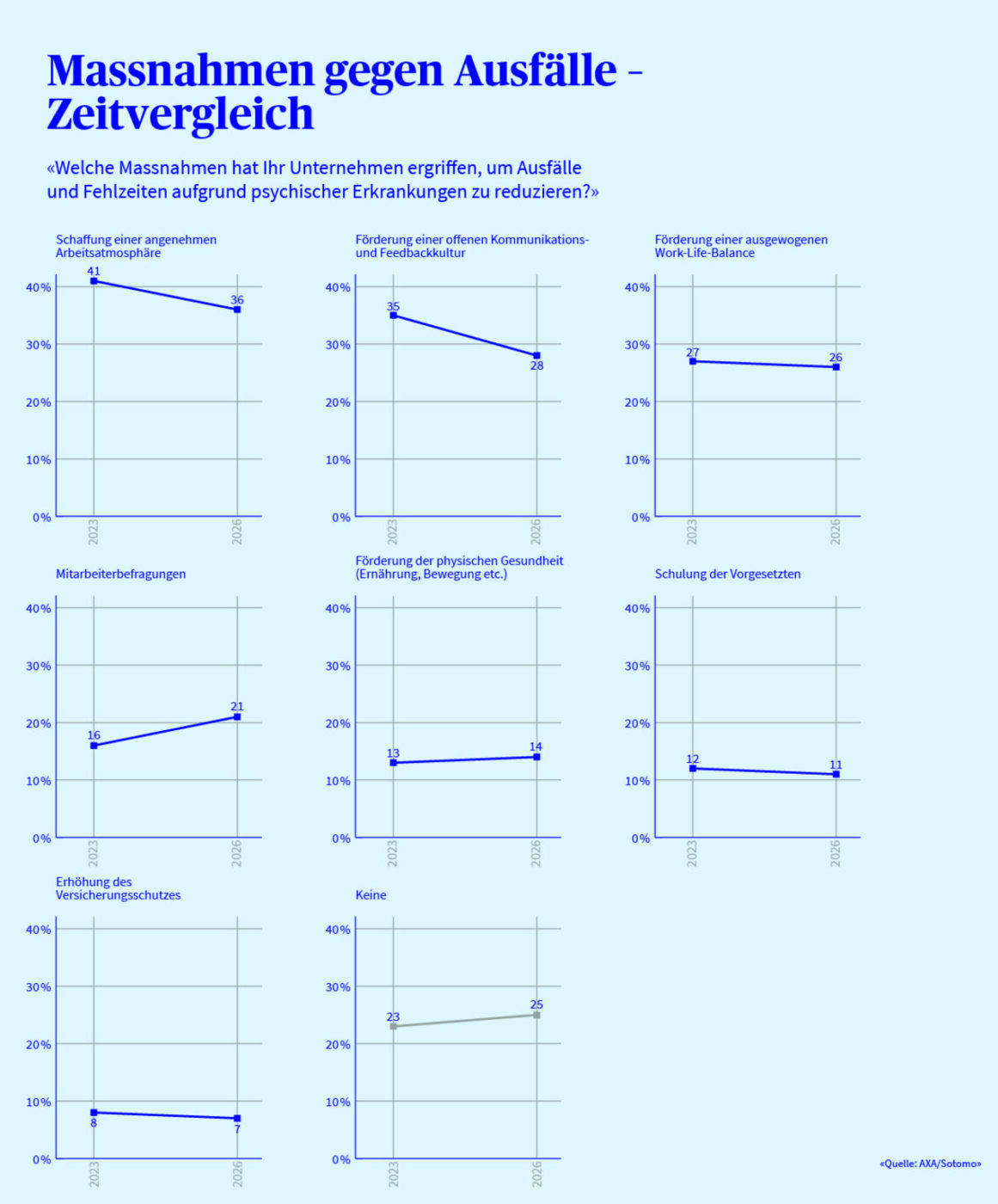
The active implementation of preventive measures has not increased since 2023—on the contrary: The percentage of SMEs seeking to counteract mental stress through an open culture of communication and feedback has fallen from 35 percent (2023) to 28 percent (2026). Efforts to promote physical health and training for supervisors have stagnated at very low levels (14 % and 11 %, respectively). Furthermore, one in four SMEs (25 %) reports taking no specific measures whatsoever to address mental health-related absenteeism.
«In the hustle and bustle of everyday life, there’s often not enough time to translate insights into concrete actions. Yet no large-scale programs are needed: aware leaders, regular discussions, and a culture of trust often make all the difference—and are an investment in the company’s future viability,» says Laetitia Amey, summarizing the findings.
The study’s data suggest that the future stability of SMEs is also influenced by how effectively managers identify stress early on and create a work environment that the workforce perceives as socially supportive and appreciative. A close link between leadership culture and workplace health management could be a key starting point in this regard.
Source: www.axa.ch


