Companies overwhelmed with many data sources
Almost every second company in Germany, Austria and Switzerland has a Big Data problem: Only eight percent use a wide variety of data sources across the company, including data from other organizations, to make decisions.





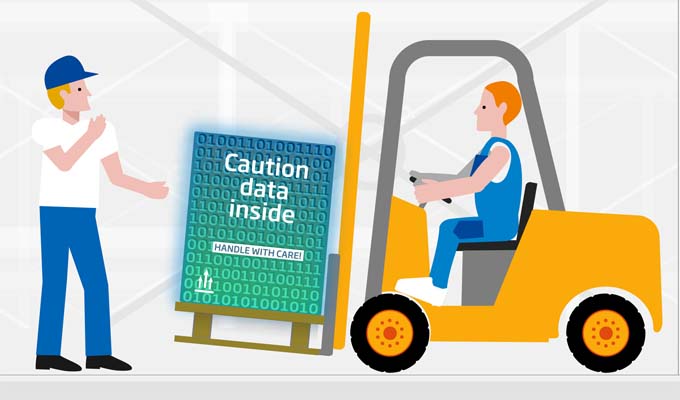
Too big to use: Many companies are overwhelmed by the abundance of data sources. In the DACH region, only eight percent use a wide variety of data sources throughout the company, including data from other organizations, for decision-making. In 44 percent, this goal has been partially achieved. Many companies get bogged down in the handling and systematic integration of data from different sources. Four out of ten complain about technical deficits in using data for further analyses. The result: a lack of added value from analytics investments. These are the findings of the BI & Analytics study biMA® 2017/18 by Sopra Steria Consulting in collaboration with the Business Application Research Center (BARC). The studies are based on the biMM® (Business Intelligence Maturity Model) maturity model and the biMA® (Business Intelligence Maturity Audit) analysis method developed by Sopra Steria Consulting in collaboration with the universities of Duisburg-Essen and St. Gallen and the University of Düsseldorf.
Professional utilization of data sources is missing
With new technical possibilities (advanced analytics), the prediction of the future involving differentiated data sources is moving into the focus of companies. Many digital services are based on artificial intelligence and machine learning. These include, for example, forecasts of how customers and markets will behave in order to control production. Moreover, it is no longer just online retailers who want to recommend products to their customers or show them alternatives if the desired product is not available at the moment. Algorithms evaluate many millions of data records for this purpose. These come from an increasing number of data sources, for example geo, social media and sensor data.
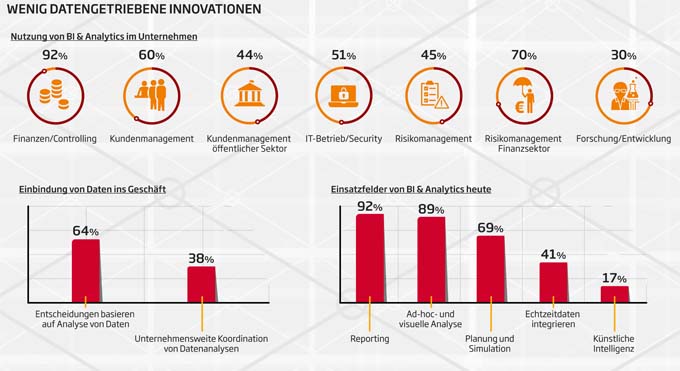
The sticking point in the development of new business models and services is not so much the technical power of analysis, but the lack of professional utilization. 43 percent of the companies surveyed have difficulties deriving knowledge and insights from data and, as a result, creating added value through information. More than one in four companies (27 percent) see a need to catch up when it comes to integrating and linking data in their business work. As a result, the information fizzles out or companies draw the wrong conclusions.
Data-driven business models require new approach
Some companies are now moving away from the strategy of using as many data sources and data sets as possible. Companies such as the bank Goldmann Sachs and the German e-commerce group Otto are expressing that the use of artificial intelligence and machine learning is more about having the right selection of data, but one that is fully understood. Other companies are embracing new concepts such as data thinking - a method that combines design thinking with data analysis and data mining. These examples show that a rethink is underway in many industries, away from Big Data to Smart Data strategies.
"It's not about becoming the world champion in tapping as many data sources as possible," says Lars Schlömer, Head of BI & Analytics at Sopra Steria Consulting. "It is not the quantity and quality of data that determine the quality of data-driven business models, but the technical and analytical know-how to do something value-added with the data. It is important to bring together qualified teams of data scientists and specialists who systematically identify and develop use cases in an agile working environment and who also answer the question of what data is actually needed," says Schlömer.
Source and further information: Sopra Steria