Swiss software industry caught between innovation pressure, AI boost and new work culture
The new Swiss Software Industry Survey (SSIS) was presented on October 27, 2025. The report provides an insight into the state of the Swiss software industry. 189 companies took part in the study conducted by the University of Bern on behalf of the industry association Swico.
Editorial
-
October 29, 2025
Discussing the results of the Swiss Software Industry Survey: Simon Perrelet (moderator), Denis Druzic (Noser Engineering), Nadja Perroulaz (Liip AG), Ernst Hegg (Nexplore). Picture: Thomas Berner
The Swiss software industry in 2025 is at a turning point, according to an early conclusion of the Swiss Software Industry Survey (SSIS) 2025, which was presented at this year's CNO Panel (see secondary text) in Bern: Economic pressure, a shortage of skilled workers and technological upheaval are shaping the picture. According to the study, published by the University of Bern on behalf of Swico, profit margins are falling noticeably - from 9.1 % in 2023 to 6.4 % in 2024. Expectations for sales and employment growth are also more subdued: An increase of 1.8 % is expected for 2025 and 2.5 % for 2026. Nevertheless, the sector is proving resilient and adaptable overall.
Internationalization on the rise
One striking result is the increasing degree of internationalization. 11.1 % of sales were generated abroad in 2024, primarily in Germany (59 % of the export volume). This reinforces the trend towards European networking, while North America (6 %) and the rest of Europe (14 %) are gaining in importance. Almost 54 % of companies outsource parts of their development or services - primarily standard and individual software manufacturers.
Falling EBITDA margins are putting pressure on business in the Swiss software industry. (Graphic: Swico)
Special topic «New Work»
This year's special topic was «New Work». In this context, the study shows structural changes in everyday working life: flexibility, a sense of purpose and self-organization characterize the new world of work. And this is particularly evident in the area of «home office»: around half of companies allow employees to work from home for at least 50 % of their working hours; for software developers, the proportion is almost 60 %. Decision-making processes are increasingly decentralized: 74 % of companies grant teams a high degree of autonomy, innovations are often created „bottom-up“. Leadership is understood less hierarchically and more as empowerment - 92 % of companies promote independent action.
AI on the rise
Artificial intelligence has established itself within a short space of time. 81 % of companies use AI in the software development process - almost twice as many as in 2024, although many are still in the experimental phase: over half of employees are allowed to decide for themselves which AI tools to use. This openness is also reflected in the corporate culture: 89 % of companies describe themselves as „family-like“, characterized by flat hierarchies and personal relationships. Large companies tend to remain more structured and centralized, while small and medium-sized companies are more agile.
Ongoing training remains important
There is a clear focus on further training. Three quarters of the companies surveyed promote external training, conferences and specialist courses; more than half provide time or budget resources for individual development. Most programs are flexible and informal, especially in smaller companies. The majority of companies invest around 4.5 % of turnover in research and development - a stable figure compared to the previous year.
In contrast, the sector is conservative when it comes to remuneration policy: salaries and bonuses are usually determined by management, often on the basis of the company's success. Only around 13 % of companies link variable remuneration to team performance. Traditional structures remain in place here too.
New working models increase satisfaction
The study also shows that new working models measurably increase satisfaction: 65 % of the companies report higher employee motivation and 62 % report improved customer satisfaction. In particular, those companies that specifically promote measures such as skills development, self-determined work and meaningful management approaches record better performance values.
With over CHF 20 billion in added value and 3 % of all employees, the software industry remains a central pillar of the Swiss economy. However, the SSIS 2025 shows that in order to remain competitive in the long term, companies must master the balancing act between stability and renewal - with a clear strategic focus, investment in talent and a work culture that combines innovation and humanity.
Source: Swico. This report was created with the support of KI.
CNO Panel 2025
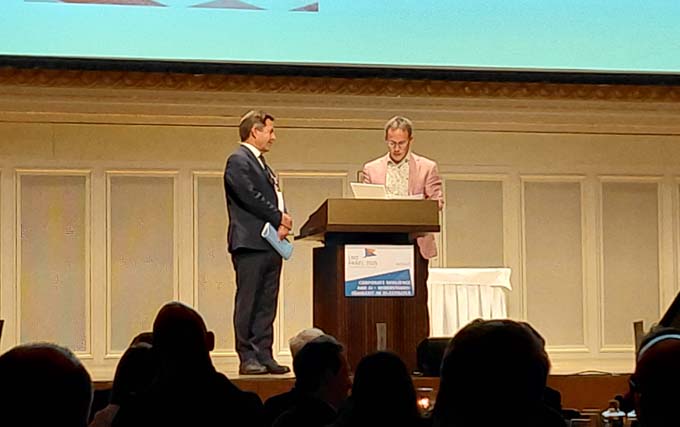
Walter Thurnherr (left) in conversation with Pascal Sieber from Sieber & Partners, host of the CNO Panel. (Image: Thomas Berner)
Bern-based consultancy Sieber & Partners has been hosting the CNO Panel for 25 years. This year's event was dedicated to the topic of «Corporate Resilience and AI - Resilience in the age of AI». The aim was to examine and shed light on the issue of resilience in corporate management and infrastructure, taking into account the dimensions and interactions of society, organizations (state, company), team, people and technology. In keynotes and interviews, Walter Thurnherr, Jon Fanzun (Swico), Nadja Perroulaz (Liip AG), Marc Marthaler (ICT Vocational Training Switzerland), Matthias Stürmer (Bern University of Applied Sciences), Valérie Dittli (Councillor of the Canton of Vaud) and Hannes Scheidegger (Info-Tech Research Group) discussed their perspectives, experiences and findings. Former Federal Chancellor («the 8th Federal Councillor») Walter Thurnherr, in particular, gave an astute warning about the risks and side effects of AI. He drew comparisons with other technologies that initially caused euphoria in the past, but then created a whole host of new problems. «AI resilience starts with prudent thinking, scenarios and sensible regulations,» said Thurnherr.
(Visited 283 times, 1 visits today)
More articles on the topic
BDO Digital and GObugfree Join Forces to Boost Cyber Resilience Among SMEs
Abraxas Emphasizes Continuity: Ruedi Häni to Become New CFO
The Future of Strategy: WARC Sees Cautious Optimism